
Supersymmetry: theory, motivations, and experimental status
Supersymmetry (SUSY) is a proposed symmetry between bosons and fermions that predicts partner particles, offers solutions to theoretical problems, and remains unconfirmed by current experiments.
Overview
Supersymmetry (often abbreviated SUSY) is a proposed extension of particle physics that postulates a fundamental symmetry relating two broad classes of particles: bosons and fermions. In this framework every known elementary particle such as the photon, the electron or the quark would have a partner particle with differing spin statistics. Many formulations of the idea imply that these paired degrees of freedom were present in the hot, early stages of the universe, even if those partners are not apparent at everyday energies today.
Image gallery
1 Image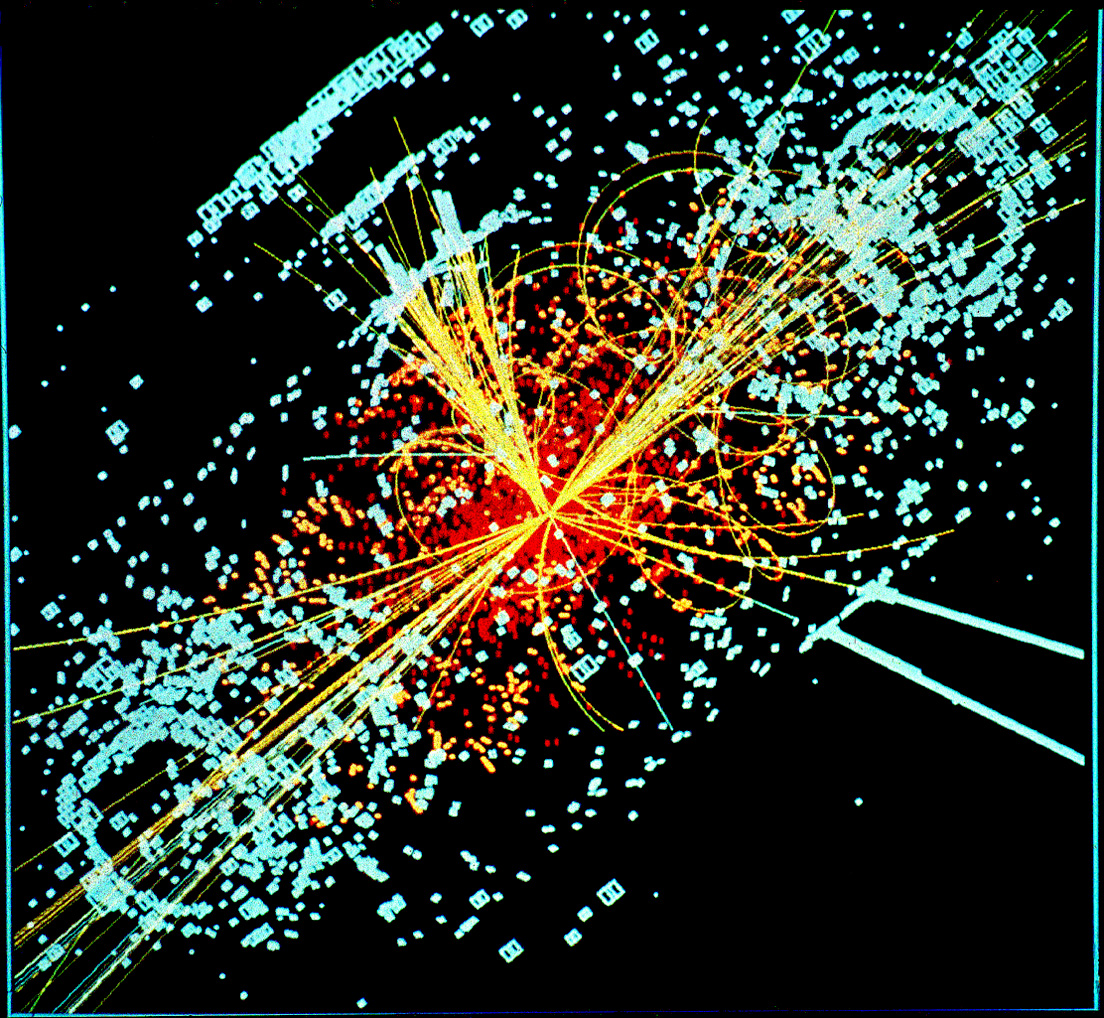
Basic characteristics and particle content
Supersymmetry introduces new states — commonly called superpartners — which mirror the quantum numbers of standard particles but differ by half a unit of spin. If SUSY were an exact symmetry, partners would have identical masses; in realistic models the symmetry is broken, allowing superpartners to be heavier and more difficult to detect. The idea can be combined with notions of extra dimensions or embedded into larger theoretical frameworks, producing a variety of model classes with different particle spectra.
- Examples of superpartners include: electron → selectron, quark → squark, photon → photino, gluon → gluino, W/Z → winos/zinos, Higgs → higgsinos.
- Model variants include minimal realizations (often called the MSSM), extended supersymmetries, and local supersymmetry that leads to supergravity theories.
Theoretical roles and motivations
Researchers proposed supersymmetry because it addresses several puzzles in theoretical physics. SUSY can soften the sensitivity of the Higgs mass to very high energies (the so‑called hierarchy problem), improve the unification of forces at high energy scales, and provide natural candidates for dark matter when a conserved quantum number prevents the lightest superpartner from decaying. Supersymmetry also arises naturally in many formulations of string theory, where it helps control quantum corrections and maintain mathematical consistency.
Experimental searches and current status
For decades physicists have searched for superpartners using particle colliders and indirect observations. The Large Hadron Collider (LHC) and other experiments have placed increasingly stringent limits on many simple SUSY scenarios by excluding superpartners below certain mass ranges. No conclusive direct signal has been confirmed so far, so contemporary models accommodate a broken symmetry with heavier or more elusive partners, or more compressed spectra that evade current searches.
History, variations and significance
Early theoretical hints that inspired modern supersymmetry research date back to mid‑20th century work; among those who explored related algebraic ideas was Hironari Miyazawa. The subject developed rapidly into a central area of theoretical physics with a rich mathematical structure — a graded extension of spacetime symmetries governed by operators that convert fermions to bosons and vice versa. Variants include global versus local (supergravity) SUSY and minimal versus extended models, each with distinct phenomenology.
Why it matters
Even without experimental confirmation, supersymmetry has shaped modern approaches to quantum field theory, cosmology, and mathematical physics. It offers concrete frameworks to address open problems and continues to motivate searches in high‑energy experiments, astrophysical observations, and precision measurements. Ongoing work refines model building, explores indirect signatures, and develops more sensitive experimental strategies to confirm or refute the idea.
Further reading and detailed reviews are available from standard texts and pedagogical resources; introductory overviews and technical literature can be found through general portals and specialized reviews (the Standard Model context and beyond).
Questions and answers
Q: What is supersymmetry?
A: Supersymmetry is a scientific theory that proposes the existence of matching theoretical "superparticles" for elementary particles that were formed at the beginning of the universe.
Q: How many kinds of particles would supersymmetry create?
A: Supersymmetry would at least double the kinds of particles in the universe.
Q: How many extra dimensions are predicted in M-Theory?
A: M-Theory predicts up to 11 extra dimensions.
Q: What gaps in the Standard Model of physics would supersymmetry fill?
A: Supersymmetry would fill many gaps in the Standard Model of physics, including dark matter.
Q: What is the relationship between supersymmetry and string theory?
A: Supersymmetry would give support to the ideas of string theory.
Q: What is the Large Hadron Collider?
A: The Large Hadron Collider is a particle accelerator located on the border between France and Switzerland.
Q: Has evidence of supersymmetry been found so far in experiments with the Large Hadron Collider?
A: No, experiments in the Large Hadron Collider have not found evidence of supersymmetry so far.
Related articles
Author
AlegsaOnline.com Supersymmetry: theory, motivations, and experimental status Leandro Alegsa
URL: https://en.alegsaonline.com/art/95089
Sources
- hitoshi.berkeley.edu : "Introduction to Supersymmetry"
- businessinsider.com : "Here's how proving supersymmetry could completely change how we understand the universe"
- ui.adsabs.harvard.edu : 1966PThPh..36.1266M
- doi.org : 10.1143/PTP.36.1266
- ui.adsabs.harvard.edu : 1968PhRv..170.1586M
- doi.org : 10.1103/PhysRev.170.1586
- nucl.phys.s.u-tokyo.ac.jp : "Miyazawa Supersymmetry"
- doi.org : 10.1063/1.2932297