
Surface wave (physics and applications)
Wave localized near an interface between different media; includes water and seismic surface waves, electromagnetic surface modes, and radio ground waves with applications in oceanography, seismology and communications.
Overview
A surface wave is a disturbance that propagates along the interface between two different media and whose amplitude decays away from that boundary. The term covers a range of phenomena: mechanical waves on fluid surfaces, elastic waves confined near a solid surface, and electromagnetic modes bound to material interfaces. The confinement and decay perpendicular to the interface are often described as evanescent behavior. For general background on wave phenomena see physics overviews.
Image gallery
3 Images

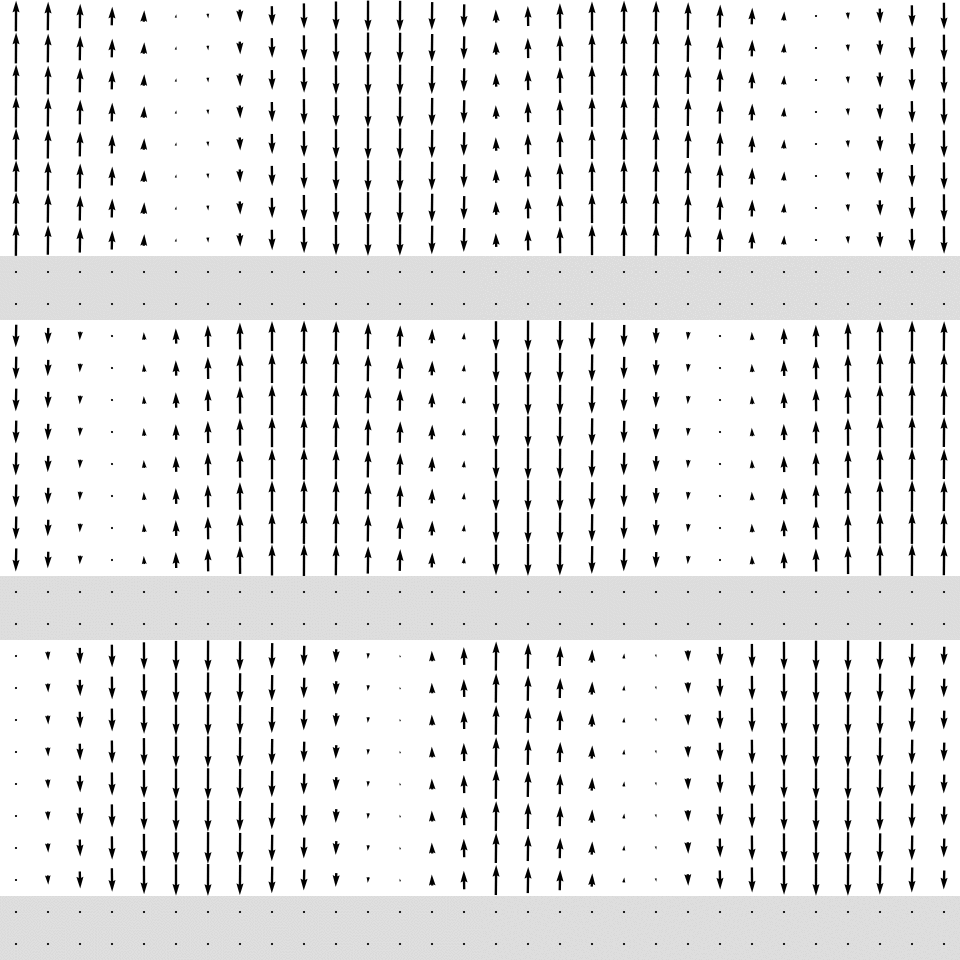
Common characteristics
Despite diverse physical origins, surface waves share several features. They are often dispersive (phase velocity depends on wavelength), their energy is concentrated near the interface, and boundary conditions together with contrasts in material properties determine their form. Typical parameters include wavelength, frequency, phase and group velocity, attenuation, polarization and the dominant restoring force (for example gravity or surface tension for fluid surfaces).
Types and examples
- Water surface waves — Waves on the sea, lakes and channels where gravity and surface tension act as restoring forces. Long waves are gravity-dominated while very short waves are influenced by surface tension.
- Seismic surface waves — Elastic waves such as Rayleigh and Love waves that travel along the Earth's surface and generally produce the strongest ground motion during earthquakes.
- Electromagnetic surface modes — Electromagnetic fields bound to an interface by discontinuities in permittivity or by refractive-index gradients; notable examples include surface plasmon polaritons at metal–dielectric boundaries and guided surface modes in dielectric structures. See materials on electromagnetic guidance and mechanical surface waves for related concepts.
- Radio ground waves — Low-frequency radio signals that follow the Earth's contour and can provide coverage beyond the horizon; these are important in long-wave and medium-wave broadcasting and certain communication links. Practical treatments appear in radio propagation texts radio ground-wave theory and historical surveys technical reviews.
Physical description and models
Surface waves are modeled with boundary-value problems in continuum mechanics or electrodynamics. In mechanical contexts, linearized fluid or elastic equations with boundary conditions at the interface lead to dispersion relations that relate frequency and wavenumber. Electromagnetic surface modes follow from Maxwell's equations with appropriate material parameters; commonly the fields decay exponentially away from the interface, forming bound states when the contrast supports them.
Generation and measurement
Surface waves may be generated by localized forcing at or near an interface: wind and disturbances generate water waves, fault rupture produces seismic surface waves, and localized electromagnetic excitation or coupling structures produce guided surface modes. Measurement techniques depend on the type: wave gauges and remote sensing for water waves, seismometers for ground waves, and near-field probes or optical coupling methods for electromagnetic surface modes.
Applications and significance
Surface waves have practical importance across disciplines. In oceanography and coastal engineering they govern energy transport, sediment movement and ship interactions. In seismology they are central to assessing earthquake hazard because of their large amplitudes and long durations. In photonics and sensing, surface electromagnetic modes enable subwavelength confinement, sensitive detection of surface-bound phenomena and compact integrated components. Radio ground-wave propagation supports reliable low-frequency broadcasting and certain types of long-range communications.
Distinctions and limitations
Surface waves differ from bulk waves that propagate through a medium's interior; they are tied to interfaces and their behavior depends on material contrasts and boundary geometry. Coupling between surface and bulk waves can occur, especially near discontinuities or in lossy materials, which influences attenuation and energy transfer. Understanding dispersion and losses is essential for both natural phenomena and engineered devices.
Further reading
Introductory and specialized texts treat surface-wave theory, numerical methods for boundary-value problems, and experimental techniques. For overviews and applied perspectives consult general wave physics sources and domain-specific literature for oceanography, seismology, electromagnetics and radio propagation: see the referenced summaries above and more detailed treatments in discipline-specific works (basic physics resources, mechanical wave literature, electromagnetic mode references, radio propagation guides, historical and applied reviews).
Questions and answers
Q: What is a surface wave?
A: A surface wave is a mechanical wave that propagates along the interface between two different media, usually two fluids with different densities. It can also be an electromagnetic wave guided by a refractive index gradient.
Q: What type of waves are ground waves?
A: Ground waves are surface waves that propagate close to the surface of the Earth and are specific to radio waves.
Q: How do surface waves travel?
A: Surface waves travel along the interface between two different media, usually two fluids with different densities or as an electromagnetic wave guided by a refractive index gradient.
Q: Are there any special types of surface waves?
A: Yes, ground waves which are specific to radio waves and propagate close to the surface of the Earth.
Q: What kind of media do surface waves typically travel through?
A: Surface Waves typically travel through two different media, usually two fluids with different densities or as an electromagnetic wave guided by a refractive index gradient.
Q: Is it possible for one type of medium to be used for both fluid and electromagnetic propagation?
A: Yes, it is possible for one type of medium to be used for both fluid and electromagnetic propagation depending on the situation.
Related articles
Author
AlegsaOnline.com Surface wave (physics and applications) Leandro Alegsa
URL: https://en.alegsaonline.com/art/95161