
Supercluster (large-scale cosmic structure)
A supercluster is an enormous assembly of galaxy groups and clusters that forms one of the largest known patterns of matter, arranged into filaments, walls and surrounding voids across cosmic scales.
Overview
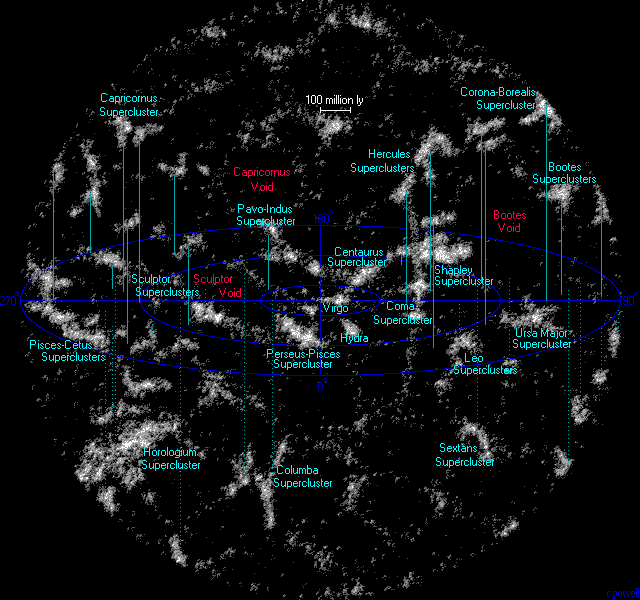
A supercluster is a vast congregation of smaller gravitationally associated systems: galaxy groups and galaxy clusters, together with isolated galaxies, bound loosely into a single extended structure. They are among the largest coherent structures identified in the observable cosmos, extending across tens to hundreds of millions of light‑years and sometimes appearing as parts of still larger networks of matter.
Image gallery
6 Images




Characteristics and components
Superclusters are heterogeneous: they contain dense knots (clusters), filamentary connections, and more diffuse regions. Individual galaxies in these environments (galaxies) can experience different evolutionary paths than those in isolation because of interactions, mergers, and the cluster medium. On still larger scales these collections are arranged within the fabric of the Universe as filaments, sheets, and walls that thread across great distances.
Formation and large-scale pattern
The current cosmological picture links superclusters to the growth of initial density irregularities in the early universe. Over billions of years, gravity amplified small fluctuations in the distribution of dark matter and baryons to produce a web-like pattern: dense nodes (clusters and supercluster cores) connected by filaments with expansive voids between them. The detailed orientation and internal motions of structures within superclusters can retain clues about their formation history.
Notable examples
- The Virgo or Local Supercluster — the extended region that contains the Milky Way and nearby clusters.
- The Laniakea complex — a modern description of the basin of galaxies gravitationally flowing toward a common attractor.
- Large walls and filaments such as the Great Wall and the Sloan Great Wall, visible as long, sheetlike overdensities spanning hundreds of millions of light‑years.
Why superclusters matter
Studying superclusters informs multiple areas of astrophysics and cosmology: the distribution of dark matter, the role of environment in galaxy evolution, and the statistical properties of large-scale structure used to test cosmological models. Surveys mapping millions of galaxies have revealed that these structures occupy a modest fraction of the observable Universe yet dominate the mass distribution on intermediate scales.
Observational methods and terminology
Superclusters are identified through redshift surveys, X‑ray observations of hot intracluster gas, and mapping of galaxy velocities. Astronomers often subdivide superclusters into subunits such as "clouds" or sheets, and they refer to particularly empty regions as voids. Terms like "filament", "wall", and "complex" reflect geometric and connectivity properties rather than strict dynamical bounds: many superclusters are not gravitationally bound in their entirety and will evolve with cosmic expansion.
Distinctions and caveats: unlike bound galaxy clusters, superclusters may be only partially gravitationally connected and their classification can depend on survey depth and the linking algorithms used. Ongoing and future wide-field surveys continue to refine the census, shape, and significance of these immense cosmic structures.
Questions and answers
Q: What are superclusters?
A: Superclusters are large collections of smaller galaxy groups and galaxy clusters, forming some of the largest known structures in the cosmos.
Q: Are galaxies evenly distributed in the universe?
A: No, galaxies in the universe are not evenly distributed.
Q: What are groups and clusters in the context of superclusters?
A: Groups have some dozens of galaxies, and clusters up to several thousand galaxies.
Q: What are the larger collections formed by groups, clusters, and isolated galaxies?
A: They form even larger collections called superclusters.
Q: What are the larger structures that superclusters themselves form?
A: They form even larger structures called "filaments", "complexes", "walls" or "sheets", like the Great Wall.
Q: What percentage of the observable universe do these larger structures cover?
A: They cover more than 5% of the observable universe.
Q: Are there many galaxies inside superclusters?
A: Yes, there are many galaxies inside superclusters, but there are also large voids of space in which few galaxies exist. Superclusters are often subdivided into groups of clusters called "galaxy clouds".
Related articles
Author
AlegsaOnline.com Supercluster (large-scale cosmic structure) Leandro Alegsa
URL: https://en.alegsaonline.com/art/95041
Sources
- eso.org : "An Intergalactic Heavyweight"
- arxiv.org : astro-ph/0508669
- ui.adsabs.harvard.edu : 2006Ap&SS.302...43H
- doi.org : 10.1007/s10509-005-9006-7