
Sunspot
A sunspot is a relatively cool, magnetically active region on the Sun's visible surface. Sunspots follow an approximately 11-year cycle and influence solar activity and space weather.
Overview
A sunspot is a temporary region on the visible surface of the Sun that displays intense magnetic activity. When viewed through appropriate filters or indirect projection, these regions appear darker than their surroundings because they are cooler than the surrounding photosphere, even though they still emit large amounts of light. Sunspots vary in size from small features comparable to Earth’s scale up to structures many times larger than Earth.
Image gallery
10 Images





Structure and characteristics
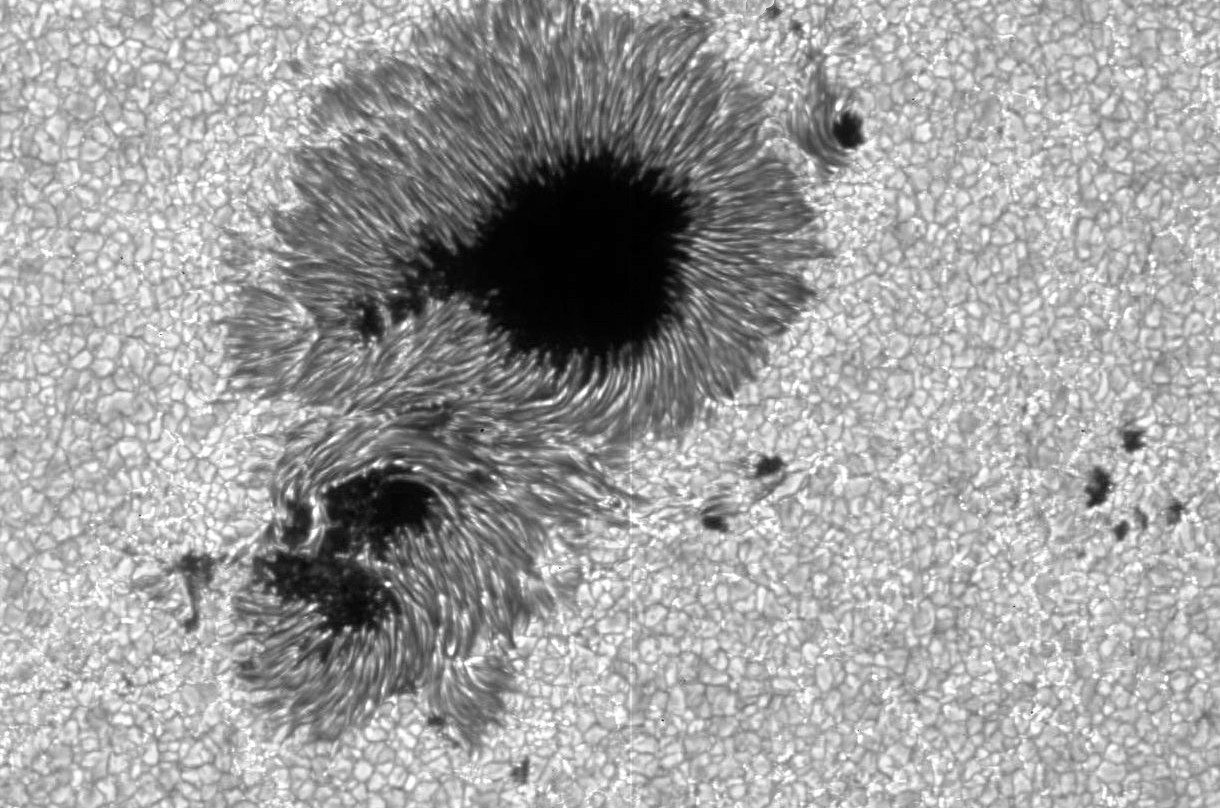
Most sunspots show a two-part structure: a dark central umbra and a lighter surrounding penumbra. The umbra contains the strongest, most vertical magnetic fields and the lowest temperatures within the spot; the penumbra consists of more filamentary structures with inclined magnetic fields. Sunspots are often grouped into complexes and can persist for days to months as they evolve and rotate across the solar disk.
- Temperature: Cooler than the surrounding photosphere, which makes them appear dark in contrast.
- Magnetic fields: Concentrated and more intense than the surrounding areas; fields inhibit convective heat transport.
- Size and lifetime: Range widely in size and duration, from short-lived small spots to large groups that last several rotations.
Formation and solar cycle
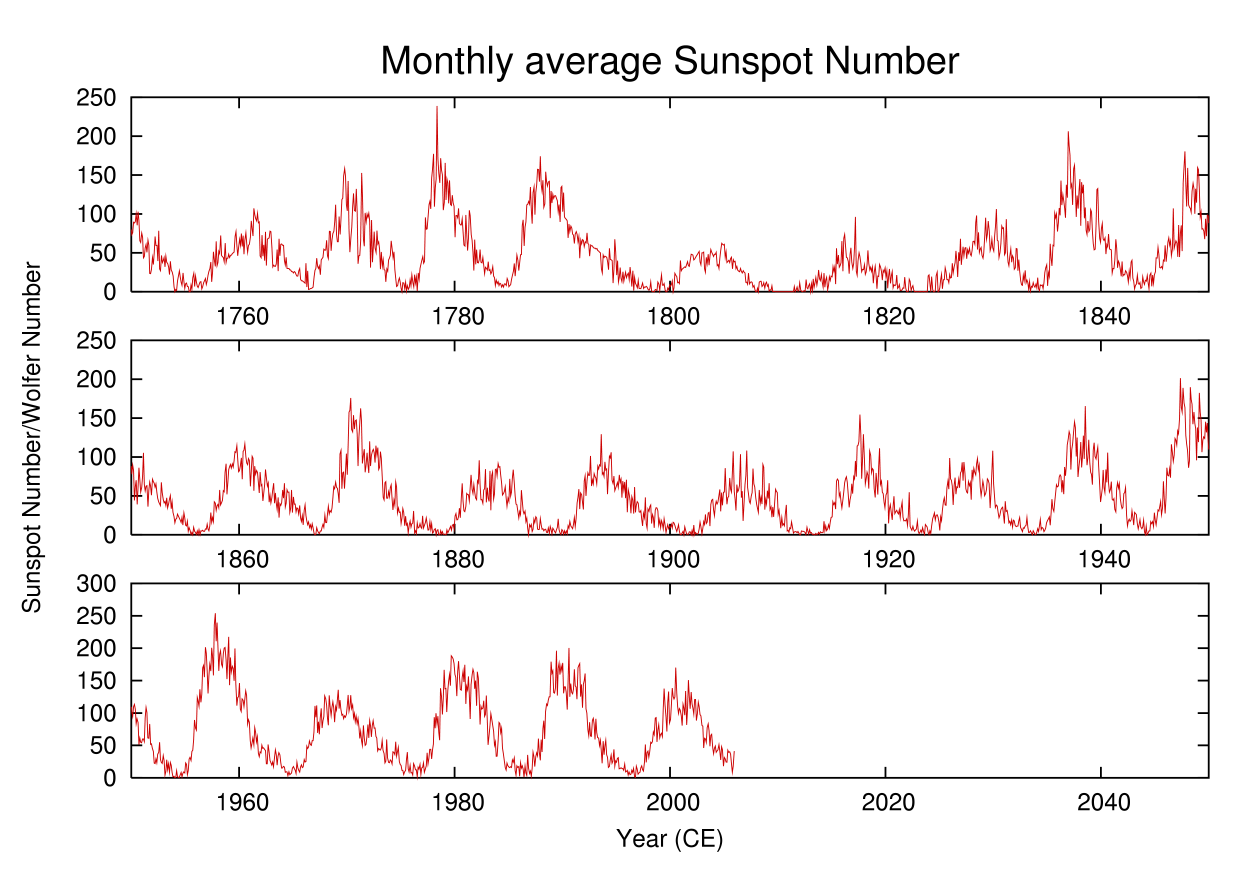
Sunspots arise where magnetic field lines emerging from the solar interior break through the photosphere. These concentrated fields reduce the normal convective transport of heat, cooling the plasma locally. Observations show that sunspot numbers wax and wane on roughly an 11-year rhythm known as the Schwabe cycle. Because each 11-year cycle reverses the magnetic polarity of new spots, a full magnetic cycle completes in about 22 years (the Hale cycle).
History and notable variations
Telescopic records of sunspots date back to the early 17th century and were critical to early studies of solar rotation and the Sun’s magnetic nature. Long-term records reveal periods of unusually low sunspot counts, the most famous being the Maunder Minimum in the 17th and early 18th centuries, when very few sunspots were observed for several decades. Such intervals have stimulated research into solar variability and its possible links to Earth's climate.
Effects and importance
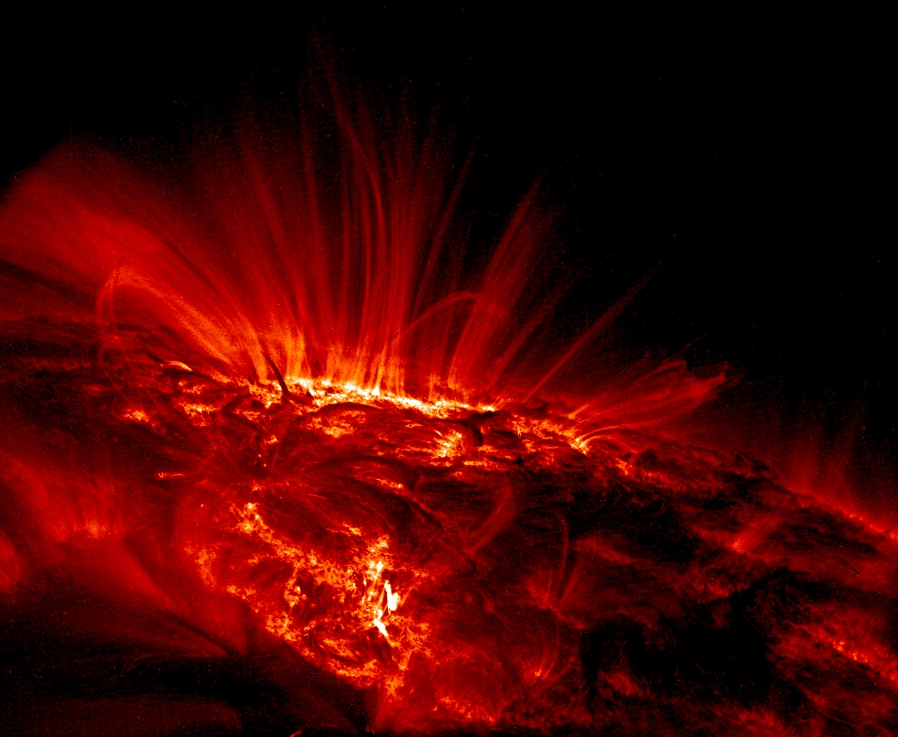
Sunspots are closely associated with other manifestations of solar activity, including solar flares and coronal mass ejections. Large active regions with many sunspots can produce energetic eruptions that alter the heliospheric environment and trigger space weather effects at Earth. These effects can include enhanced auroras, disruptions to radio communications, and impacts on satellites and electrical grids. Because of this, monitoring sunspots is an important component of space weather forecasting.
Distinctions and observations
Sunspots are not the only magnetic features on the Sun, but they are among the most conspicuous. Scientists use a variety of observational techniques—photography, spectroscopy, and magnetograms—to study their magnetic fields, motions, and lifecycles. Patterns such as the latitudinal migration of spots over a cycle produce the characteristic "butterfly diagram," which helps researchers track the dynamo processes thought to generate the Sun’s magnetic field.
For further general reading about solar magnetism and observational records, see introductory resources and data archives linked from educational and research centers (magnetic activity overview, solar observations).
Questions and answers
Q: What is a sunspot?
A: A sunspot is an area of high magnetic activity on the surface of the Sun.
Q: Why do sunspots appear dark?
A: Sunspots appear dark in comparison to the surface around them because they produce bright light but not as much as the surrounding area.
Q: How do sunspots differ from the rest of the sun?
A: Sunspots are cooler than the rest of the sun.
Q: What is the sunspot cycle and how long is it?
A: The sunspot cycle is a period of 11 years during which the number of sunspots on the sun increases and later declines.
Q: How long is the total sunspot cycle and what causes the differences between cycles?
A: The total sunspot cycle is 22 years and sunspots on one cycle are magnetically different from the next. The cause of these differences is not fully understood.
Q: When was the sunspot cycle discovered and how long did it take to observe a pattern?
A: The sunspot cycle was discovered in the 18th century and it takes 11 years to observe a full cycle.
Q: What was the "Maunder Minimum" and why is it significant?
A: The "Maunder Minimum" was a period of over 100 years in which there were very few sunspots. Astronomers do not know what caused this phenomenon, but it is significant because it provides insight into the behavior of the sun and highlights the need for continued research.
Related articles
Author
AlegsaOnline.com Sunspot Leandro Alegsa
URL: https://en.alegsaonline.com/art/94932
Sources
- adsabs.harvard.edu : "A Few Pre-Copernican Astronomers"
- exploratorium.edu : "Sunspots Modern Research 3 of 7"