
Battle of Cambrai (1917) — first large-scale tank offensive
A 1917 First World War engagement near Cambrai notable for the first mass use of tanks, tactical surprise, and lessons for combined-arms operations on the Western Front.
Overview
The Battle of Cambrai was fought on the Western Front from 20 November to early December 1917. Launched by British forces against German defences, the operation surprised observers because it employed a large number of armored vehicles in a coordinated assault rather than a prolonged preparatory artillery bombardment. The town of Cambrai was a strategic rail and road hub, and the fighting occurred close to the German Hindenburg Line.
Image gallery
9 Images



Tactics and innovations
The offensive is best remembered for the concentrated use of tanks together with infantry, artillery and aircraft. Rather than attempting to pulverize the front with an extended barrage, planners sought surprise by launching a sudden attack supported by moving artillery and aircraft observation. The operation demonstrated both the potential and the limitations of early tanks: they could breach barbed wire and defeat strongpoints in places, but mechanical reliability, terrain and logistics constrained exploitation.
Course of the battle
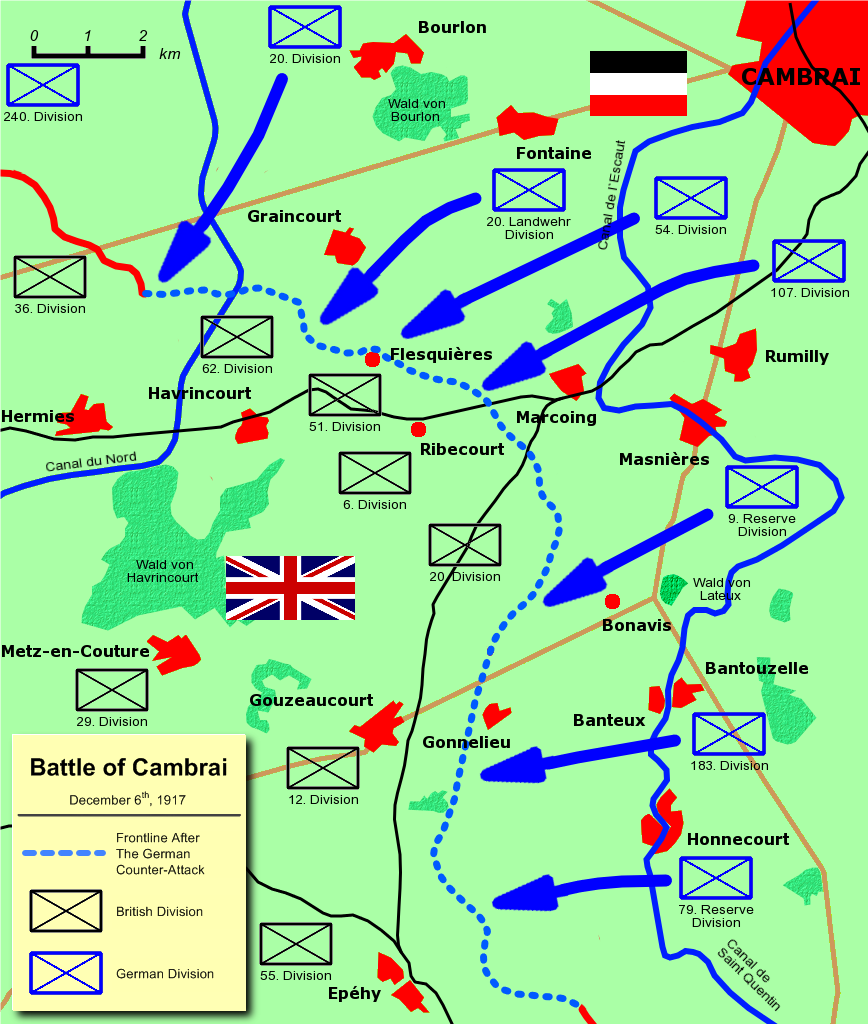
The initial British advance achieved significant local gains, including the capture of trenches and villages in front of the German positions. After several days, German forces launched organized counter-attacks, supported by reserves and concentrated artillery, retaking much of the lost ground. Fighting continued into December and ended with both sides holding positions not far from their starting lines.
Casualties and territory
Combined casualties—killed, wounded, missing and captured—numbered in the tens of thousands on both sides; contemporary summaries often cite figures approaching 95,000 for the entire period, though exact totals vary by source. Territorial changes were limited: the offensive gained ground temporarily but did not deliver a decisive breakthrough of strategic depth.
Significance and legacy
Cambrai is historically important because it marked a shift in thinking about mechanized warfare and combined-arms operations. Commanders studied the battle for lessons about surprise, logistics, the integration of tanks with artillery and infantry, and the need for reliable communications. Many of these lessons influenced later 1918 operations and interwar military thought.
Context and notable facts
Related articles
Author
AlegsaOnline.com Battle of Cambrai (1917) — first large-scale tank offensive Leandro Alegsa
URL: https://en.alegsaonline.com/art/9452