
Battle of Canton (1857–1858)
A summary of the capture of Canton (Guangzhou) by Anglo‑French forces during the Second Opium War (28 Dec 1857–1 Jan 1858), its course, context, and consequences.
Overview
The Battle of Canton took place from 28 December 1857 to 1 January 1858 during the Second Opium War. Allied Western forces attacked and captured the southern Chinese city of Canton (Guangzhou), a major port and regional administrative centre. The operation saw combined action by French forces and British troops against defenders of the Qing dynasty represented here by local and imperial units (Qing defenders).
Image gallery
8 Images


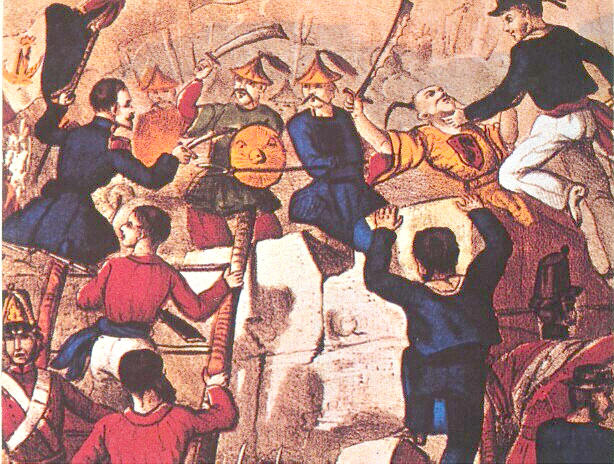
Course of the fighting
The campaign began with naval and land maneuvers aimed at overcoming the city’s riverine defenses and forts guarding approaches. After bombardment and coordinated landings, allied troops advanced on walled suburbs and key defensive works. Resistance varied by district; in several places defenders withdrew or surrendered, while in others there were sharp local engagements. By 1 January the city fell into the hands of the European allies, who occupied portions of Canton.
Context and background
The battle was part of the broader Second Opium War (1856–1860), a conflict sparked by disputes over trade, diplomatic relations, and treaty enforcement between China and Western powers. Canton had long been important as the main southern trade outlet and a symbolically significant target for forces seeking leverage in negotiations with the Qing government.
Consequences and significance
The fall of Canton deepened Qing vulnerabilities and helped set the stage for further allied advances and diplomatic pressure that contributed to the Treaty of Tientsin (1858). Occupation of the city disrupted local administration and trade and demonstrated the growing military reach of Western naval and expeditionary forces along China’s coast and rivers.
Forces, tactics and notable features
- Allied operations combined naval gunfire with amphibious landings and infantry assaults on urban defenses.
- Defenders relied on city walls, river batteries and local militias alongside imperial troops.
- Urban combat and riverine operations were characteristic, reflecting Canton’s geography.
Aftermath and historical perspective
Although the capture of Canton was a tactical victory for the Anglo‑French expedition, it formed one episode in a longer conflict that continued to reshape Sino‑foreign relations. The engagement illustrates mid‑19th century imperial warfare, the strategic value of port cities, and the unequal military balance that prompted treaties with lasting political and economic impact for China.
Questions and answers
Q: When did the Battle of Canton occur?
A: The Battle of Canton occurred from December 28, 1857, to January 1, 1858.
Q: What was the Battle of Canton?
A: The Battle of Canton was a battle of the Second Opium War in which the French and British attacked the Chinese city of Canton.
Q: Who attacked the Chinese city of Canton?
A: The French and British attacked the Chinese city of Canton.
Q: Did the Europeans win the Battle of Canton?
A: Yes, the Europeans won the Battle of Canton as the city fell in their favour on January 1, 1858.
Q: What happened after the Battle of Canton?
A: After the Battle of Canton, the Europeans took over the city.
Q: Which war did the Battle of Canton take place in?
A: The Battle of Canton took place in the Second Opium War.
Q: When did the city of Canton fall?
A: The city of Canton fell on January 1, 1858.
Related articles
Author
AlegsaOnline.com Battle of Canton (1857–1858) Leandro Alegsa
URL: https://en.alegsaonline.com/art/9455