
Stochastic process: concepts, types, and applications
An introduction to stochastic processes: random time-ordered systems used to model evolving phenomena in finance, science and engineering, with core ideas, history, and common examples.
Overview
A stochastic process is a mathematical model for quantities that evolve randomly over time. Informally it describes a sequence or family of random events or variables ordered by time. The phrase "random event" is often used to refer to each outcome in the sequence; see random events. A stochastic process produces a collection of possible time-indexed outcomes called sample paths, and it provides a framework for predicting probabilities, averages and long-run behavior.
Image gallery
5 Images

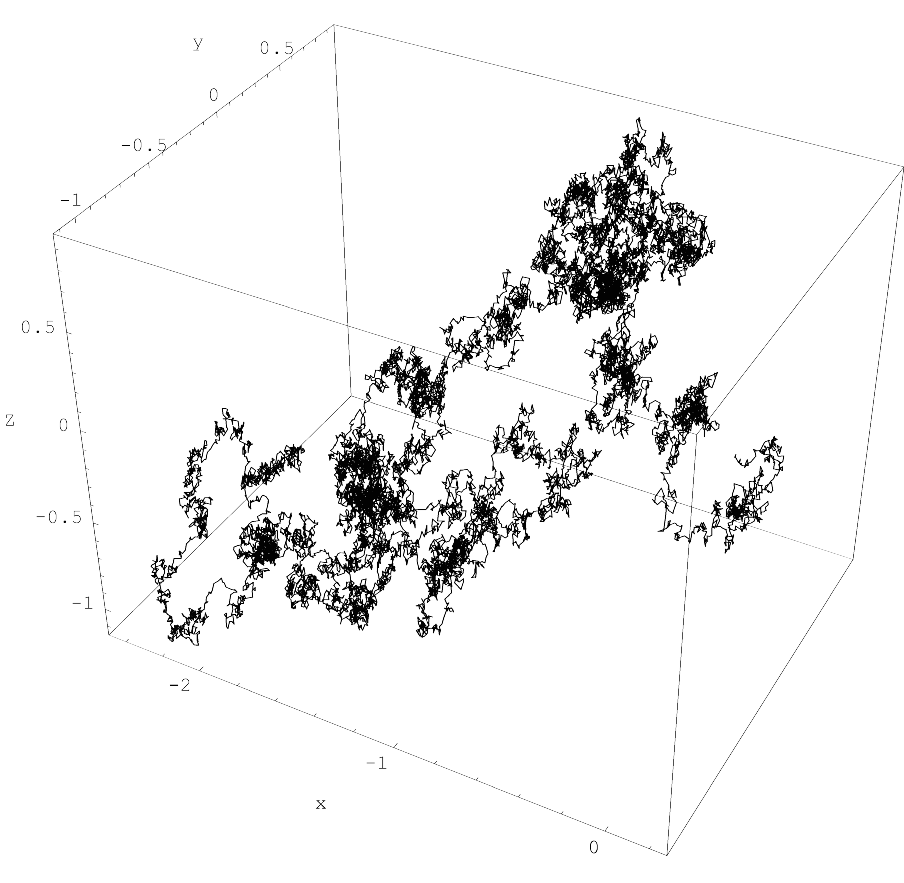


Core concepts and characteristics
Key elements that distinguish different stochastic processes include the index set (time), the state space (possible values), and dependence structure. Time may be discrete (steps 0,1,2,...) or continuous (all nonnegative real numbers). The state space can be finite, countable or continuous. Important properties commonly considered are:
- Stationarity — whether statistical properties are invariant over time;
- Markov property — future evolution depends only on the present and not the past;
- Ergodicity — long-run averages converge to ensemble averages;
- Independence and increments — e.g., independent increments for processes like the Poisson process or Brownian motion.
Types and examples
Common families include Markov chains, Poisson processes, and diffusion processes such as Brownian motion. Markov chains model systems with memoryless transitions and are widely used in discrete settings. The Poisson process models random arrival events in time. Diffusions describe continuous random fluctuation and form the basis for many models in physics and finance.
History and development
Stochastic processes grew from 19th- and early 20th-century work on probability, random walks and statistical physics. Development accelerated as mathematicians formalized limit laws and measure-theoretic probability, enabling rigorous treatment of continuous-time processes and tools such as filtrations and stochastic calculus. These foundations made it possible to connect probabilistic models with differential equations and applied sciences.
Applications and examples
They are used across disciplines. In finance and economics, stochastic models describe price movements and exchange rates; for example, models of stock market behavior and foreign exchange. In medicine and physiology, time-series measurements such as an individual’s EKG waveforms, EEG recordings, blood pressure traces or temperature profiles are often analyzed with stochastic techniques to detect patterns or anomalies; see blood pressure monitoring as an example. Other areas include queueing theory, population dynamics, signal processing, and climate modeling.
Distinctions and notable facts
Not every random sequence is treated the same: modeling choices depend on the question of interest (prediction, estimation, control) and on mathematical tractability. Some processes are best analyzed by probabilistic limit theorems, others by numerical simulation. Practical use often combines theoretical insight with data-driven methods to estimate parameters and test hypotheses about the underlying stochastic mechanism.
Related articles
Author
AlegsaOnline.com Stochastic process: concepts, types, and applications Leandro Alegsa
URL: https://en.alegsaonline.com/art/93974
Sources
- princeton.edu : "Stochastic process"