
Spratly Islands (South China Sea)
A group of more than one hundred reefs, islets and atolls in the South China Sea, the Spratly Islands are ecologically productive but politically contested by several neighbouring states for strategic, economic and legal reasons.
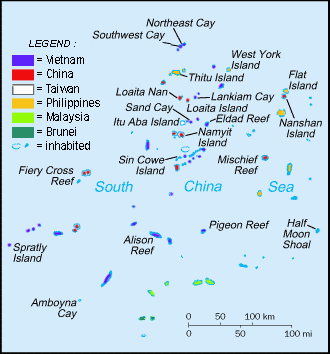
The Spratly Islands are a dispersed group of reefs, islets, cays and atolls in the central South China Sea. Often described as "around a hundred" features rather than large islands, the group has very little combined land area (under 2 km² in total) but occupies a much larger maritime and ecological footprint. The name derives from the British mariner Richard Spratly, who reported one of the features in the 19th century. Their remote shallow seas and shoals create complex navigation and jurisdictional questions in a busy international waterway such as the South China Sea.
Image gallery
10 Images



Geography and environment
Most Spratly features are coral atolls, sandbanks or rocky outcrops that rise only slightly above sea level at high tide. Surrounding waters support diverse reef ecosystems and abundant fisheries, which local communities and distant fleets exploit. Ecological concerns include coral damage, loss of habitat from land reclamation and dredging, and pressure on fish stocks from intensive fishing.
Claimants and occupation
Several states assert sovereignty over parts of the Spratlys; a number of features are occupied or serviced by military or civilian personnel. Principal claimants include:
History and legal context
Local use of Spratly features goes back centuries for fishing and navigation, but modern diplomatic disputes intensified in the 20th and 21st centuries as coastal states sought maritime rights. International law, including the United Nations Convention on the Law of the Sea (UNCLOS), shapes competing claims by defining territorial seas and exclusive economic zones, although historical assertions and differing interpretations complicate resolution. A high-profile arbitral ruling in 2016 addressed some legal questions between claimants, a decision that influenced diplomacy but did not end rival assertions.
Strategic and economic importance
Despite limited land, the Spratlys are strategically positioned near major shipping lanes and are adjacent to potentially valuable fisheries and seabed resources, including hydrocarbons. These factors make control of features attractive for economic reasons and for projecting maritime presence. Developments such as the construction of facilities, airstrips and helicopter pads on several features have heightened international attention and regional tensions.
Diplomatic efforts to manage disputes include bilateral talks, ASEAN-centered consultations and occasional confidence-building measures at sea. The combination of ecological sensitivity, dense maritime traffic and overlapping rights ensures the Spratly Islands remain a prominent subject in regional geopolitics, environmental management and international maritime law.
Related articles
Author
AlegsaOnline.com Spratly Islands (South China Sea) Leandro Alegsa
URL: https://en.alegsaonline.com/art/92836
Sources
- cia.gov : "Spratly Islands" at CIA World Factbook