
Spheroid: definition, types, geometry and natural examples
A spheroid is an ellipsoid of revolution formed by rotating an ellipse. This article explains its geometry, oblate and prolate forms, mathematical properties, natural occurrences and practical significance.
Overview
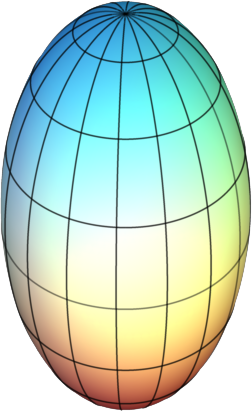
A spheroid is a special case of an ellipsoid created when an ellipse is rotated about one of its principal axes. In simpler terms, it is an axisymmetric solid whose cross-sections perpendicular to the axis of rotation are circles. All spheres are spheroids, but most spheroids differ from a perfect sphere because two of their three principal semi-axes are equal while the third is different.
Image gallery
4 Images


Geometry and terminology
A spheroid has two equal semi-axes (often called equatorial radii) and a distinct polar semi-axis. These equal semi-diameters are sometimes labeled 'a' while the polar semi-diameter is labeled 'c', and the relation among them determines the shape. The common mathematical volume formula for a spheroid is V = (4/3)πa²c, where a is the equatorial radius and c the polar radius.
Types
- Oblate spheroid: flattened at the poles so the equatorial radius exceeds the polar radius. This form arises when an object is rotated around its short axis.
- Prolate spheroid: elongated along the axis of rotation so the polar radius exceeds the equatorial radius. This is the result of rotating an ellipse about its major axis.
- Sphere: a special spheroid with all three semi-axes equal and perfect rotational symmetry.
Natural occurrence and causes
Many rotating celestial bodies approximate an oblate spheroid because rotation produces outward centrifugal effects that redistribute mass toward the equator. Centrifugal force associated with spin is the primary mechanical cause of this flattening; see centrifugal force for the physical concept. Earth, other planets and rapidly spinning stars often show measurable oblateness. By contrast, truly spherical bodies are rare except when internal forces (such as strong gravity in large planets and stars) dominate rotation.
Examples, applications and notable facts
Spheroidal geometry is important in geodesy, astronomy and engineering. The Earth is commonly modeled as an oblate spheroid for mapmaking and global positioning because its equatorial radius differs slightly from its polar radius. Some small bodies like certain asteroids or elongated satellites may be better approximated as prolate or irregular shapes. Mathematical models of spheroids simplify gravitational potential calculations and satellite orbit predictions, and they appear in optical designs where rotational symmetry is required.
Further reading and distinctions
When studying spheroids it is useful to distinguish them from more general triaxial ellipsoids (three unequal axes) and from deformed or irregular shapes that cannot be captured by axisymmetric models. For more technical treatments of curvature, surface area, and gravity of spheroids, see standard references on solid geometry and celestial mechanics available through academic sources such as ellipsoid treatments, introductory materials on ellipses, and overview texts on planetary figures and rotation dynamics (sphere and oblate models). Additional summary resources and simulations can be found at instructional and research portals referenced by educators and geoscientists (oblate examples, centrifugal force summaries).
Related articles
Author
AlegsaOnline.com Spheroid: definition, types, geometry and natural examples Leandro Alegsa
URL: https://en.alegsaonline.com/art/92644