
Centrifugal force: concept, formulas, examples and distinctions
An apparent outward force experienced in rotating reference frames. Explains its meaning as a fictitious (inertial) force, its mathematical form, common examples, applications and how it differs from centripetal force.
Centrifugal force is the apparent force that seems to push objects away from the axis of rotation when observed from a rotating frame of reference. In everyday language it describes the sensation of being flung outward on a turn or on a spinning ride. In physics it is categorized as a fictitious or inertial force: it does not arise from any physical interaction with another body, but appears in the equations of motion when Newton’s laws are written in a non-inertial (accelerating or rotating) coordinate system.
Image gallery
5 Images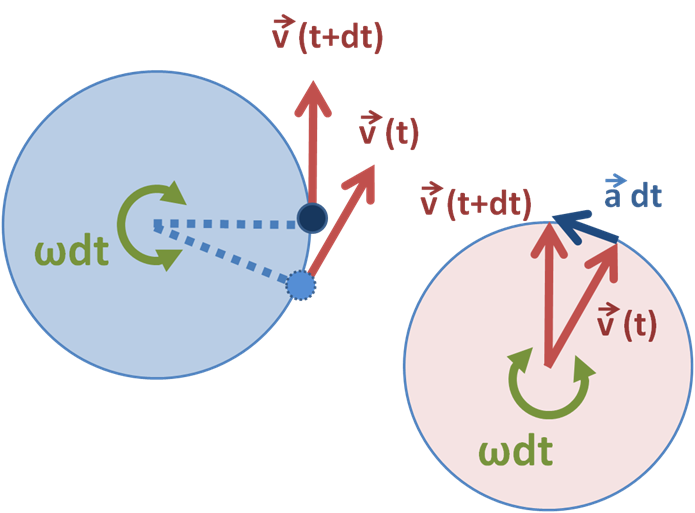


Definition and basic formula
When an observer rotates with an object, the centrifugal force on a mass m located at radius r from the rotation axis and rotating with angular speed ω has magnitude m ω² r and is directed radially outward. For an object moving in a circle with linear speed v, the same magnitude can be written as m v² / r. These expressions quantify the apparent outward tendency that must be balanced by real contact or constraint forces (for example, a rope or a car door) if the object remains in circular motion relative to the rotating observer.
How it relates to centripetal force
In an inertial (non-rotating) frame, circular motion is maintained because a real inward force — the centripetal force — acts toward the center and continuously changes the direction of the velocity. From the viewpoint of a rotating observer, however, there is an additional apparent outward force of equal magnitude: the centrifugal force. The two descriptions refer to the same physical situation but use different frames. See also centripetal force for the inward perspective.
Common examples and applications
- Holding a weight on a string and whirling it: the string provides the inward tension (centripetal) while the mass seems pushed outward (centrifugal) in the rotating frame.
- Passenger in a car taking a sharp turn: inside the car the person feels pushed outward against the door; the car must exert an inward force to change the passenger’s direction.
- Centrifuges: laboratory and industrial centrifuges exploit the outward apparent force to separate materials of different densities by spinning them at high speed.
- Rotating habitats or centrifuges in space: designers use centrifugal effects to generate artificial gravity by setting up a steady outward acceleration on the interior surface.
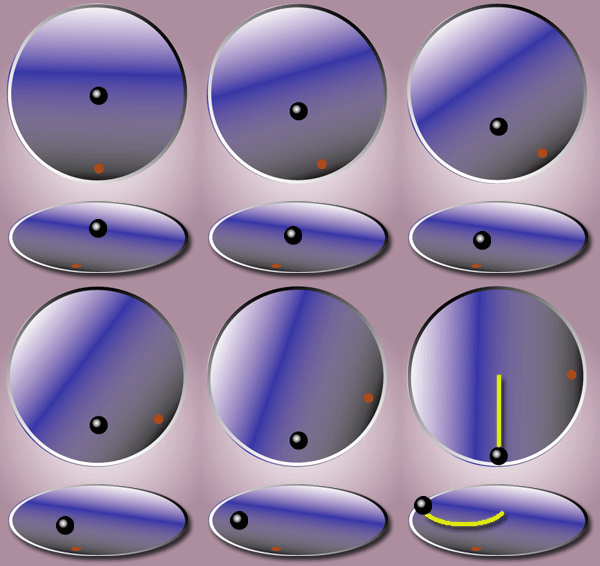
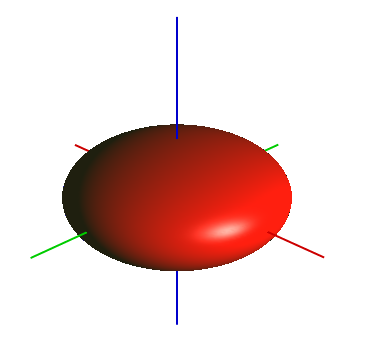
- Fluid surfaces in rotation: rotating liquids develop a parabolic free surface because the outward acceleration balances gravity and pressure gradients.
Historical and conceptual notes
The word centrifugal derives from Latin roots meaning "center" and "to flee." The concept has been part of classical mechanics since the formulation of rotational dynamics; it became precise when scientists formalized the use of non-inertial frames and inertial (fictitious) forces such as the centrifugal and Coriolis forces. In calculations, introducing centrifugal force is a convenient device that allows Newton’s second law to be applied inside a rotating frame by adding appropriate inertial forces to the force balance.
Distinctions and cautions
It is important to distinguish the inertial centrifugal force (apparent only in rotating frames) from reaction forces that may be labeled "centrifugal" in some contexts. The inertial centrifugal force has no physical source; it reflects the observer’s accelerating coordinates. Real contact or constraint forces (tension, normal forces, friction) are what physically act on objects to produce the motion seen by an outside inertial observer. Additionally, rotating frames introduce other fictitious effects such as the Coriolis force, which affects moving objects within the rotating system and must be considered alongside centrifugal effects when analysing motion.
Understanding centrifugal force helps clarify how different frames describe the same phenomena and is central to engineering designs that involve rotation, to laboratory separation techniques, and to interpreting phenomena in atmospheric and planetary sciences where rotating reference frames are natural.
Author
AlegsaOnline.com Centrifugal force: concept, formulas, examples and distinctions Leandro Alegsa
URL: https://en.alegsaonline.com/art/18119