
Sponde (Jupiter moon)
Sponde (Jupiter XXXVI) is a small irregular, retrograde moon discovered in 2001. About 2 km across, it orbits Jupiter at ~24.25 million km in a highly inclined, eccentric orbit and belongs to the Pasiphaë group.
Overview
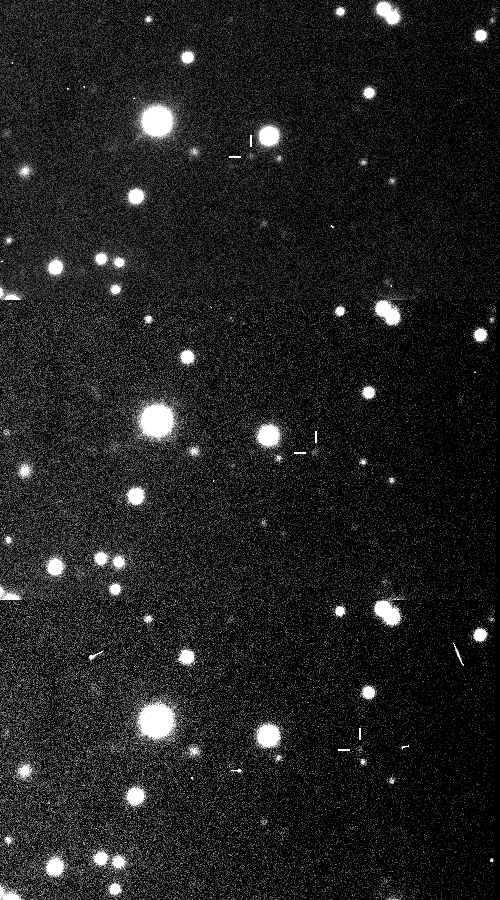
Sponde, officially Jupiter XXXVI and provisionally S/2001 J 5, is one of Jupiter's numerous small outer satellites. It was discovered in 2001 by a team from the University of Hawaii led by Scott S. Sheppard. With an estimated diameter of about 2 kilometres, Sponde is classified as an irregular satellite: a small, likely non-spherical body that orbits far from the planet on a tilted and often eccentric path.
Image gallery
2 Images
Discovery and designation
The object was identified during deep ground-based surveys for faint Jovian companions. Initially given the provisional designation S/2001 J 5, the satellite received the permanent Roman numeral Jupiter XXXVI after follow-up observations confirmed its orbit. Continued monitoring refined its orbital elements and allowed astronomers to estimate its size from brightness measurements combined with typical assumptions about surface reflectivity.
Orbit and motion
Sponde orbits Jupiter at an average distance of roughly 24,253,000 kilometres and completes one revolution in about 771.6 days. Its orbit is retrograde, meaning it travels in the opposite direction to Jupiter's rotation. The orbital inclination is approximately 154° to the ecliptic (about 156° relative to Jupiter's equator) and the orbit is notably elongated, with an eccentricity near 0.443; for general background, see orbital eccentricity. These characteristics place Sponde among Jupiter's dynamically active outer moons, whose orbits can be altered over long timescales by gravitational interactions.
Name and mythological background
In August 2003 the International Astronomical Union assigned the name Sponde, taken from Greek mythology. Sponde is one of the Horae (the Hours), goddesses associated with particular hours of the day and aspects of natural order; she was said to preside over the seventh hour. The Horae are described in myth as daughters of Zeus and Themis, which links the moon's name to Jupiter's mythological parentage. The name also follows the naming convention for retrograde Jovian satellites, which typically end in the letter "-e".
Group membership and origin
Sponde is considered part of the Pasiphaë group, a set of retrograde irregular moons that share broadly similar orbital distances and inclinations. Members of this group orbit Jupiter at distances roughly between 22,800,000 and 24,100,000 kilometres and have inclinations in the approximate range 144.5°–158.3°. The common orbital parameters suggest a related origin: these bodies may be fragments of a single captured object that was later disrupted by collisions or tidal stresses after capture.
Physical characteristics and observation
Because Sponde is small and faint, detailed physical information is limited. Its diameter estimate (about 2 km) comes from its observed brightness and assumptions about surface reflectivity (albedo). Objects of this size are expected to be irregular in shape and heavily cratered rather than spherical. Spectral or compositional data are sparse; acquiring such data typically requires very large ground-based telescopes or spacecraft observations. Astronomers continue to monitor Sponde's motion to improve models of the long-term dynamics of Jupiter's irregular satellite population.
Scientific importance
- Sponde and similar irregular moons provide evidence about the processes of capture and collisional fragmentation in the early Solar System.
- The dynamics of retrograde, inclined, and eccentric orbits help test models of satellite stability and the influence of planetary perturbations.
- Studying ensemble properties of groups like the Pasiphaë group aids reconstruction of their possible progenitors and collisional histories.
Further context
For general information on the Horae and their role in mythology see Horae. For additional context on the discovery team and survey programs consult resources associated with the University of Hawaii group and profiles of Scott S. Sheppard. For summaries of irregular satellite groups and dynamics see material on the Pasiphaë group and overviews of orbital parameters such as eccentricity and definitions of the ecliptic. Discussion of shape and size classification for small moons is available under descriptions of non-spherical bodies.
Sponde is a minor member of Jupiter's satellite system but contributes to the larger scientific picture of how giant planets acquire and retain irregular satellites. Continued observation refines its orbit and helps place it in the broader context of planetary satellite formation and evolution.
Related articles
Author
AlegsaOnline.com Sponde (Jupiter moon) Leandro Alegsa
URL: https://en.alegsaonline.com/art/92761
Sources
- cfa-www.harvard.edu : IAUC 7900: Satellites of Jupiter
- cfa-www.harvard.edu : MPEC 2002-J54: Eleven New Satellites of Jupiter
- cfa-www.harvard.edu : IAUC 8177: Satellites of Jupiter, Saturn, Uranus