
Spandrel: architectural space, ornament, and broader meanings
A spandrel is the triangular or curving area beside or between arches or between stacked windows; used structurally and decoratively and also as a metaphor in other fields.
A spandrel is a residual area formed where two structural or decorative elements meet. In classical architecture it commonly names the roughly triangular space between the outer curve of an arch and a rectangular frame or the area between adjacent arches in an arcade. The term is also applied vertically to the panel-like zones between the top of a window on one floor and the sill of the window above; these are often called spandrel panels. For basic geometric references see arch geometry and general definitions at architectural glossaries.
Image gallery
3 Images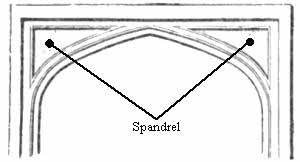


Characteristics and types
- Arch spandrels: curved-triangular shapes bounded by an arch and an enclosing right angle, common in Romanesque and classical work.
- Inter-arch spandrels: the small, often decorated zones between neighboring arches in colonnades or arcades.
- Vertical spandrel panels: horizontal bands on facades between stacked windows, frequently clad with opaque materials or glazing called spandrel glass.
- Pendentives vs. spandrels: pendentives are curved triangular elements that transition a dome to a square base and are different in function though sometimes confused with spandrels.
History and examples
Spandrels appear across traditions because they naturally arise from common structural combinations. In Byzantine and Islamic buildings the spandrel surface became a favored site for mosaics, calligraphy and vegetal ornament; Gothic cathedrals used spandrels for carved foliage and figures. During the late 19th and 20th centuries the rise of steel-frame construction introduced glazed or metal-clad spandrel panels to conceal floor slabs and insulation. Architects and historians often illustrate these uses with case studies; for further reading see historic examples and technical notes at façade engineering.
Uses, function and conservation
- Decorative canvas: spandrels serve as convenient surfaces for ornament, painting, or inscriptions.
- Concealment and building systems: modern spandrel panels hide structure, insulation, and services between floors.
- Structural and weatherproofing role: when executed in masonry they may help distribute loads or protect openings from rain.
- Conservation issues: historic spandrel decoration can be vulnerable to pollution and requires specialized restoration.
Beyond architecture, "spandrel" has been adopted as a metaphor in other disciplines. Notably, evolutionary biologists use it to refer to a by-product trait that arises as a consequence of structural constraints rather than direct adaptation. Art historians distinguish between the architectural spandrel and painted or sculpted motifs applied to that surface; many museum catalogues and monographs discuss such treatments—see art-historical treatments for examples.
Related articles
Author
AlegsaOnline.com Spandrel: architectural space, ornament, and broader meanings Leandro Alegsa
URL: https://en.alegsaonline.com/art/92470