
South Asian River Dolphin (Platanista gangetica)
Freshwater dolphin of South Asia (Platanista gangetica), with Ganges and Indus subspecies; adapted to turbid rivers with reduced eyesight and echolocation; vulnerable from habitat change, pollution and fishing.
Overview
The South Asian river dolphin (Platanista gangetica) is a freshwater cetacean native to large river systems in South Asia. It is commonly treated as a single species with two geographically separated subspecies, the Ganges river dolphin and the Indus river dolphin. These animals are fully adapted to life in turbid, braided rivers and rely primarily on sound rather than vision to locate prey and navigate. For a general species summary see the species overview.
Image gallery
8 Images





Appearance and adaptations
South Asian river dolphins have a long, narrow rostrum lined with numerous conical teeth, a robust body and a low, ridge-like dorsal profile instead of a tall dorsal fin. Eyes are small and often encased in soft tissue, rendering the animals effectively functionally blind in the muddy waters they inhabit. They possess a flexible neck, which allows precise manoeuvring, and produce high‑frequency clicks and bursts used for echolocation to detect prey and obstacles.
- Size: adults typically measure around one to two meters depending on sex and subspecies.
- Diet: primarily fish and some crustaceans and other invertebrates.
- Behavior: generally found alone or in small groups, feeding by sound and rapid turns in shallow channels.
Distribution and subspecies
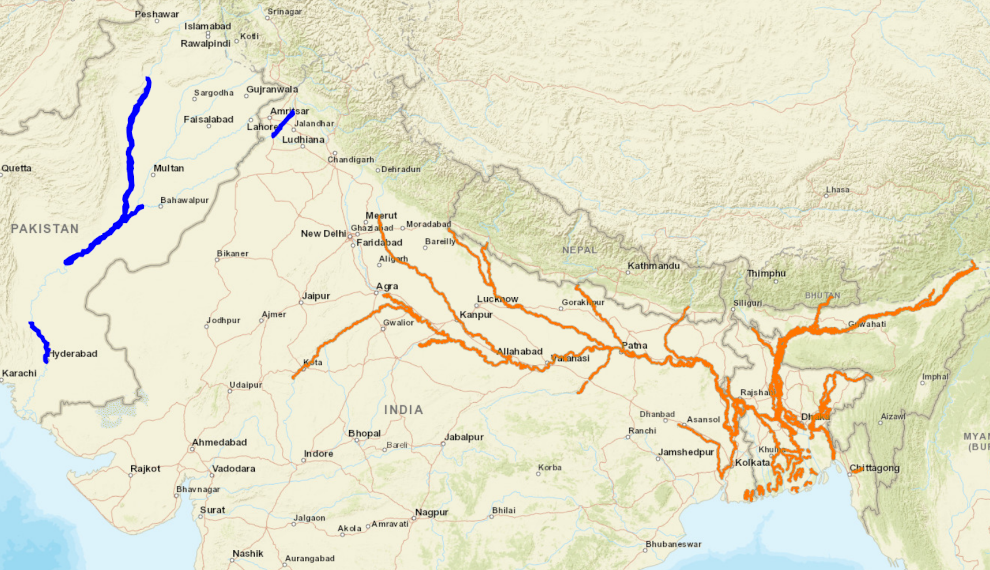
The Ganges form is associated with the Ganges–Brahmaputra–Meghna river system and its tributaries across parts of India and Bangladesh, while the Indus form occurs in sections of the Indus river system in Pakistan and adjacent waters. Small populations or historical records also include river stretches in Nepal. River connectivity and seasonal flow shape their distribution and movement.
Taxonomy and research
Taxonomic treatment has varied: the two river populations were once regarded as separate species but were later classified as subspecies of a single species pending further analysis. Ongoing genetic studies and morphological research continue to refine understanding of population structure and evolutionary relationships. Such research informs whether distinct management units should be conserved separately.
Threats and conservation
Major threats include habitat fragmentation from dams and irrigation, entanglement in fishing gear, boat strikes, water pollution, and declining prey due to overfishing. Conservation measures focus on protecting critical river stretches, reducing bycatch, improving water quality, and community engagement to promote coexistence. Because these dolphins are restricted to riverine habitats, they are useful indicators of freshwater ecosystem health and are a priority for transboundary conservation efforts.
Human significance
Culturally, economically and ecologically, South Asian river dolphins have importance for riverside communities. Conservation success depends on integrated approaches that address river management, pollution control and sustainable fisheries while respecting local livelihoods.
Related articles
Author
AlegsaOnline.com South Asian River Dolphin (Platanista gangetica) Leandro Alegsa
URL: https://en.alegsaonline.com/art/92114