
Southern cassowary (Casuarius casuarius)
Large flightless bird of New Guinea and northeast Australia, notable for its casque, two wattles and role as a major seed disperser in tropical rainforest ecosystems.
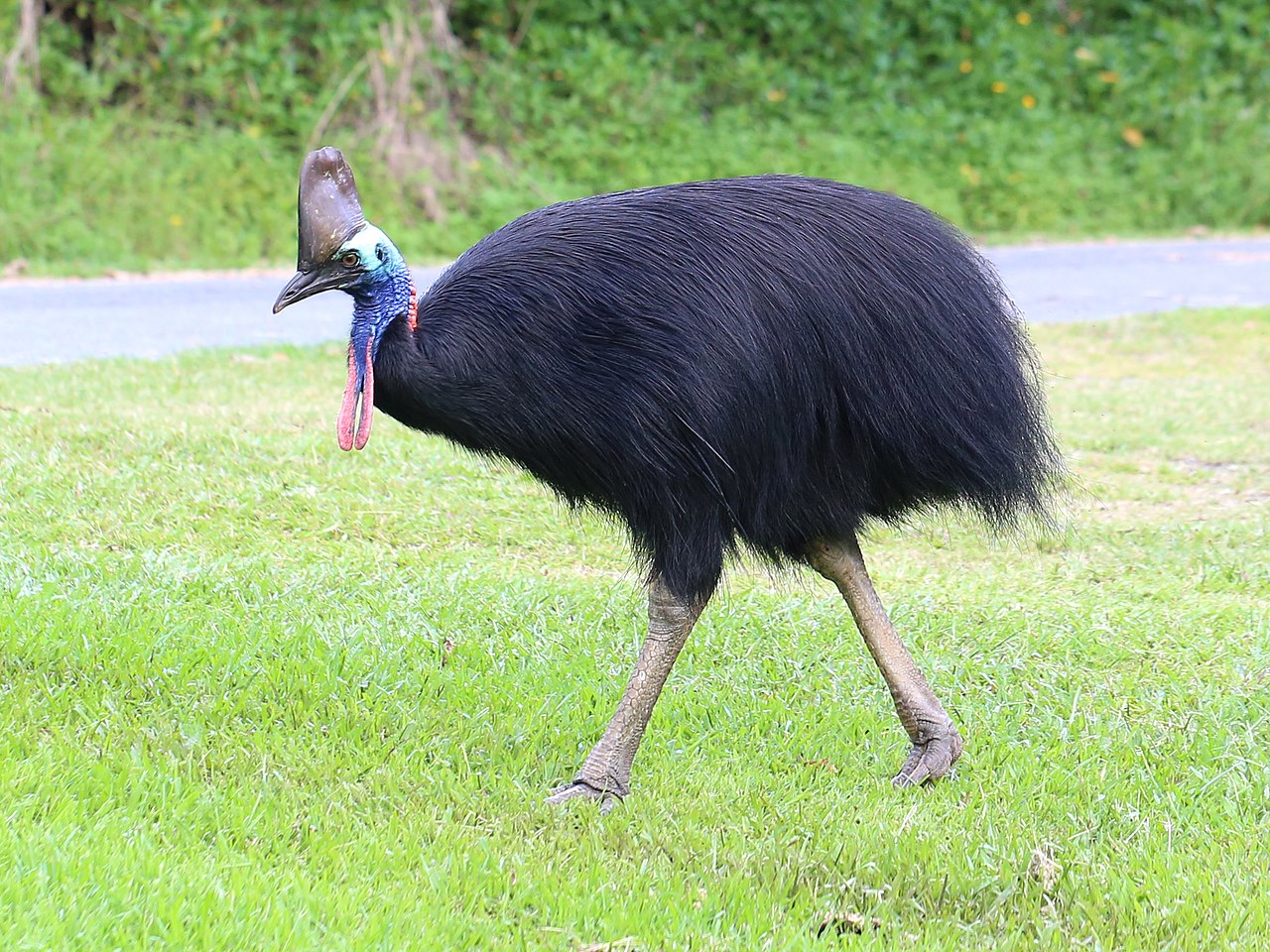
The southern cassowary (Casuarius casuarius), sometimes called the double-wattled or two-wattled cassowary, is a large flightless bird native to the wet tropical forests of New Guinea and the far north of Australia. It is most often associated with dense tropical rainforest, where it forages on the forest floor and helps shape plant communities by dispersing the seeds of many fruiting trees. Adults are striking for their glossy black plumage, tall casque and a pair of long, pendulous wattles on the throat and upper chest.
Image gallery
10 Images




Description and key features
The southern cassowary is a heavy-bodied bird with short, stiff feathers that act like coarse hair, protecting it as it moves through thick undergrowth. The casque is a keratinous structure on the skull that varies in size and shape among individuals. The bare skin of the head and neck shows vivid blues and reds in many birds, and the wattles hang below the throat. Each foot has three forward-pointing toes, and the central toe bears a long, sharp claw that can be used defensively.
- Body: large and robust with powerful legs suited to running and pushing through vegetation.
- Casque: helmet-like structure; its functions have been variously proposed as display, protection, or aiding in sound reception and vegetation clearing.
- Plumage and skin: predominantly black feathers with colorful bare skin on head and neck and two wattles.
- Feet: strong three-toed feet with a dagger-like inner claw.
Behavior, diet and ecological role
Cassowaries are primarily frugivorous and are among the most important large seed dispersers in their ecosystems. They swallow whole fruits and disperse seeds over wide areas, often depositing them away from the parent tree and thus aiding forest regeneration. Their diet can also include fungi, invertebrates and occasional small vertebrates. For summaries of fruit and diet associations see diet and fruit.
Reproduction and life cycle
Breeding includes a notable role reversal: the female lays a clutch of large, glossy green eggs on a simple ground nest and then departs. The male incubates the eggs and cares for the chicks, which are striped and capable of following the parent soon after hatching. Chicks depend on the male for protection and foraging guidance until they become independent.
Distribution, conservation and threats
The species occurs across suitable lowland and hill forests of New Guinea and the Wet Tropics of northeastern Australia. Population status varies regionally; the bird is uncommon in parts of Australia and the subject of focused conservation efforts. Key threats include habitat loss and fragmentation, vehicle collisions where roads intersect forest, attacks by domestic or feral dogs, and other disturbances associated with human activity. Conservation measures emphasise habitat protection, creation of wildlife corridors, road mitigation and community engagement to reduce negative interactions.
Human interactions and cultural significance
Cassowaries are culturally important to many Indigenous communities in New Guinea and northern Australia and feature in traditional stories and art. Wild cassowaries are generally shy but can be dangerous if cornered or provoked; they are capable of inflicting serious wounds with their powerful legs and claws, so people are advised to keep a safe distance and avoid feeding or approaching them. For regional information see resources on Australia and New Guinea.
As representatives of the ancient ratite lineage of flightless birds, southern cassowaries are of scientific interest for studies of biogeography, ecology and the evolution of large terrestrial birds in Australasia.
Related articles
Author
AlegsaOnline.com Southern cassowary (Casuarius casuarius) Leandro Alegsa
URL: https://en.alegsaonline.com/art/92283