
Southern corroboree frog (Pseudophryne corroboree)
A critically endangered, brightly striped frog endemic to alpine bogs of Australia's Kosciuszko National Park. Threats include disease, habitat change and small population size.
Overview
The southern corroboree frog (Pseudophryne corroboree) is one of two closely related corroboree frog species; see the species list at corroboree frogs. The other species is the northern corroboree frog (Pseudophryne pengilleyi). The southern species is notable for its vivid black-and-yellow striping and tiny body: it is a very small frog (size reference) with distinctive warning coloration (aposematic patterning).
Image gallery
1 Image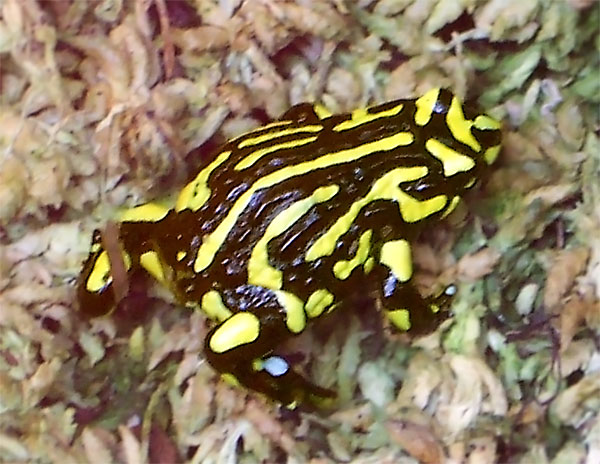
Description and life history
Adults are exceptionally small, measuring only a few centimetres, and display contrasting bands of black and bright yellow (occasionally greenish). This pattern serves as a warning to predators because the species produces skin-borne toxins that reduce predation. Breeding occurs in subalpine bogs and wet heath in the austral summer. Adults deposit eggs on land within moist vegetation or sphagnum moss; when seasonal rains or floods connect nests to shallow pools the eggs hatch and aquatic tadpoles develop until metamorphosis.
Range and habitat
The southern corroboree frog has an extremely restricted range in south‑eastern Australia, confined to a small area of high country within Kosciuszko National Park. The extant wild distribution is estimated to be on the order of 10 km² (about 4 sq mi) in and around alpine and subalpine bogs of Kosciuszko National Park. This narrow endemism makes the species highly vulnerable to localized threats and environmental change.
Threats
- Chytridiomycosis: infection by the chytrid fungus (Batrachochytrium dendrobatidis) is widely regarded as a principal driver of declines in many Australian frogs, including corroboree frogs.
- Habitat alteration: changes to hydrology, grazing and trampling, and loss of suitable bog habitat reduce breeding opportunities.
- Climate change and fire: reduced snow, warmer conditions and severe fires alter alpine wetland environments that this species depends on.
- Small population size: low numbers increase extinction risk from chance events, inbreeding and loss of genetic diversity.
Conservation and recovery efforts
Because of dramatic declines, the southern corroboree frog is listed as Critically Endangered by the IUCN (IUCN listing). Conservation responses include captive-breeding and insurance populations maintained by zoos and government programs, targeted disease research and monitoring, habitat protection and experimental reintroductions. Captive breeding aims to maintain genetic diversity and produce animals for release when conditions are suitable. Recovery teams coordinate surveillance, research on disease management, and habitat restoration.
Notable facts and cultural notes
The name "corroboree" references Indigenous Australian ceremonial gatherings; early observers likened the frog's bright stripes to painted ceremonial designs. The southern corroboree frog is often described as one of the world’s brightest frogs because of its intense yellow-and-black contrast. Recent field estimates indicate very small remaining wild numbers—declines of roughly 80% over a decade have been reported and total wild counts may be fewer than a few hundred animals—emphasizing the species' precarious status and the importance of ongoing conservation work.
For additional context on the species group and conservation actions see resources on corroboree frogs and conservation programs: species overview, northern species, and management pages linked through recovery networks (research, biology, range, area, park information, IUCN).
Questions and answers
Q: What is the scientific name of the southern corroboree frog?
A: The scientific name of the southern corroboree frog is Pseudophryne corroboree.
Q: How many species of corroboree frog are there?
A: There are two species of corroboree frog: the southern corroboree frog and the northern corroboree frog.
Q: What is the coloration of the southern corroboree frog?
A: The southern corroboree frog has black and yellow stripes, sometimes with a greenish tinge. It has warning colouration and is one of the brightest frogs in the world.
Q: Where does the southern corroboree frog live?
A: The southern corroboree frog only lives in an area of about 10 km2 (4 sq mi) in the Kosciusko National Park in south east Australia.
Q: What is the population of corroboree frogs?
A: The total population of corroboree frogs is less than 250.
Q: Has the population of the southern corroboree frog decreased or increased in the last ten years?
A: The numbers of the southern corroboree frog have reduced by 80% in the last ten years.
Q: What is the status of the southern corroboree frog in terms of conservation?
A: The southern corroboree frog is listed as being a critically endangered species by the International Union for Conservation of Nature and Natural Resources (IUCN).
Related articles
Author
AlegsaOnline.com Southern corroboree frog (Pseudophryne corroboree) Leandro Alegsa
URL: https://en.alegsaonline.com/art/92287
Sources
- iucnredlist.org : "Pseudophryne corroboree (Corroboree Frog)"
- environment.nsw.gov.au : "Southern corroboree frog - endangered species listing"
- amphibiaweb.org : "- Pseudophryne corroboree"