
Sodium chromate (Na2CrO4): properties, production, uses and safety
Sodium chromate (Na2CrO4) is a bright yellow, water‑soluble chromate salt. It is a strong oxidizer and a source of toxic Cr(VI) ions; used in industry and laboratories with strict safety and disposal controls.
Sodium chromate is an inorganic compound with the formula Na2CrO4. In its pure form it appears as yellow crystalline solids that dissolve readily in water to give the chromate anion, CrO42−. The salt functions as a convenient source of chromate for chemical reactions and industrial processes.
Image gallery
1 Image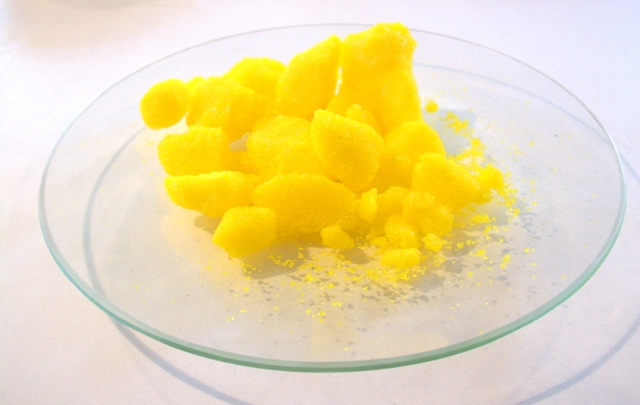
Composition and chemical behavior
The compound contains two sodium cations and one chromate anion; chemically it is described as a salt of the ions that comprise basic chromium(VI) oxyanion chemistry. The chromate group (chromate) is strongly oxidizing under many conditions and participates in equilibria that shift to the dichromate form as solutions become acidic.
Production and historical notes
Industrially, sodium chromate is typically manufactured by roasting chromium‑bearing ores (such as chromite) with sodium carbonate in the presence of oxygen and then extracting the product into water. This route converts lower‑valent chromium in the ore to the hexavalent chromate anion that dissolves as Na2CrO4. The compound has long been used as a building block for other chromium chemicals and for metal treatment reagents.
Uses and applications
- Source of chromate for laboratory analysis and synthesis.
- Precursor or constituent in metal finishing and plating processes, and in corrosion control treatments.
- Component in certain pigments, dyes and surface‑treatment formulations (analogous to potassium chromate in some roles).
- Occasional use in analytical chemistry as an oxidant or indicator (oxidizing agent).
Safety, environmental impact and remediation
Sodium chromate contains hexavalent chromium (chromium in the +6 oxidation state), a form that is toxic and associated with increased cancer risk in exposed populations. Because of its hazards, handling requires engineering controls, personal protective equipment and restricted disposal routes. Environmental releases are of particular concern because Cr(VI) is mobile in water.
Treatment and neutralization of sodium chromate waste rely on chemical reduction to convert chromium(VI) to chromium(III). Addition of a reducing agent under controlled conditions converts Cr(VI) to the less soluble and less toxic Cr(III), which can then be precipitated and removed. Regulatory limits, monitoring and safer alternatives are commonly used to reduce occupational and ecological risks.
Related articles
Author
AlegsaOnline.com Sodium chromate (Na2CrO4): properties, production, uses and safety Leandro Alegsa
URL: https://en.alegsaonline.com/art/91524