
Johannes Kepler
German mathematician and astronomer who formulated the three laws of planetary motion and made foundational contributions to optics, celestial mechanics and the Scientific Revolution.
Johannes Kepler (27 December 1571 – 15 November 1630) was a German scholar whose work helped transform astronomy from descriptive cataloguing into a quantitative science. Trained in mathematics and theology, Kepler combined careful analysis of observational data with geometric insight to propose physical rules for planetary motion. He held roles as an astronomer, teacher, optician and natural philosopher, and his writings reflect the blend of scientific, religious and astrological thinking common to his era; he was also a Lutheran theologian by training.
Image gallery
10 Images




Kepler's laws of planetary motion
Kepler is best known for three empirical laws that describe how bodies orbit the Sun. These laws replaced older circular models and provided a basis for later physical explanations:
- First law (ellipses): Planets move in elliptical orbits with the Sun at one focus.
- Second law (equal areas): A line joining a planet to the Sun sweeps out equal areas in equal times, implying variable orbital speed.
- Third law (harmonic law): The square of a planet's orbital period is proportional to the cube of its average distance from the Sun, linking period and size of orbit.
Life and scientific development
Kepler’s advance depended on the precise observations of his predecessor: he worked with the data collected by Tycho Brahe, first as an apprentice and later as Brahe’s mathematical collaborator. Using those detailed records of planetary positions, especially of Mars, Kepler sought a concise geometric description of motion and gradually arrived at the three laws. His career included positions at imperial and regional courts, where he produced major works such as Astronomia Nova and Harmonices Mundi, combining rigorous calculation with philosophically motivated questions about cosmic harmony.
Other contributions and interests
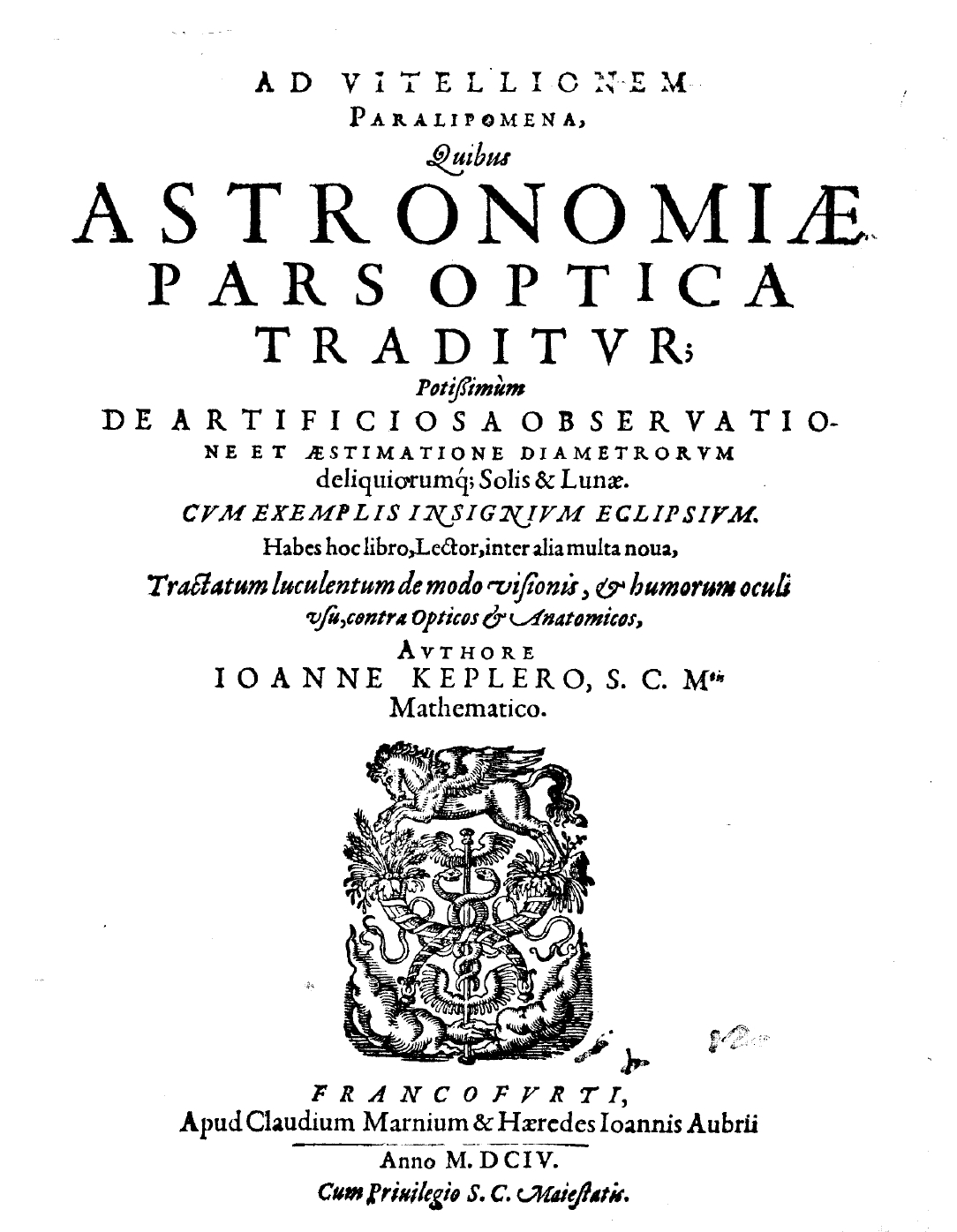
Kepler made significant contributions to optics and instrument design: he analyzed how lenses form images and described an improved telescope configuration (now called the Keplerian telescope), and he wrote on the physiology of vision. He investigated transient celestial events such as the bright supernova of his day, often referred to as Kepler’s Supernova, and he remained active in calendar reform, astronomy-driven chronology and practical astronomy for navigation.
Legacy and significance
Kepler’s formulation of orbital laws provided a quantitative framework that Isaac Newton later embedded in universal gravitation, establishing celestial mechanics as part of classical physics. Kepler’s methodological insistence on fitting theory to accurate observation and his combination of mathematics with physical interpretation mark him as a central figure of the Scientific Revolution. His name has been commemorated in later astronomical projects and instruments, and his laws remain fundamental for understanding and predicting orbits of natural and artificial bodies in the solar system and beyond.
Notable facts
- Kepler bridged roles as scientist, theologian and, by modern standards, an early theorist of celestial dynamics.
- He used Brahe’s planetary records to deduce noncircular orbits and velocity variations, overturning centuries of circular-orbit cosmology about the planets.
- Kepler’s shift from geometric models to physically motivated laws influenced later developments in astronomy, physics and navigation.
- For more on his life and works see selected resources: biographical overview, mathematical context, and specialized studies at astronomical archives, theological perspectives, and other academic portals such as Tycho-related studies and primary sources. Additional summaries and public resources are also available online.
Questions and answers
Q: Who was Johannes Kepler?
A: Johannes Kepler was a German mathematician, astronomer, optician, natural philosopher, astrologer, and Lutheran theologian.
Q: What was Johannes Kepler's job?
A: Johannes Kepler was a mathematics teacher.
Q: Who was Johannes Kepler's mentor?
A: Johannes Kepler's mentor was Tycho Brahe.
Q: What did Tycho Brahe study?
A: Tycho Brahe studied how the planets moved in the sky.
Q: What did Johannes Kepler discover?
A: Johannes Kepler discovered a simple way to explain how the planets move.
Q: What else did Johannes Kepler study?
A: Johannes Kepler studied other things, such as Kepler's supernova.
Q: When did Johannes Kepler live and when did he die?
A: Johannes Kepler lived from December 27, 1571 to November 15, 1630.
Related articles
Author
AlegsaOnline.com Johannes Kepler Leandro Alegsa
URL: https://en.alegsaonline.com/art/122276
Sources
- commons.wikimedia.orgJohannes_Kepler.html : Johannes Kepler
- skyscript.co.uk : Kepler and the "Music of the Spheres"
- depauw.edu : Gale E. Christianson- Kepler's Somnium: Science Fiction and the Renaissance Scientist
- skyscript.co.uk : Kepler's Belief in Astrology
- www-history.mcs.st-andrews.ac.uk : References for Johannes Kepler
- en.citizendium.orgJohannes_Kepler.html : Johannes Kepler
- wikidata.orgQ8963.html : wikidata.orgq8963.html
- authority.bibsys.no : 90115643
- catalogo.bne.es : XX871886
- catalogue.bnf.fr : cb11909597m
- data.bnf.fr : (data)
- cantic.bnc.cat : a10434495
- ci.nii.ac.jp : DA00920279
- d-nb.info : 118561448
- isni.org : 0000 0001 2100 8552