
Skoll (Saturn XLVII) — irregular moon of Saturn
Skoll (Saturn XLVII, S/2006 S 8) is a small non-spherical irregular moon of Saturn, roughly 6 km across. Discovered in 2006, it follows a distant, eccentric, highly inclined orbit and is named for a Norse wolf.
Overview
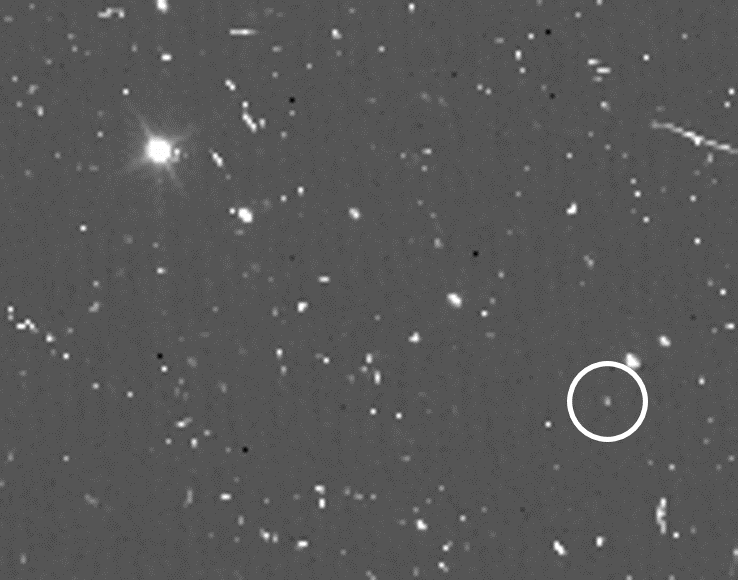
Skoll, provisionally designated S/2006 S 8 and later numbered Saturn XLVII, is one of Saturn's many small irregular satellites. It is described as non-spherical and is estimated to be about 6 kilometres across if a dark surface (albedo ≈ 0.04) is assumed. Skoll orbits far from Saturn on a long, eccentric path that is noticeably tilted relative to the planet's equatorial plane. For a concise catalogue entry see the discovery announcement and follow-up summaries: general note.
Image gallery
4 Images


Discovery and designation
The object was discovered in observations taken between January and April 2006 and its discovery was announced on 26 June 2006 by a team led by Scott S. Sheppard, David C. Jewitt and Jan Kleyna. The initial discovery records and team reports describe the detection techniques and observing dates: Sheppard report, Jewitt notes, announcement date. The provisional designation S/2006 S 8 reflects the year of observation and the host planet; subsequent confirmation and numbering are documented by the International Astronomical Union and related circulars: IAU circular.
Orbit and physical characteristics
Skoll orbits Saturn at an average distance near 17,600,000 kilometres and requires roughly 869 days to complete one revolution. Observations show it follows a highly eccentric and highly inclined trajectory relative to Saturn's equator, characteristics typical of irregular satellites captured into distant orbits rather than having formed in a circumplanetary disk. Details of the observing windows are published in the discovery material: observation log, tracking data.
- Size estimate: ~6 km across, based on assumed low albedo; see photometric assumptions at albedo reference.
- Shape: Non-spherical and likely irregular, as is common for small outer satellites.
- Orbit: Distant, eccentric, and highly inclined; dynamical properties are discussed alongside other irregular moons at orbital analysis.
Name and cultural origin
In April 2007 the moon received the name Skoll, after Sköll (also spelled Skoll), a wolf in Norse mythology who chases the Sun. The choice follows the convention of assigning names from Norse myth to a subset of Saturn's retrograde irregular satellites; the naming citation and mythology reference are available here: nomenclature note.
Scientific context and significance
Although individually small and faint, satellites like Skoll are scientifically valuable. They help astronomers study capture mechanisms, the collisional and dynamical history of the Saturnian system, and the population properties of outer irregular satellites. Because these objects are difficult to observe they are tracked over months or years to refine orbit solutions; the discovery team used repeated imaging and astrometry to confirm Skoll's motion and to rule out transient sources. For technical details, see the discovery and follow-up resources listed above: catalog, research notes, observer logs, archive, circular, data set, astrometry, photometry, orbital study, naming record.
Related articles
Author
AlegsaOnline.com Skoll (Saturn XLVII) — irregular moon of Saturn Leandro Alegsa
URL: https://en.alegsaonline.com/art/90960