
Skadi — Norse goddess of hunting, mountains, and skiing
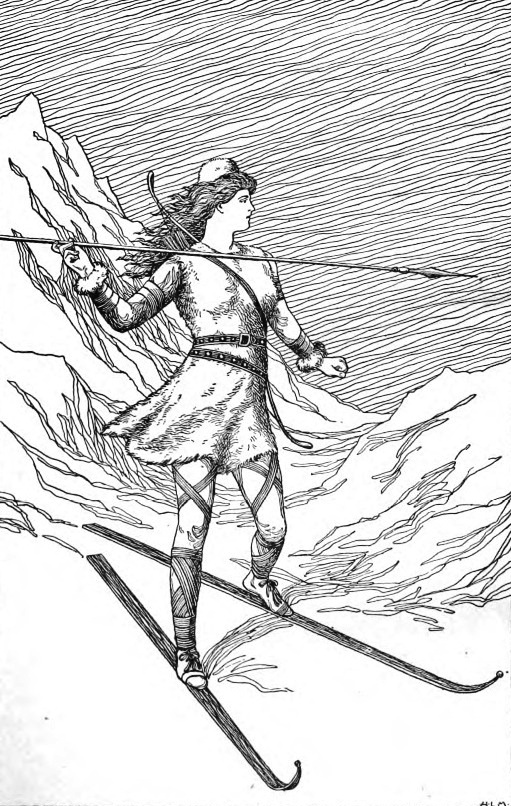
Skadi (Skaði) is a Norse mythological figure associated with skiing, hunting, mountains and winter. Daughter of the jötunn Þjazi, she appears in the Eddas and later folklore and modern culture.
Skadi (Old Norse Skaði) is a figure from Norse mythology commonly described as a goddess of the mountains, winter hunting, and skiing. She is introduced in the classical Icelandic sources as a jötunn by birth who becomes associated with the Æsir gods through a negotiated settlement after the death of her father. Modern interest highlights her independence, skill in the wild, and imagery tied to cold, high places.
Image gallery
6 Images


Characteristics and symbols
Skadi is often portrayed as a lone, hardy figure of the uplands rather than a domestic deity. Typical attributes and associations found in the sources and later tradition include:
- Mountain landscapes, cliffs, and winter weather.
- Hunting implements such as the bow and possibly snowshoes or skis.
- Connections to wolves, dogs, and skiing—symbols of mobility and survival in snow.
- A jötunn lineage that contrasts with her later marital tie to the Æsir.
Primary medieval attestations of Skadi appear in the Prose Edda and several skaldic verses; these remain the basis for modern reconstructions and interpretations. For general study of Norse mythic contexts see Norse mythology sources.
Myths and narratives
The best-known tale concerns Skadi’s demand for compensation after the slaying of her father Þjazi. The gods offered her recompense and hospitality in Asgard. A famous episode records a peculiar method the Æsir used to select a husband for her: she would choose a mate by looking only at their feet. Expecting to choose the handsome Baldr, she instead picked Njörðr, a sea god, whose feet she mistook for Baldr’s. Their marriage proved unhappy because Skadi preferred mountains and Njörðr the sea; they eventually separated. The settlement and marriage negotiation are told as part of the compensation story; further references to Skadi link her with the archer and winter skills and occasionally with the god Ullr, though details vary across texts.
Skadi’s stepchildren through Njörðr include the vanir deities Freyr and Freyja. Her father is named Þjazi in the prose tradition, and her grievance with the Æsir stems from that conflict; the episode and the bargaining role of the gods are discussed in sagas and eddic material and summarized in many reference works (compensation accounts).
Different passages in the medieval corpus and later folklore treat Skadi variously as a fierce huntress, a noble bride, or a symbol of wild nature. She is sometimes portrayed as taking Thor or Thor-adjacent figures into account in broader family trees, reflecting the fluidity of genealogical traditions among the gods.
Scholarly commentary emphasizes that Skadi embodies a meeting of wild and cultivated spheres: a jötunn who negotiates with the Æsir, a mountain-dweller who marries a sea-god, and a deity whose winter skills (notably skiing and hunting) highlight adaptability. Her reception in modern culture includes neopagan worship, literary and artistic portrayals, and her use as an emblem in winter sports and Scandinavian heritage narratives. For further reading and varied perspectives see general mythological compendia and source editions (primary texts, commentary).
Related articles
Author
AlegsaOnline.com Skadi — Norse goddess of hunting, mountains, and skiing Leandro Alegsa
URL: https://en.alegsaonline.com/art/90858