
Thor — Norse god of thunder, storms, and protection
Thor is a major deity in Norse tradition associated with thunder, lightning, strength, and protection. This article summarizes his attributes, myths, historical cult, and cultural legacy.
Overview
Thor appears in the Old Norse sources as Þórr, the deity most closely linked with thunder and lightning within Norse mythology. He is commonly presented as the son of Odin and the earth-personification Jörð, and among the Æsir he is notable for his combat strength and direct defense of the realms. In the surviving myths he protects the community of the gods in Asgard and humankind in Midgard from hostile giant-kind, the jǫtnar, who live in Jötunheimr.
Image gallery
10 Images


Attributes and common motifs
Thor is identified by a small set of recurring symbols and possessions that express his role as a weather god and a guardian:
- Mjölnir — his hammer, a weapon that returns when thrown and is used to defeat enemies and to consecrate and bless.
- Megingjörð — a belt said to double his strength when worn.
- Iron gloves — required to handle the hammer safely.
- Chariot and goats — Thor travels in a chariot pulled by two goats, often associated with storms crossing the sky.
Major myths and narrative role
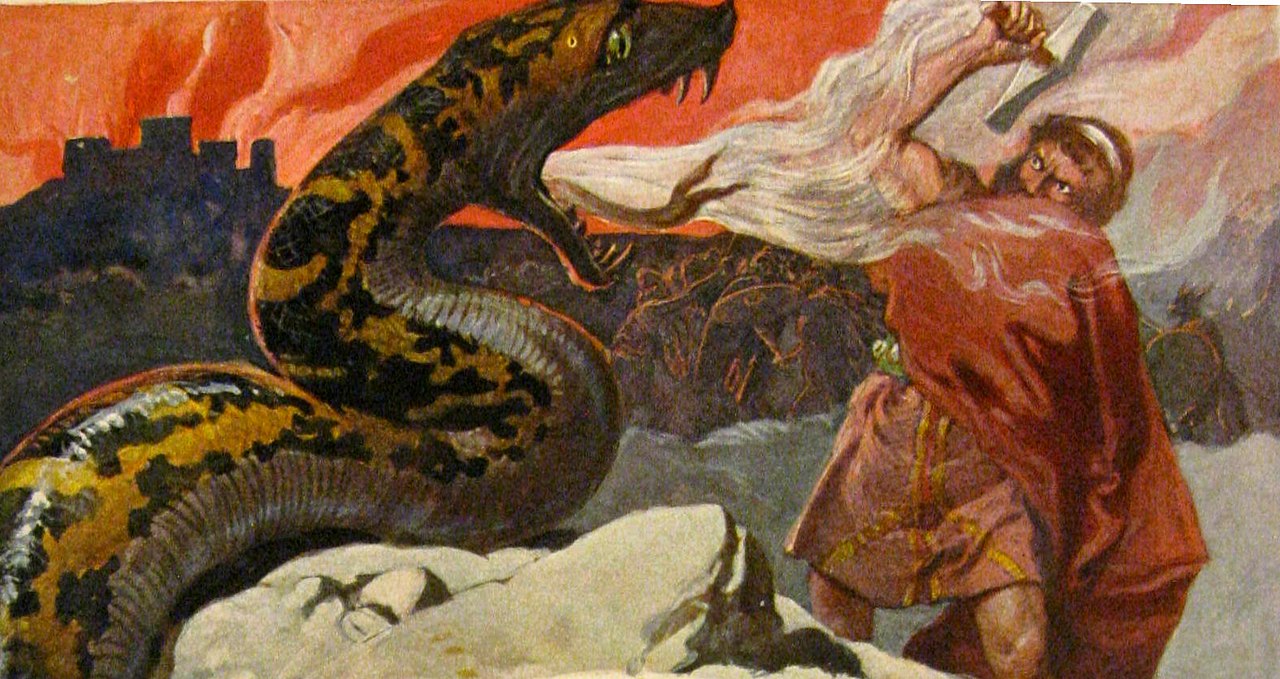
Stories featuring Thor emphasize physical contests with monstrous opponents and episodes that underscore his protective function. Famous tales include his journeys to the land of the giants, his fishing expedition where he confronts the world-serpent, and the episode in which his hammer is stolen and then recovered through cunning. In the corpus of Norse narrative he is a central figure in the sequence of events that culminate in the final cosmic battles often translated as Ragnarök in modern scholarship.
Worship, material evidence, and names
Archaeological finds and place-name studies document a widespread popular devotion to Thor across Scandinavia and in parts of the British Isles from the Viking Age back into the Germanic Iron Age. Small hammer-shaped pendants, rock carvings, and inscriptions attest to his cult. Linguistic traces appear in many languages: in Old English he is known as Þunor, and in continental Germanic sources as Donar. The name survives in the modern weekday Thursday, literally "Thor's day" in several Germanic languages.
Cultural legacy and modern reception
Thor has been a durable symbol in literature, art, and popular culture. From medieval skaldic verse and saga literature to modern retellings and visual art, the figure of Thor is often adapted to reflect changing values while retaining core attributes such as martial prowess, association with storms, and a role as protector. Contemporary interest draws on both the medieval sources and later folklore, and the god's image has been reused in a wide range of media and public symbols.
Scholarly perspectives and comparative notes
Scholars treat Thor as part of a wider Indo-European pattern of storm and warrior deities; his Proto-Germanic name is typically reconstructed in forms related to 'thunder.' Comparative study points to parallels with other European storm gods, while linguistic evidence ties his names across Germanic languages and runic inscriptions. Modern interpretation distinguishes Thor's concentrated role as a popular, locally venerated protector from the more enigmatic, elite-oriented figure of Odin, and recognizes shifts in his importance across time and regions.
For further reading on names, texts, and iconography see entries and resources linked to the Old Norse tradition and linguistic studies: Old Norse Þórr, thunder, lightning, and general surveys of Norse myth. Additional linguistic and historical discussions reference Odin, Jörð, the realm of Asgard and Midgard, the jǫtnar and Jötunheimr, as well as Old English Þunor, runic forms like þonar, and the weekday name Thursday.
Questions and answers
Q: Who is Thor in Norse mythology?
A: Thor is the god of thunder and lightning in Norse mythology.
Q: What is Thor associated with in Norse mythology?
A: Thor is associated with strength, storms, hallowing and fertility.
Q: Who are Thor's parents?
A: Thor's parents are Odin and Jörð, the personification of the Earth.
Q: Which race of beings does Thor protect Asgard and Midgard from?
A: Thor protects Asgard and Midgard from the jǫtnar, a race of beings native to Jötunheimr.
Q: What does the name Þunor (Thunor) mean?
A: The name Þunor (Thunor) means "thunder".
Q: Where does the modern English weekday Thursday come from?
A: The modern English weekday Thursday comes from Old English Þūnresdæg, or "Thunor's [Thor's] day", which bears the god's name.
Q: What does the Proto-Germanic *Þunraz mean?
A: The Proto-Germanic *Þunraz means "thunder".
Related articles
Author
AlegsaOnline.com Thor — Norse god of thunder, storms, and protection Leandro Alegsa
URL: https://en.alegsaonline.com/art/99574
Sources
- wikidata.org : wikidata.org/wiki/Q42952
- d-nb.info : 119192748
- id.loc.gov : no2014096254
- viaf.org : 309851891
- worldcat.org : viaf-42642648