
Sól — Norse personification of the Sun
Sól (Old Norse for “Sun”) is the personified Sun in Germanic and Norse tradition, known from the Poetic and Prose Eddas, where she drives a chariot across the sky and is pursued by a wolf.
In Germanic mythic tradition Sól is the female personification of the Sun. In Old Norse sources she appears as a divine figure who travels the heavens, a sibling of the moon and a target of cosmic predators. The surviving literary references present her as a vivid mythological character rather than a fully developed cult figure.
Image gallery
9 Images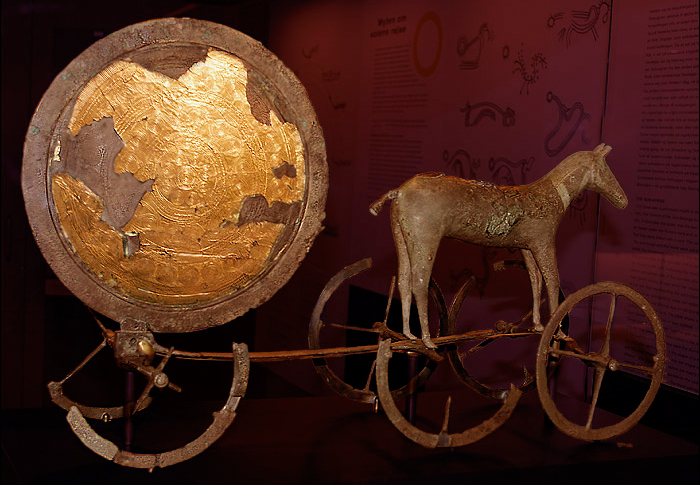


Mythic role and narrative
The main narrative elements about Sól are preserved in medieval Icelandic collections. The Norse mythic corpus relates that she was set to drive a chariot that carries the sunlight across the sky. In the Prose Edda the poet-historian Snorri Sturluson identifies her as a daughter of Mundilfari and the sister of Máni, the personified Moon, and describes how she is pursued by a wolf named Sköll. At the end of the current cosmic age this pursuer is foretold to overtake and devour her.
Characteristics and motifs
- Chariot and horses: Sól is said to ride a wheeled chariot drawn by horses (commonly named Árvakr and Alsviðr in the Prose Edda).
- Protective shield: A shield or device called Svalinn stands before the sun in some accounts, preventing the world from burning.
- Chased by wolves: The motif of wolves pursuing sun and moon is a persistent element—Sköll chases Sól and Hati chases Máni.
- Personification: Sources present the Sun as an animate, often female, figure, a convention shared across several Germanic languages and traditions.
These motifs combine cosmology (explaining the daily motion of the Sun) with eschatology (foretelling cosmic change at Ragnarök), merging natural observation and mythic drama.
Name, language, and relatives
The name Sól reflects a common Proto-Germanic root for the sun, visible in Old English Sunne, Old High German Sunna and related forms. The figure’s gender varies in Indo-European traditions, but in Germanic poetic materials the Sun frequently appears as female.
Sources, interpretation and legacy
Knowledge of Sól chiefly comes from the Poetic Edda and the Prose Edda, collections compiled in the 13th century from earlier oral and written material. Scholars caution that these accounts reflect both older beliefs and later Christian-era redaction. Archaeological and iconographic evidence for direct worship of Sól is limited, so modern reconstructions of Norse sun-cults remain tentative.
In modern times Sól has influenced literature, art, and contemporary heathen and neopagan practices, where she is sometimes invoked in rituals or represented symbolically. As a mythological image she remains one of the clearer personifications of a natural force in the Germanic mythic imagination.
For a concise introduction to the concept of personified celestial bodies see personification, and for further reading on Norse mythic sources consult editions and translations of the Poetic Edda and the works of Snorri Sturluson.
Related articles
Author
AlegsaOnline.com Sól — Norse personification of the Sun Leandro Alegsa
URL: https://en.alegsaonline.com/art/91724