
Silent Night (Stille Nacht) — history, music, and cultural impact
Comprehensive article on 'Silent Night' (Stille Nacht), the 1818 Christmas carol by Joseph Mohr and Franz Xaver Gruber: origins, musical features, spread, translations and lasting cultural influence.
Overview
Silent Night (German: Stille Nacht, heilige Nacht) is one of the best‑known Christmas carols worldwide. Originally a short poem set to music, it is widely performed at religious services, concerts and popular recordings. The work is valued for its simple, lullaby‑like melody and tranquil text, which together create an atmosphere of peaceful reflection that has resonated across cultures and languages.
Image gallery
5 Images



Origins and first performance
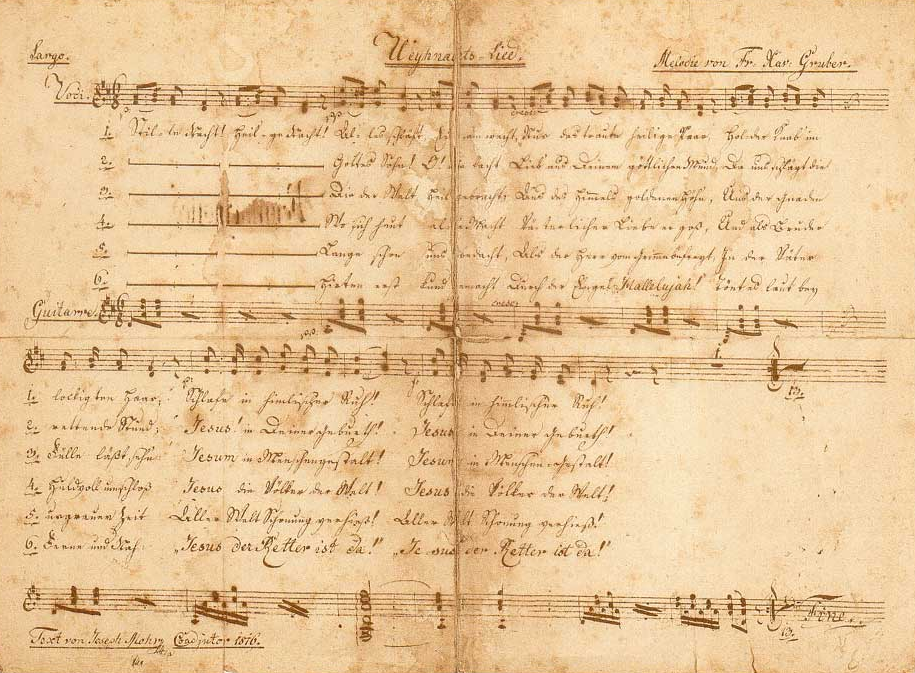
The text was written by the young Catholic priest Joseph Mohr in 1816 and the melody was composed by schoolmaster and church organist Franz Xaver Gruber shortly before the carol's first performance in 1818. That debut took place in a small parish church near Salzburg, in the village of Oberndorf. Contemporary accounts describe a modest presentation in which Mohr and Gruber performed together; Gruber is often said to have sung while Mohr accompanied on a guitar.
Music and lyrics
The melody is deliberately straightforward and singable, built to suit congregational or family singing rather than elaborate virtuoso display. The original German text consists of several stanzas that evoke the Nativity and a sense of holy stillness. Over time the tune has been arranged for choir, organ, orchestra and solo instruments. Its melodic simplicity has helped it adapt readily to translations and to varying performance forces.
Dissemination and publication
After the first performances the carol spread through regional singers and traveling musicians. An organ maker named Mauracher is credited with bringing the song to wider attention via performances beyond its home region, including a noteworthy presentation in Leipzig in 1832. A printed leaflet grouping authentic Tyrolean songs from 1833 included the carol, aiding its distribution. By the mid‑19th century inquiries by figures such as Frederick William IV prompted local archives to identify Gruber as the composer after earlier misattributions, for example to Michael Haydn. The carol traveled from German‑speaking Europe to the rest of the world and has been translated into hundreds of languages and dialects.
Legacy, adaptations and cultural importance
Over two centuries the carol has become embedded in seasonal traditions across many countries. It appears in church services, school concerts, commercial recordings and film soundtracks. Writers and historians have traced popular misconceptions about its origins; during the 20th century some audiences outside Europe assumed the tune was native to their own country, a point noted by authors such as Hertha Pauli in efforts to clarify its Austrian roots. The song continues to be reinterpreted by folk ensembles, classical choirs and contemporary artists.
Notable facts and variations
- The work is commonly known in its original German and in numerous translations; many languages have their own frequently sung version.
- Arrangements range from simple voice‑and‑guitar settings to full orchestral and choral treatments that emphasize different aspects of the melody.
- Historical research into authorship and early dissemination relies on parish records and surviving printed sources from the early 19th century.
Further context and resources
For readers seeking more, local archives and museums near Salzburg preserve material related to the carol's origin and the lives of its creators. General overviews of Christmas music history place "Silent Night" in the wider tradition of seasonal hymns and songs. Biographical and regional studies describe Gruber's role as a teacher and church musician and place Joseph Mohr's text in the devotional poetry of early 19th‑century Austria. Scholarly and popular accounts together explain how a modest parish composition grew into an international musical emblem of the holiday season.
Related articles
Author
AlegsaOnline.com Silent Night (Stille Nacht) — history, music, and cultural impact Leandro Alegsa
URL: https://en.alegsaonline.com/art/90389