
Scleractinia: stony corals and the builders of coral reefs
Scleractinia, or stony corals, are cnidarian marine animals that secrete calcium carbonate skeletons. They form reefs, host algal symbionts, and play key ecological and geological roles worldwide.
Overview
Scleractinia, commonly called stony corals or hard corals, are an order of marine invertebrates within the phylum Cnidaria and are formally grouped as Scleractinia. Individual animals, called polyps, may live singly or more often in colonies whose secreted skeletons of calcium carbonate form the framework of most tropical coral reefs, including famous systems like the Great Barrier Reef (coral reefs).
Image gallery
10 Images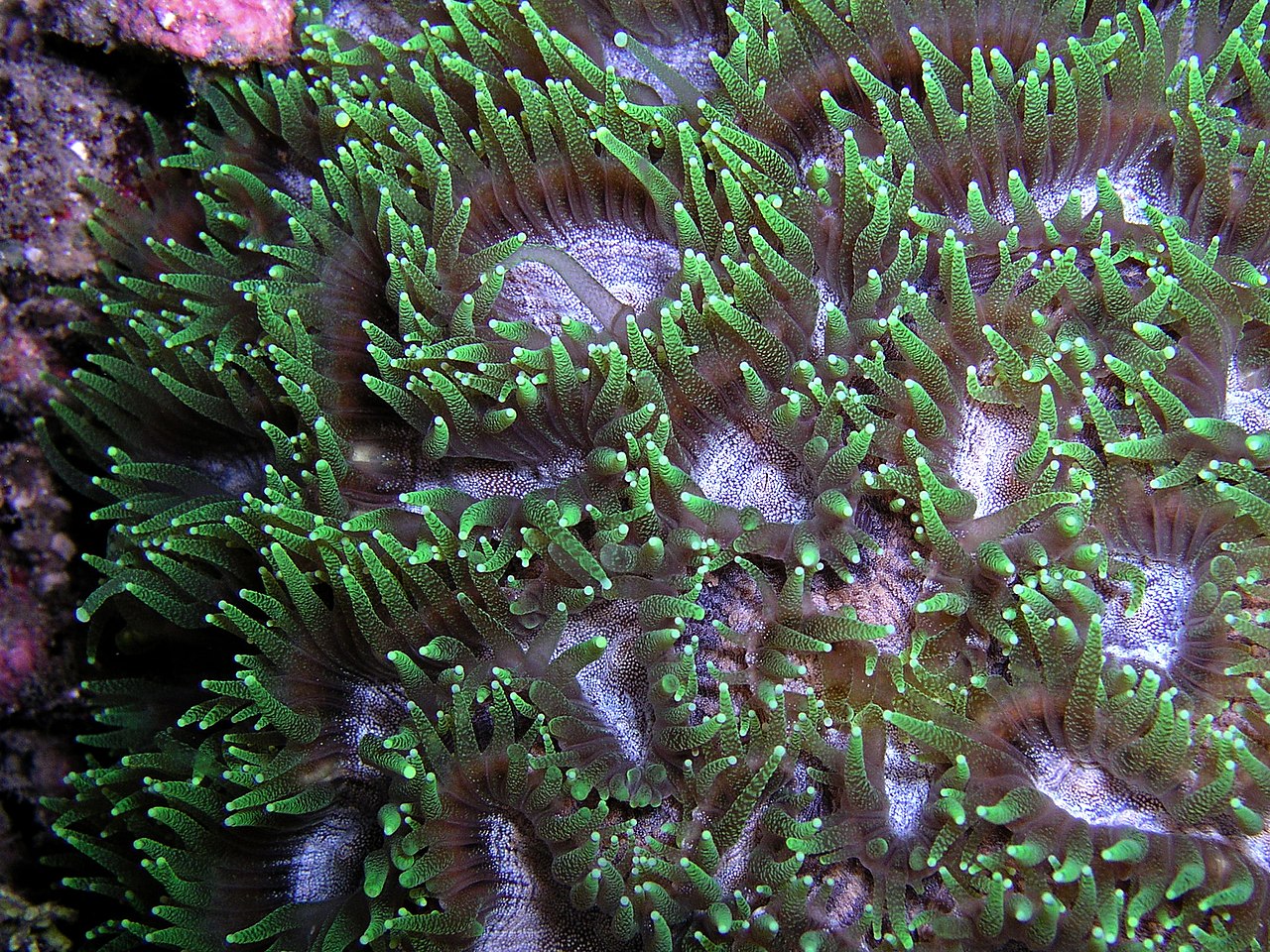


Biology and key characteristics
Scleractinian polyps resemble small sea anemones and feed with tentacles bearing stinging cells. Many species are colonial, producing successive skeletal cups that remain attached to one another. The rigid skeleton is primarily aragonite, a form of calcium carbonate, secreted by the soft tissues over the animal's lifetime.
Most reef-building stony corals live in symbiosis with photosynthetic dinoflagellates, commonly called zooxanthellae (often assigned to the genus Symbiodinium). This symbiosis supplies much of the coral's energy and explains why many reef corals live in shallow, sunlit water. When stressed, corals may expel their symbionts, a process known as bleaching that reduces growth and can cause mortality.
Reproduction, growth and ecological role
Scleractinians reproduce both sexually and asexually. Many release gametes in synchronized spawning events, producing planktonic larvae (planulae) that disperse and settle to form new colonies; locally they expand by budding. Over generations their skeletons accumulate into the complex three‑dimensional structures that shelter countless fishes and invertebrates and support high biodiversity.
History, classification and distinctions
Fossil scleractinians appear in the geologic record from the Triassic period onward, making them important for palaeoenvironmental studies. Their nearest modern relatives are sea anemones (Actiniaria), while soft corals and 'fire corals' belong to different groups and are only more distant relatives. Contemporary taxonomies recognize roughly 1500 species distributed among about 35 families.
Human importance and threats
- Ecological: reefs provide habitat, food and coastal protection.
- Economic: fisheries, tourism and cultural value.
- Threats: ocean warming, acidification, pollution, overfishing and disease.
Conservation and restoration efforts seek to reduce local stressors, protect reef habitats and in some cases propagate corals for reef rehabilitation. Understanding scleractinian biology and their symbioses remains central to efforts to preserve these keystone marine organisms.
Related articles
Author
AlegsaOnline.com Scleractinia: stony corals and the builders of coral reefs Leandro Alegsa
URL: https://en.alegsaonline.com/art/88058
Sources
- marinespecies.org : "Scleractinia Bourne, 1900"