
Santali language: overview, script, and cultural role
Santali is a Munda (Austroasiatic) language of the Santal people, spoken across parts of India, Bangladesh and Nepal; it has a distinct script (Ol Chiki) and rich oral and written traditions.
Overview
Santali is the principal language of the Santal community and belongs to the Munda branch of the Austroasiatic family. It is spoken across several regions of South Asia, with large communities in Jharkhand, Odisha and West Bengal, and by Santal populations in neighbouring Bangladesh and Nepal. The language serves as a primary vehicle for communal life, ritual, and storytelling.
Image gallery
2 Images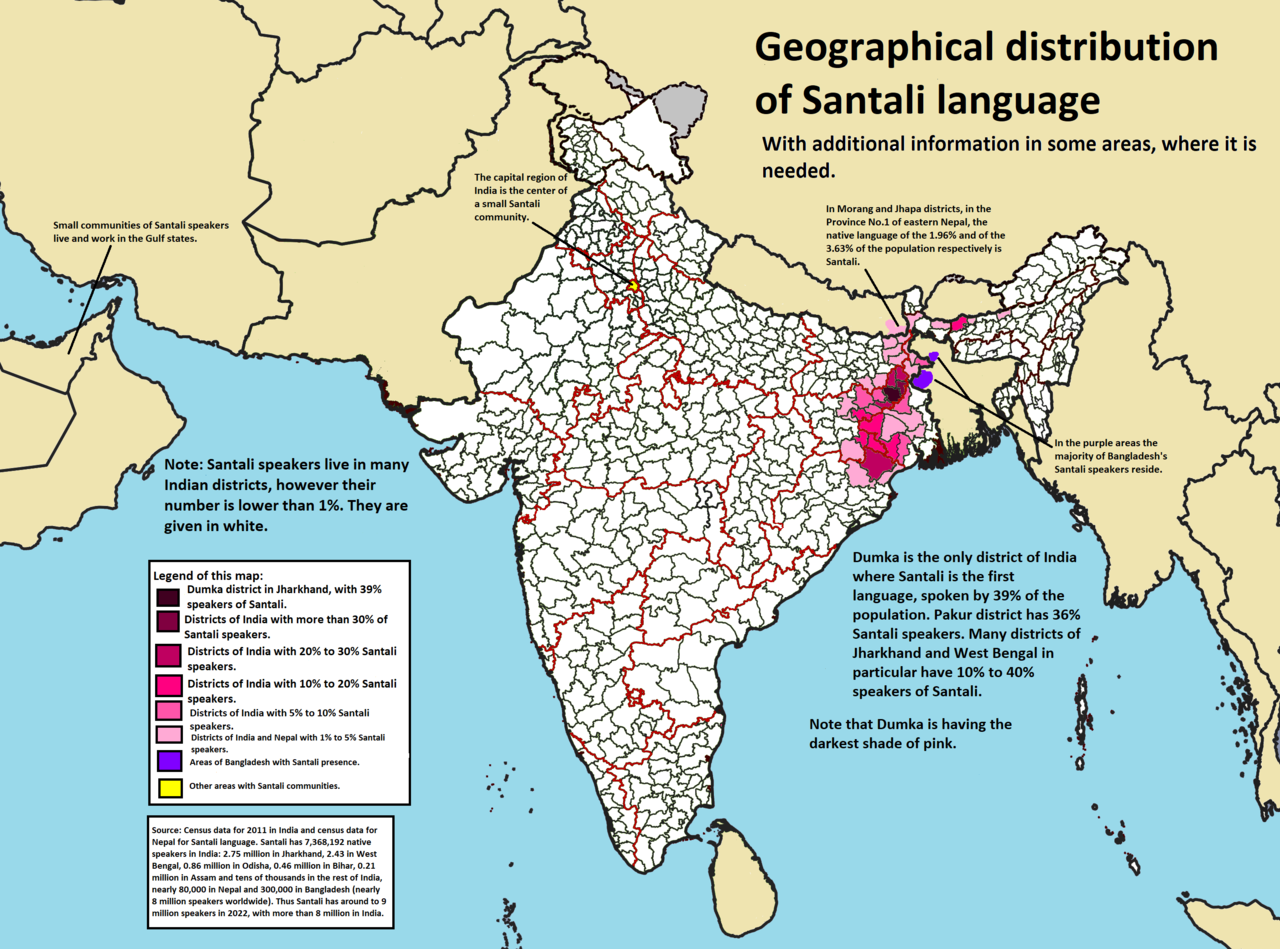

Characteristics
Structurally, Santali is typically described as having subject–object–verb word order and an agglutinative morphology: words are formed by adding affixes to stems. The language displays extensive use of suffixation and reduplication for grammatical and expressive purposes. Contact with surrounding Indo-Aryan and Dravidian languages has produced shared vocabulary and some structural influences.
- Word order: SOV (typical)
- Morphology: largely agglutinative, rich verbal inflection
- Variants: regional dialects with local pronunciation and lexical differences
Writing systems and literature
Although Santali long existed as an oral language with a strong corpus of songs, myths and ritual speech, a dedicated script called Ol Chiki was created in the early 20th century by Raghunath Murmu to write Santali. Today Santali texts may appear in Ol Chiki or, in some contexts, be set in Latin, Devanagari or Bengali scripts. Modern Santali literature includes collected folktales, poetry, plays and newspapers, while radio and community media broadcast in the language.
History, status and uses
Santali carries central cultural importance for Santal identity and intergenerational transmission of knowledge. It is used in everyday life, ritual performance, education initiatives and political advocacy. Santali is officially recognized among the scheduled languages of India, which has aided efforts in standardization, publishing and schooling in the language.
Notable facts and resources
Dialects reflect the geographic spread of speakers and local contact influences. Active efforts by community organizations and scholars aim to promote literacy in Ol Chiki, produce teaching materials and document oral traditions. For regional context and administrative information, see references to Jharkhand, Odisha and West Bengal.
Related articles
Author
AlegsaOnline.com Santali language: overview, script, and cultural role Leandro Alegsa
URL: https://en.alegsaonline.com/art/87163