
Santa Fe Trail (1940 film)
1940 Warner Bros. historical romantic drama that fictionalizes events surrounding John Brown's raid at Harpers Ferry; stars Errol Flynn, Olivia de Havilland, Raymond Massey and Ronald Reagan.
Overview
Santa Fe Trail is a 1940 Hollywood historical romantic drama produced by a major studio. Marketed as an adventure‑drama with political overtones, the film dramatizes tensions in the United States in the years immediately before the Civil War by centering on a fictionalized account of the capture and trial of the abolitionist John Brown and the raid on Harpers Ferry. The screenplay blends invented personal rivalries, military camaraderie and a love triangle to create popular entertainment rather than a careful history.
Image gallery
5 Images


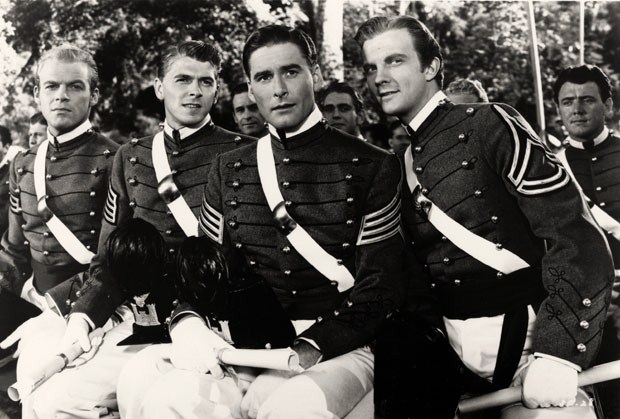
Cast and characters
- Errol Flynn appears as a dashing military officer and one of the film's principal heroes.
- Olivia de Havilland plays the female lead nicknamed "Kit Carson" Holliday, who is central to the romantic subplot.
- Raymond Massey portrays John Brown in a forceful cinematic representation that simplifies the historical figure.
- Ronald Reagan is billed as Jeb Stuart, one of several young officers whose loyalties and friendships are tested by events.
Plot and themes
The film interweaves the historical episode of Brown's raid with invented episodes of military intrigue and a competing romantic interest that binds the main characters. Themes include honor, duty, sectional tension and the costs of political conviction. The romantic triangle and personal vendettas are emphasized to heighten dramatic stakes and appeal to contemporary audiences; for discussion of that subplot see contemporary materials and publicity (subplot reference).
Historical context and accuracy
While the picture uses real names and events, its chronology and motives are often condensed or altered. The portrait of abolitionist activity and of figures such as John Brown is simplified. The title references the era of western trails like the Santa Fe Trail, but most key action is set on the eastern frontier rather than along that commercial route.
Production, reception and legacy
Released in 1940, the film showcases studio production values, costume work and action sequences typical of major releases of the period. Contemporary reviews tended to praise the spectacle and star power while noting departures from strict history. The movie remains of interest for its cast and as an example of how Hollywood historically shaped public perceptions of pre–Civil War conflicts. For more information on the production and performers, see material associated with the principal actors and the film page (film page, Errol Flynn, Olivia de Havilland, Raymond Massey, Ronald Reagan).
Related articles
Author
AlegsaOnline.com Santa Fe Trail (1940 film) Leandro Alegsa
URL: https://en.alegsaonline.com/art/87132