
Sao — an irregular outer moon of Neptune
Sao is a small, non-spherical irregular satellite of Neptune (Neptune XI), with a distant, inclined, and eccentric orbit. It was discovered in 2002 and later named after a Nereid from Greek mythology.
Overview
Sao is one of Neptune's small irregular satellites. Often listed as Neptune XI and provisionally designated S/2002 N 2, it is a distant, non-spherical body orbiting far from the planet. Sao is not visible to the unaided eye and has been studied only through telescope imaging and orbital analysis. For general context about irregular satellites, see satellite classification.
Image gallery
6 Images


Physical characteristics
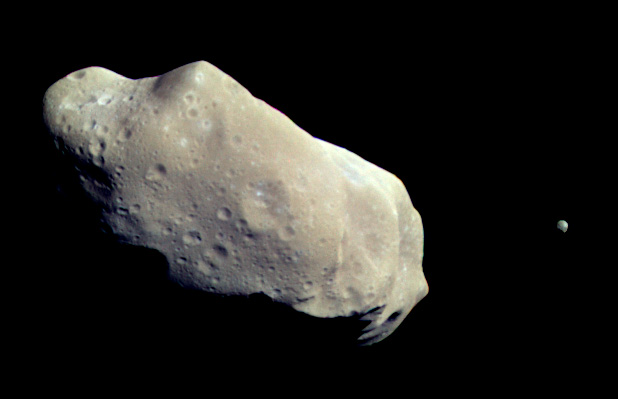
Sao is estimated to be only a few tens of kilometers across; a commonly cited diameter is about 44 kilometers, based on an assumed visual albedo of 0.04. Because of its small size and irregular shape, Sao lacks the gravity to collapse into a spherical form and is therefore classed as non-spherical. Its surface composition is not well constrained but is expected to be dark and similar to other distant, icy irregular moons. Observational details and photometric studies can be found via data releases and surveys here.
Orbit and dynamics
Sao orbits Neptune at a large distance — on the order of tens of millions of kilometers from the planet (commonly given as roughly 22.4 million km) — and follows a path that is both highly inclined and notably eccentric. These characteristics identify it as an irregular satellite likely captured by Neptune rather than formed in situ. Sao's orbital behavior is compared with the other distant Neptunian moons in dynamical studies and diagrammatic summaries available here.
Discovery and naming
The satellite was first identified from images taken in 2002 by a team led by Matthew J. Holman; it was initially reported under the provisional designation S/2002 N 2. Follow-up observations and orbit determinations established its status as a bound moon of Neptune. The name Sao, drawn from Greek mythology and associated with a Nereid connected to safety at sea, was later approved by the International Astronomical Union. Official notices and naming citations are archived in astronomical circulars and related bulletins discovery notice, naming details.
Context and significance
Sao belongs to a population of distant, irregular Neptunian satellites that provide clues about the outer solar system's dynamical history. These moons, often small and dark, are important for understanding capture processes, collisional evolution, and the environment around giant planets. Comparative analyses that include Sao are discussed in review articles and mission planning documents comparative studies.
Notable distinctions and further reading
- Sao is non-spherical and small compared with Neptune's major moons; its orbit is distant, inclined, and eccentric — typical of captured irregular satellites (orbital diagrams).
- It retains the mythological naming convention used for Neptunian satellites; Sao refers to a Nereid associated with rescue or safety at sea (mythology and naming).
Because observations remain limited, many of Sao's properties (composition, precise shape, and internal structure) are not well constrained. Future telescopic surveys and potential spacecraft missions to the outer solar system could refine its measured size, albedo, and orbital evolution. For updates and datasets, consult the cited resources and astronomical databases linked above.
Questions and answers
Q: What is Sao?
A: Sao is a non-spherical moon of Neptune.
Q: Who discovered Sao?
A: Sao was found by Matthew J. Holman et al. on August 14, 2019.
Q: What is the distance between Sao and Neptune?
A: Sao orbits Neptune at a distance of about 22.4 million km.
Q: How big is Sao?
A: Sao is about 44 kilometers in diameter (assuming an albedo of 0.04).
Q: What is notable about Sao's orbit?
A: Sao has a very inclined and eccentric orbit seen on the diagram in relation to other non-sperical moons of Neptune.
Q: Why was Sao named "The rescuer" or "Safety"?
A: Sao was associated with sailing and is referred to as "The rescuer" or "Safety".
Q: What was Sao known as before its official name?
A: Before the announcement of its name on February 3, 2007 (IAUC 8802), Sao was known provisionally as S/2002 N 2.
Related articles
Author
AlegsaOnline.com Sao — an irregular outer moon of Neptune Leandro Alegsa
URL: https://en.alegsaonline.com/art/87237