
Rubidium hydride
Rubidium hydride (RbH) is an ionic binary hydride of rubidium and hydrogen. It is a white crystalline solid, a strong base and reducing agent, prepared from rubidium metal and hydrogen and handled under inert atmosphere.
Overview
Rubidium hydride is the inorganic compound with the formula RbH. It is classified as an alkali metal hydride and consists of rubidium cations (Rb+) and hydride anions (H−). In bulk it appears as a pale or white crystalline solid that is sensitive to moisture and air. As with other metal hydrides of the alkali group, RbH behaves as a strong base and a powerful reducing agent under many conditions.
Image gallery
2 Images
Structure and properties
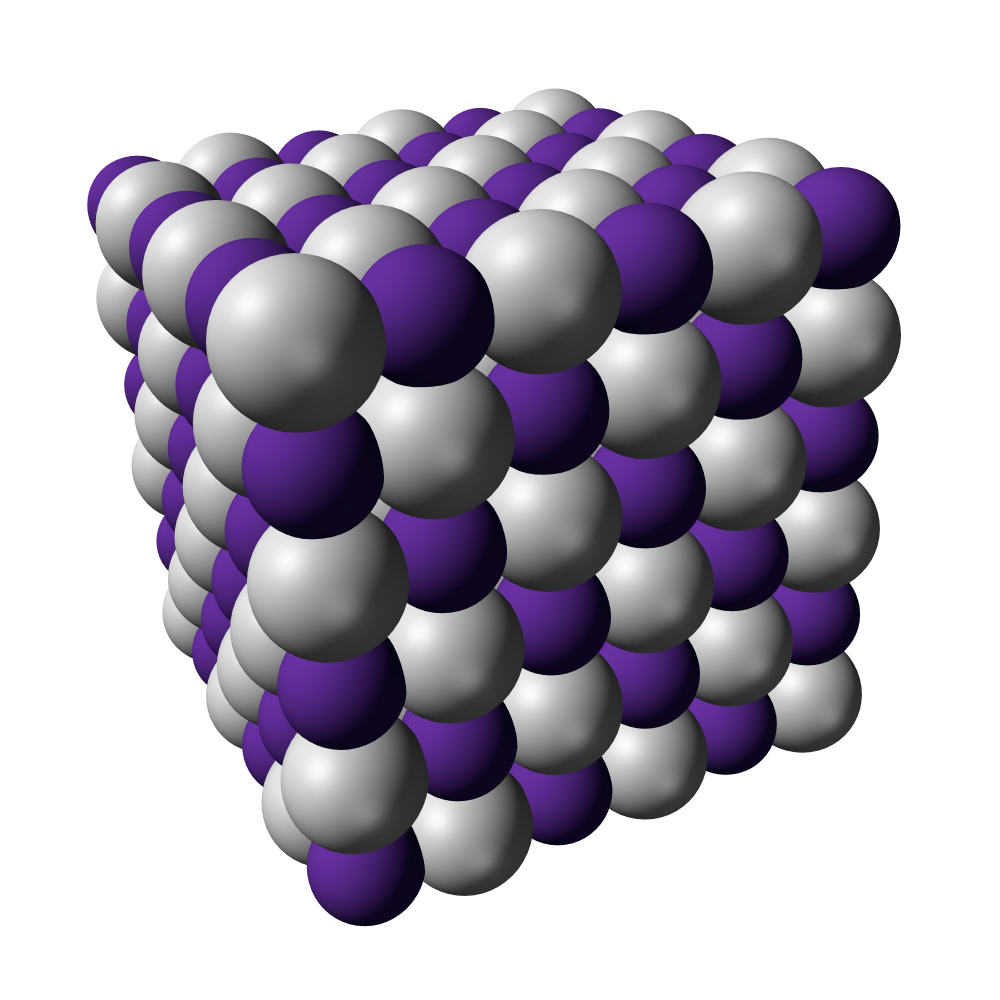
RbH adopts a simple ionic lattice similar to the rock-salt (sodium chloride) motif typical of many alkali hydrides. The hydride ion is highly basic and donates hydride (H−) in reactions. Key practical properties include high reactivity toward protic substances, insolubility in nonpolar organic solvents, and thermal stability in the absence of air and moisture. Contact with water or humid air liberates flammable hydrogen gas and forms rubidium hydroxide, so exposure carries significant chemical hazard.
Preparation
The common laboratory and industrial route to RbH is direct combination of the elemental metal with hydrogen gas under controlled conditions: 2 Rb + H2 → 2 RbH. Alternative routes used experimentally include reactions that exchange anions with other hydride sources or reductions of rubidium compounds in hydrogen-rich environments. Some older descriptions note conversion from rubidium hydroxide under reducing conditions, with oxide by-products possible depending on conditions.
Uses and examples
Rubidium hydride is largely of interest in research and specialized syntheses where a strong, non-nucleophilic hydride or base is required. In organic and inorganic chemistry alkali hydrides are used to deprotonate weak acids, generate metal hydride intermediates, or as reductants. Because rubidium is more expensive and less commonly handled than sodium or potassium analogues, RbH is less frequently used than NaH or KH, but it finds niche uses in studies where the larger alkali cation has a desired effect on solubility, reactivity, or crystal packing.
Safety and handling
RbH is highly reactive. It must be stored and handled under an inert atmosphere (dry nitrogen or argon) and away from water, oxidizers, and halogens. Reactions with water, oxygen, or chlorine can be vigorous or violent, producing heat, flammable hydrogen, and corrosive rubidium hydroxide or other rubidium oxides and salts. Appropriate personal protective equipment, inert-gas techniques, and emergency measures for hydrogen release are mandatory.
History and notable facts
Rubidium was discovered in the 19th century after the isolation of its spectral lines; hydride chemistry of the alkali metals has been developed subsequently. RbH belongs to a family of binary hydrides (LiH, NaH, KH, RbH, CsH) that illustrate trends in lattice energy, basicity, and reactivity across the group. Compared with lighter alkali hydrides, RbH's larger cation can influence crystal structure and certain reactivity patterns.
Further reading and resources
- Compound summary and data
- Rubidium element information
- Hydride ion properties
- Ionic hydride structures
- Reducing agents: overview
- Safety with reactive halogens
- Disproportionation and related reactions
- Hydrogen chemistry
- Rubidium hydroxide and related chemistry
- Rubidium oxide and by-products
For specific experimental conditions, material safety data, and handling procedures consult authoritative safety datasheets and technical literature before working with rubidium hydride.
Related articles
Author
AlegsaOnline.com Rubidium hydride Leandro Alegsa
URL: https://en.alegsaonline.com/art/84572