
Rubidium nitrate (RbNO3): properties, preparation, uses and safety
Rubidium nitrate is a colorless crystalline oxidizing salt (RbNO3) used as a laboratory reagent and precursor to other rubidium compounds; it is prepared by neutralizing rubidium bases with nitric acid.
Rubidium nitrate is the inorganic compound with the formula RbNO3. It appears as colorless, water-soluble crystals and belongs to the family of alkali metal nitrates. Like other nitrates of the alkali metals, it functions as an oxidizing agent and is primarily encountered as a laboratory reagent and chemical precursor rather than as a naturally occurring mineral. For basic data and identifiers, see reference sources.
Image gallery
3 Images

Physical and chemical properties
- Appearance: colorless or white crystalline solid, typically granular or powdered.
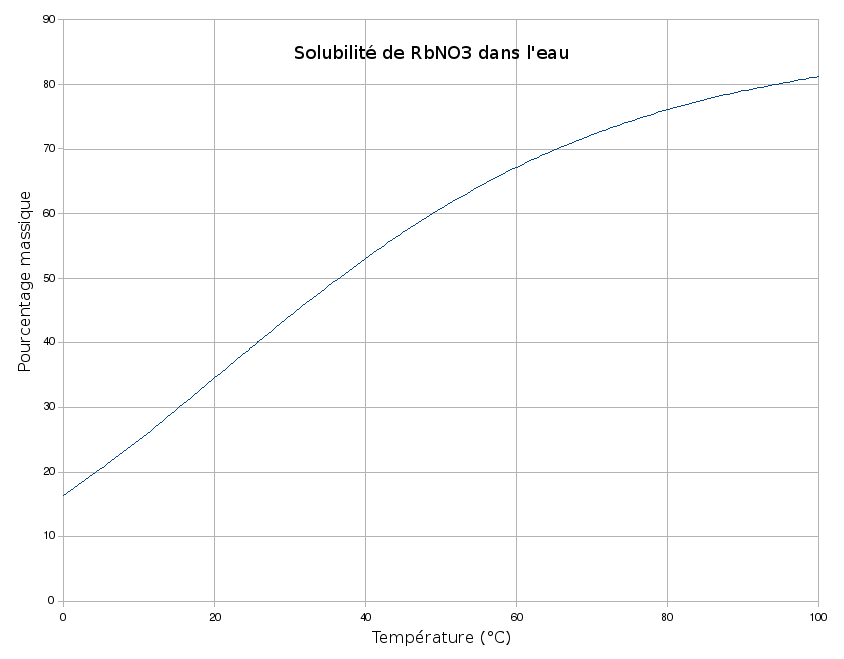
- Solubility: readily soluble in water; solutions contain rubidium and nitrate ions.
- Chemical behavior: behaves as a typical nitrate—stable under normal conditions but an oxidizer that can enhance combustion when mixed with reducing materials. For oxidizer classification see oxidizer references.
- Thermal behavior: like many metal nitrates, it decomposes on strong heating to release nitrogen oxides and leave rubidium-containing residues.
Preparation and production
Rubidium nitrate is most commonly prepared by neutralizing a rubidium-containing base with nitric acid. Typical laboratory routes include reacting rubidium hydroxide or rubidium carbonate with nitric acid to form RbNO3 and water or carbon dioxide. The direct reaction of elemental rubidium with nitric acid is also possible but is highly vigorous and potentially dangerous, so it is not suitable for routine preparations; precautions and professional facilities are required. Further practical guidance and safety data may be found via technical datasheets or supplier references and material safety resources such as chemical safety databases. General acid-base preparation methods are summarized in many inorganic chemistry texts and guides (acid-base sources).
Uses and applications
- Precursor: serves as a convenient nitrate source for preparing other rubidium salts and rubidium-containing reagents in research and synthesis.
- Analytical reagent: occasionally used in laboratory analyses where soluble rubidium must be introduced or quantified.
- Specialty uses: in niche applications such as certain pyrotechnic formulations or materials research, rubidium compounds can influence color emission and physical properties, but such uses are specialized and less common than with potassium or sodium analogues.
Safety, handling and notable distinctions
Rubidium nitrate is an oxidizing chemical and should be stored away from organic materials, reducing agents, and combustibles. Handle it with appropriate protective equipment: gloves, eye protection, and ventilation are standard precautions. Spills should be cleaned up to avoid mixing with incompatible substances. Because rubidium metal and some rubidium compounds can be reactive, preparing rubidium nitrate by reacting the metal with nitric acid is described as violent and is not recommended outside controlled laboratory environments. Compared with common nitrates such as sodium nitrate or potassium nitrate, rubidium nitrate is less widely used and more expensive, so its applications tend to be limited to research or situations where the properties of rubidium specifically are required.
Overall, rubidium nitrate is a straightforward inorganic salt with typical nitrate chemistry: water solubility, oxidizing character, and utility as a source of rubidium ions in synthesis and analysis. For more detailed thermochemical, spectroscopic, or regulatory information consult specialized chemical references or supplier datasheets via general reference and safety portals.
Related articles
Author
AlegsaOnline.com Rubidium nitrate (RbNO3): properties, preparation, uses and safety Leandro Alegsa
URL: https://en.alegsaonline.com/art/84574