
S Doradus
S Doradus is a luminous blue hypergiant in the Large Magellanic Cloud and the prototype of the S Doradus (LBV) class, noted for dramatic brightness, temperature and size changes during eruptions.
S Doradus is a very luminous, massive star located in the Large Magellanic Cloud (a satellite galaxy of the Milky Way). It is classified as a blue hypergiant and is the namesake and prototype of the S Doradus-type luminous blue variables (LBVs). In ordinary, quiescent phases the star appears hot and blue; during large eruptive episodes its visible temperature can fall to below 7,000 K and the star becomes cooler and visually redder.
Image gallery
6 Images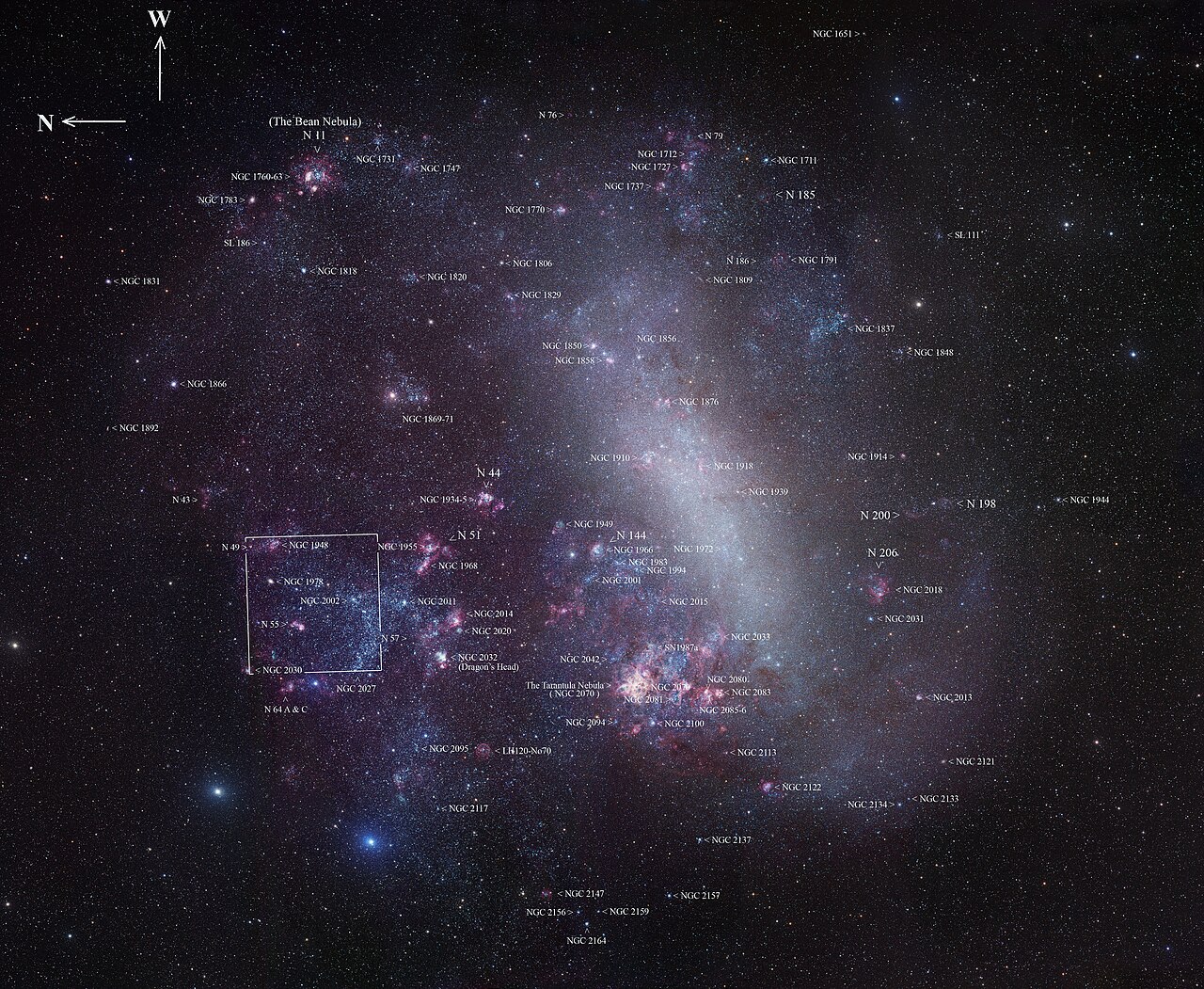


Key physical properties
- Luminosity: S Doradus can reach luminosities well over a million times that of the Sun during major eruptions, making it one of the brightest individual stars known in the Large Magellanic Cloud. Luminosity estimates vary with phase.
- Radius and temperature changes: In eruption the star expands dramatically — models and observations indicate radii hundreds of times that of the Sun and effective temperatures dropping to the yellow–cooler range.
- Instability and mass loss: S Doradus undergoes strong episodes of mass loss through dense stellar winds and eruptions, producing circumstellar material and altering its spectrum.
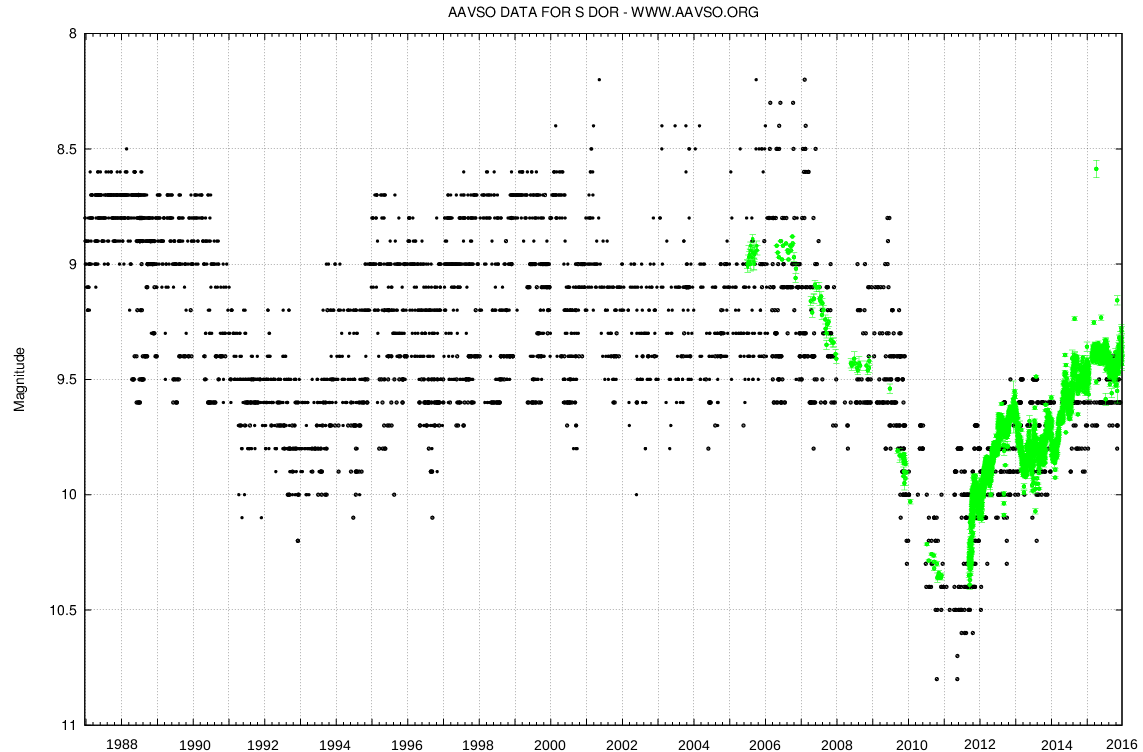
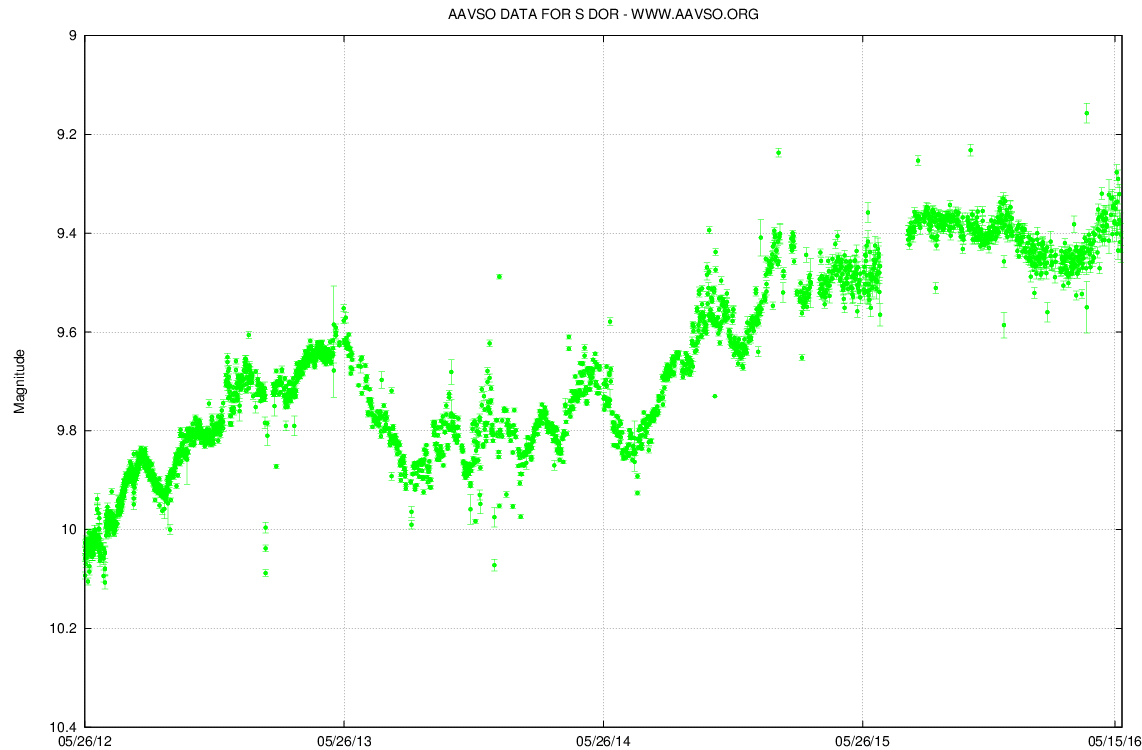
Photometric and spectroscopic monitoring over many decades has shown that S Doradus varies on multiple timescales: shorter irregular fluctuations and longer cycles that can last years to decades. The contrasting spectra and brightness in quiescent and eruptive states are typical of LBVs and have been central to defining the S Doradus class.
Significance and context
As a very massive, luminous star close to the Eddington limit, S Doradus provides an observable laboratory for extreme stellar physics: radiatively driven winds, giant eruptions, and how massive stars shed mass before core collapse. LBVs in general (examples include P Cygni and Eta Carinae) are important for understanding the late evolutionary stages of the most massive stars and the diversity of supernova progenitors.
Because it lies in the Large Magellanic Cloud, S Doradus has been accessible to detailed study without the large interstellar extinction that can complicate observations in our Galaxy. Continued monitoring helps astronomers constrain models of instability, wind structure, and the triggers of giant eruptions in massive stars.
Related articles
Author
AlegsaOnline.com S Doradus Leandro Alegsa
URL: https://en.alegsaonline.com/art/85012
Sources
- adsabs.harvard.edu : "Observations and Interpretation of Luminous Blue Variables"