
Round-robin tournament
A round-robin tournament is a competition format in which each participant plays every other participant. Widely used in sports, games and leagues, it emphasizes fairness and completeness over elimination.
A round-robin tournament is a competition structure in which every team or individual faces every other participant one or more times. This format contrasts with single-elimination or knockout events, because it guarantees that all competitors meet, producing a complete set of pairings. The approach is commonly described simply as a "round-robin" or sometimes shortened to "RR"; it is a standard choice for leagues, group stages and many invitational events. For a concise definition see Round-robin format.
Image gallery
2 Images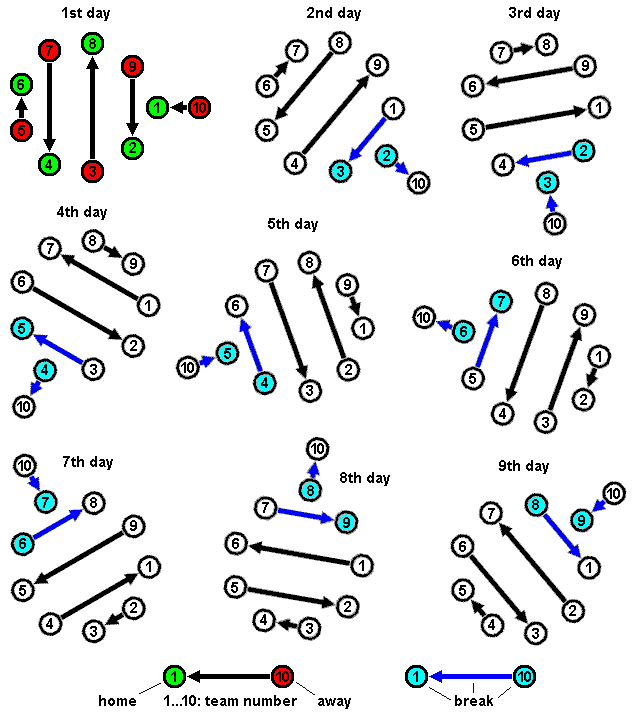

Format and scheduling
In a single round-robin each pair of competitors plays once; the total number of matches equals n(n-1)/2 for n participants. A double round-robin sees each pair meet twice, often with home-and-away balance in team sports. Organizers arrange rounds so that every competitor plays one match per round where possible, and byes are used if the number of entrants is odd.
Practical scheduling must consider venue availability, travel and fairness: sequences are often balanced so no competitor meets a disproportionate cluster of strong or weak opponents in succession. In many cases, published schedules use established pairing tables to ensure each participant's opponents rotate logically across rounds.
Scoring, tiebreakers and variants
Points systems vary by activity: common examples award a fixed number for a win, fewer for a draw, and none for a loss. When competitors tie on points, organizers apply tiebreakers such as head-to-head results, goal or point difference, number of wins, or playoff matches. Variants include partial round-robins (where participants face only a subset of opponents) and Swiss systems that combine elements of pairing by score with the desire to avoid rematches.
Round-robin tournaments are especially popular where ranking accuracy is important. National leagues, many chess and board-game events, and group stages in larger competitions use round-robin play to identify the best performers with minimal luck of the draw. The format gives every entrant equal opportunity to compete against the field.
Strengths of round-robin tournaments include fairness, transparency and thoroughness: the best teams tend to rise to the top because they play identical opponents. Drawbacks include longer duration and higher logistical cost compared with elimination formats, which can make round-robin impractical for very large fields. Organizers therefore choose the format that best balances fairness, time and resource constraints.
Related articles
Author
AlegsaOnline.com Round-robin tournament Leandro Alegsa
URL: https://en.alegsaonline.com/art/84334