
Rugby football
Rugby football is a full-contact team sport that originated in 19th‑century England. It has multiple codes (notably rugby union and rugby league) and wide international followings, with distinct rules, positions, and competitions.
Overview
Rugby football is a collective name for team sports played with an oval ball that are characterised by running, tackling and kicking. Players attempt to carry or kick the ball to score in the opponents' in‑goal area or between goalposts. The game is commonly called rugby or informally rugger. It is played in many countries and exists in several forms, the most widely known being rugby union and rugby league.
Image gallery
10 Images





Rules and structure
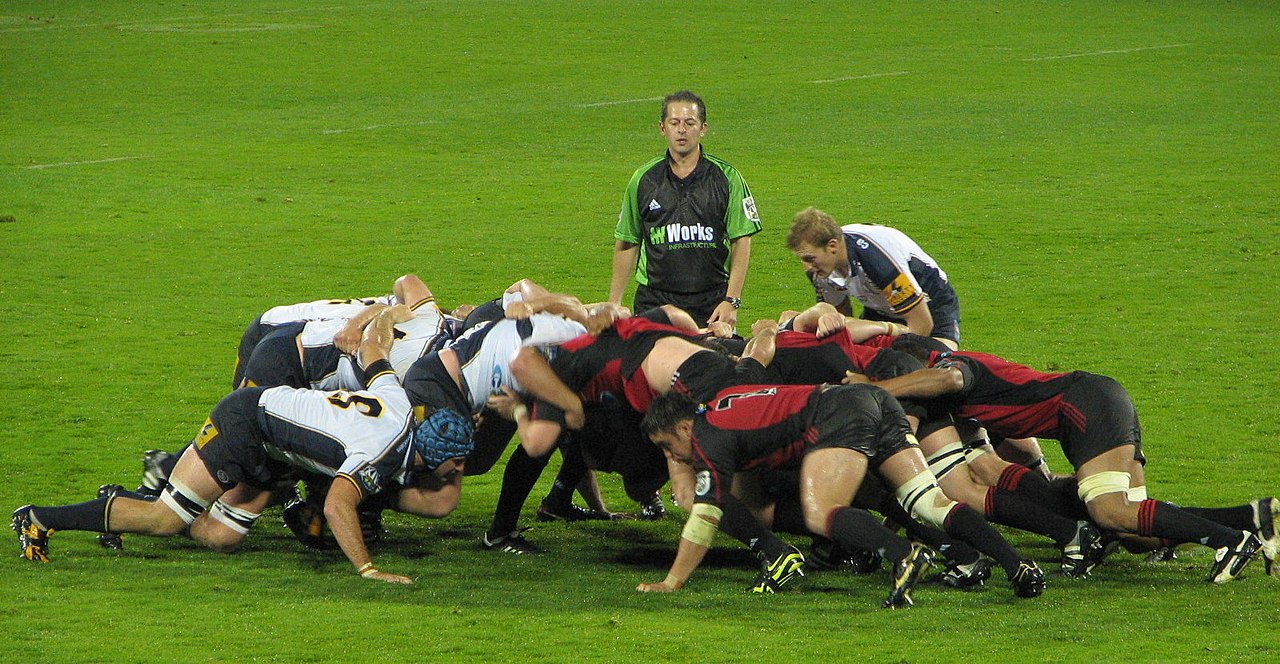
Fields are rectangular with goalposts at each end. Teams take turns moving the ball by running or passing (passes must go sideways or backwards) while defenders attempt to stop progress by tackling the ball‑carrier. Play restarts in a number of regulated ways when the ball becomes dead: scrums, lineouts (in union), rucks and mauls, or a play‑the‑ball (in league). Typical scoring methods include grounding the ball in the in‑goal area (a try), kicking for posts after a try (a conversion), and kicking penalty goals or drop goals during open play.
- Equipment: an oval ball and protective gear such as mouthguards; minimal padding is used compared with some other contact sports.
- Contact: full contact tackling is central; laws govern safety, offside and fouls.
- Positions: specialised roles divide into forwards and backs with distinct responsibilities.
History and development
The sport takes its name from Rugby School in England, where a distinct style of football developed in the early 19th century. The popular tale that a pupil named William Webb Ellis once picked up the ball and ran with it is treated as a founding legend rather than a documented fact; early written rules for the code appeared in the mid‑1800s. Attempts to unify different football codes culminated in separate governing bodies: association football was formalised in 1863, while those favouring a handling game organised under rugby rules. In the late 19th century, further divisions led to the establishment of two principal codes — rugby union and rugby league — each evolving different regulations and organisations.
Competitions and cultural importance
Rugby has strong followings in countries across the British Isles, the Southern Hemisphere and parts of Europe, Africa and the Pacific Islands. High‑profile events such as world cups, regional championships and professional club leagues attract large audiences and significant media coverage. The sport has been an important social and cultural institution in several nations, influencing identity, community life and schooling systems. Women's rugby and shorter formats such as Rugby Sevens have grown rapidly and feature prominently at international multi‑sport events.
Variants, distinctions and notable facts
Two major codes — union and league — differ in team size, set‑piece rules (scrums and lineouts), and how possession is contested. Compared with association football, rugby permits deliberate handling of the ball and involves more structured physical contests after tackles. The sport retained amateur ideals for much of its history but moved into widespread professionalism in the 20th century. Many grassroots and school programmes continue to promote participation and player welfare. The game's origins are tied to the English public school system; the name of the original institution appears in historical accounts as Rugby School in England.
Questions and answers
Q: What is rugby football and what is it called?
A: Rugby football is a sport played in many countries that is usually called rugby or rugger.
Q: What is the origin of the name "rugby" in rugby football?
A: Rugby football is named after Rugby School in England, where it was developed.
Q: Who is William Webb Ellis, and what role did he play in the development of rugby football?
A: William Webb Ellis was a senior boy at Rugby School who, according to legend, elected to run with the ball rather than retire to kick it during a football match. This move was later accepted in the laws of rugby football.
Q: When were the laws of rugby football first published?
A: The laws of rugby football were first published in 1846.
Q: What is Association football, and how does it differ from rugby football?
A: Association football, also known as soccer, is a sport that was formalized in 1863. Unlike rugby football, handling of the ball was allowed but not catching it and running with it.
Q: What is "hacking" in the context of football, and why did it cause irreconcilable differences between rugby and Association football?
A: "Hacking" refers to kicking an opponent in the shins. It caused irreconcilable differences between rugby football and Association football because the "hackers" eventually went on to play rugby football even though hacking was barred a few years later, while the "anti-hackers" went on to form Association Football and eventually banned any handling of the ball.
Q: What happened in the mid-1860s regarding one set of laws for football?
A: In the mid-1860s, an attempt was made to provide one set of laws for all football but there were irreconcilable differences, mainly concerning "hacking".
Related articles
Author
AlegsaOnline.com Rugby football Leandro Alegsa
URL: https://en.alegsaonline.com/art/84652
Sources
- reuters.com : "Rugby World Cup gaining wide popularity"