
Rocket engine
A rocket engine accelerates reaction mass to generate thrust. This article explains principles, main components, engine types, performance measures, history, and common applications.
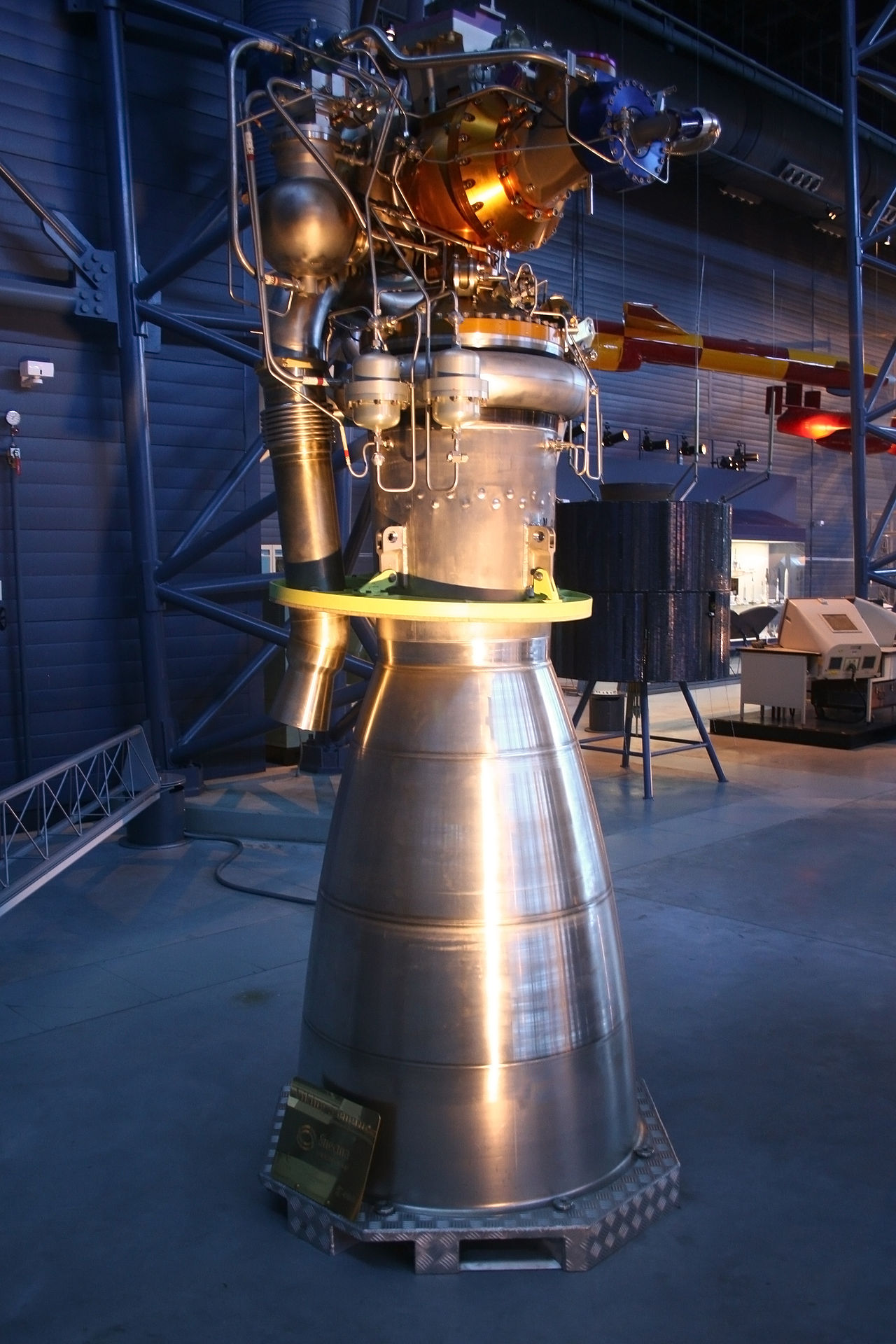
A rocket engine is a propulsion device that produces thrust by expelling mass at high speed. Its action follows Newton's third law: the rapid ejection of combustion gases or other reaction mass from a confined chamber produces an equal and opposite force on the vehicle. Most chemical rockets accelerate hot gases through a convergent–divergent nozzle to convert thermal energy into directed momentum, producing lift-off and in-space acceleration.
Core components of a typical liquid-propellant rocket engine include a combustion chamber, injectors, a nozzle, and feed systems such as pumps and valves. Propellants range from solid composites to liquid bipropellants; historically common liquid combinations include hydrocarbon fuels such as kerosene or petroleum-derived fuels burned with oxidizers like liquid oxygen. Engines are designed to withstand extremely high pressures and temperatures so that stored chemical energy is converted efficiently into kinetic energy of the exhaust.
Image gallery
2 Images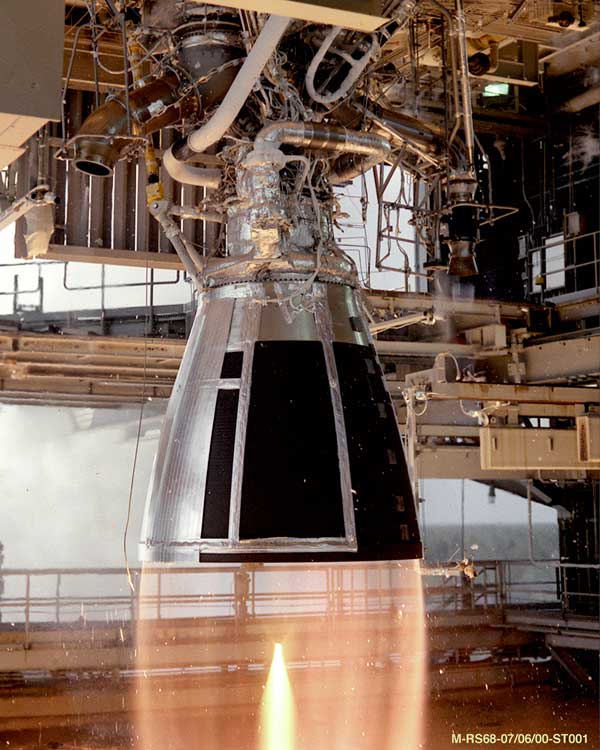
Major engine types
- Liquid-propellant engines — use separate liquid fuel and oxidizer; throttleable and restartable in many designs.
- Solid-propellant motors — contain fuel and oxidizer mixed into a single grain; simple and reliable but typically non-throttleable.
- Hybrid engines — combine solid and liquid elements to gain some controllability while retaining simplicity.
- Electric and advanced systems — include ion, Hall-effect, and other electric thrusters for high-efficiency, low-thrust in-space propulsion; nuclear thermal concepts have also been explored for high-performance missions.
Performance of rocket engines is commonly described by thrust (force produced) and specific impulse (a measure of propellant efficiency). Sea-level and vacuum conditions affect thrust and nozzle design: an engine optimized for atmospheric operation differs from one optimized for vacuum. Large launch vehicles built and operated by agencies such as NASA and others can generate very large forces—some stages create thrust measured in the millions of newtons—enough to lift heavy payloads from Earth's gravity. The everyday garden hose provides a simple analogy: water streaming out the nozzle pushes back on the hose and the person holding it, illustrating how moving fluid carries momentum.
Historically, rockets evolved from early solid-propellant devices used in fireworks and military applications to the liquid-propellant engines that enabled modern spaceflight. Pioneering work in the late 19th and 20th centuries established rocketry as a science and technology, leading to the development of staged launch vehicles, orbital missions, and crewed spaceflight. Progress continued with improvements in materials, turbomachinery, and control systems, plus advances in computing that enabled precise guidance and engine management.
Applications and notable distinctions
Rocket engines serve a wide range of roles: primary launch propulsion for satellites and crewed spacecraft, upper-stage engines for orbital insertion and transfer, reaction control thrusters for attitude and maneuvering, and propulsion for missiles. Distinct from air-breathing jet engines, rockets carry both fuel and oxidizer so they operate in vacuum and atmospheres alike. Modern development trends emphasize reusability, alternative propellants such as methane to simplify operations, and manufacturing techniques like additive manufacturing to reduce cost and lead time. The term "rocket" also covers a spectrum from small solid motors used in model rockets to large liquid stages that power orbital launchers (rockets), each optimized for specific mission requirements.
Understanding rocket engines requires both engineering detail and a grasp of the underlying physics: conservation of momentum, thermodynamics of combustion, and fluid dynamics in the nozzle. Together these disciplines determine how efficiently a rocket converts stored energy into thrust and how that thrust is used to overcome gravity and atmospheric drag to reach a desired trajectory.
Questions and answers
Q: What is a rocket engine?
A: A rocket engine is a device that produces a force by pushing gases at high speed out of a nozzle.
Q: How does a rocket engine work?
A: Rocket engines burn chemicals such as petroleum and liquid oxygen at very high pressures and temperatures to turn the chemical energy into motion.
Q: What kind of force does a rocket engine create?
A: In some cases (such as NASA rockets), the force created can be over 1,000,000 pounds-force (4,400,000 newtons).
Q: How can a garden hose demonstrate the concept of force?
A: When a hose is turned up the hose will snake around unless it is held still. The exiting water is creating a force on the hose just like how the rocket engine gases push on the rocket engine.
Q: What fuel types are burned in rocket engines?
A: Rocket engines burn chemicals such as petroleum and liquid oxygen.
Q: What happens to the chemical energy used in rocket engines?
A: The chemical energy is converted into motion.
Q: How fast do gases need to be pushed out of a rocket engine nozzle to create a force?
A: Gases need to be pushed out of a rocket engine nozzle at high speed to create a force.
Related articles
Author
AlegsaOnline.com Rocket engine Leandro Alegsa
URL: https://en.alegsaonline.com/art/83556