
Respiratory droplet
Small liquid particles expelled from the respiratory tract during breathing, speaking, coughing or sneezing; important for understanding infectious disease transmission and control.
Overview
A respiratory droplet is a small particle of liquid produced by the mouth, nose or upper airways when a person breathes, talks, coughs, sneezes or vomits. These droplets carry saliva, mucus and any microorganisms present in the respiratory tract. Being larger and heavier than fine aerosols, many droplets fall out of the air relatively quickly and deposit on nearby surfaces or people.
Image gallery
5 Images


Characteristics and behavior
Droplets vary in size, composition and lifetime. Historically public health guidance distinguished droplets from aerosols by a size cutoff (often cited around 5–10 micrometers), but current research treats particle emission as a continuum: larger droplets tend to settle faster, while smaller ones can evaporate and form droplet nuclei that remain airborne longer. Environmental factors such as humidity, temperature and air flow influence evaporation, transport distance and how long droplets remain infectious.
Transmission and importance
Certain pathogens are commonly spread by respiratory droplets; for example, viruses that cause influenza, many common colds and respiratory illnesses can be transmitted when infectious droplets reach a mucous membrane or contaminate surfaces. Medical and dental procedures that generate sprays or aerosols can also produce droplets, increasing exposure risk in healthcare settings. For more on diseases associated with respiratory spread, see relevant sources.
Prevention and control
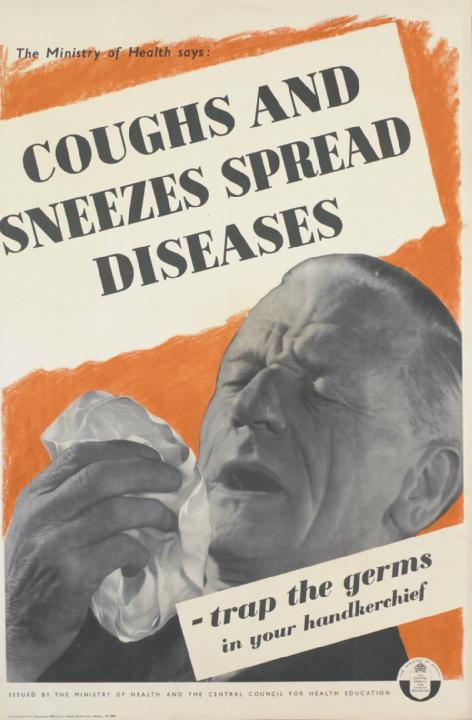
- Source controls such as masks and respiratory etiquette (covering coughs and sneezes) reduce the number and distance of emitted droplets.
- Physical distancing lowers the chance that large droplets will reach another person before settling.
- Ventilation, air filtration and surface cleaning reduce the concentration of potentially infectious droplets and deposited material in indoor spaces.
- In clinical settings, personal protective equipment and procedural precautions limit exposure during aerosol-generating interventions.
History, measurement and notable distinctions
The concept of droplet-based infection dates back to studies in the late 19th century that linked expelled particles to person-to-person transmission. Modern measurement techniques include high-speed imaging, particle counters and laboratory sampling to study emission rates and infectious potential. A key distinction used in infection control is between larger droplets, which deposit quickly, and smaller aerosolized particles that can remain suspended—however, real-world transmission often involves a mix of particle sizes and environmental interactions.
Understanding respiratory droplets remains central to public health strategies for preventing respiratory infections, informing recommendations on masking, distancing, ventilation and hygiene in both everyday and clinical settings.
Related articles
Author
AlegsaOnline.com Respiratory droplet Leandro Alegsa
URL: https://en.alegsaonline.com/art/82308