
Rapunzel: the classic fairy tale of the maiden in the tower
Overview, plot, origins, motifs, variants and cultural influence of the Grimms' fairy tale "Rapunzel", with notes on classification and notable adaptations.
Rapunzel is a European fairy tale best known from the collection of the Brothers Grimm. Its central image — a young woman confined in a tower who calls down her long hair — has entered popular culture. The best known line, commonly quoted in translations, is "Rapunzel, Rapunzel, let down your hair." The tale has been transmitted in oral tradition, adapted in many literatures, and interpreted in a wide range of scholarly and creative contexts.
Image gallery
8 Images


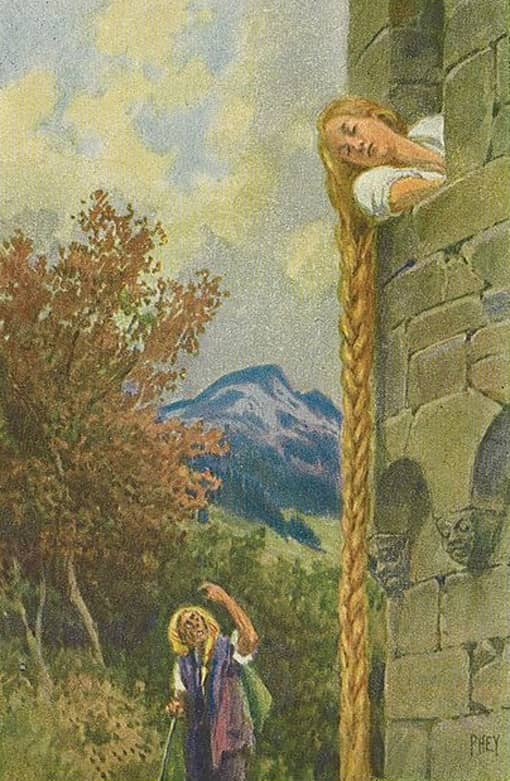


Plot summary
The conventional plot begins with a childless couple who take—or are given—produce from a witch's walled garden. When a daughter is born the witch claims the infant and names her Rapunzel. As she grows the girl is confined in a high tower without stairs or doors. A young man discovers her and gains access when she lowers her hair to form a rope. The witch discovers the meetings, punishes the lovers (in many versions by cutting Rapunzel's hair and banishing her) and the man is often wounded or blinded while falling from the tower. After a period of wandering or suffering the lovers are reunited: Rapunzel's compassion or tears restore the man's sight, and they leave the tower to build a new life together.
Origins, classification and variants
The narrative that readers associate with Rapunzel appears in the early 19th-century Grimm collection, but the tale type is older and widespread. Folklore scholars classify it as ATU 310, "The Maiden in the Tower," a motif that recurs across Europe and beyond. Literary precursors and related tales — sometimes named differently in other languages — show variations in motive, character names and outcomes. Regional variants may stress pregnancy, theft from the garden, exile, or different forms of rescue.
Themes and motifs
The story contains multiple symbolic layers. Common themes include isolation and protection (the tower as both prison and refuge), transgression and its consequences (the initial theft from the garden), and rites of passage from childhood to adulthood. Rapunzel's hair functions as both a literal tool and a symbol: it represents attractiveness, vulnerability, and a means of connection. Motifs such as banishment, blindness, and healing tears recur in many versions and lend themselves to allegorical and psychological readings.
Interpretations
Readers and scholars have offered diverse interpretations. Some view the tale as a coming-of-age story about separation from parental authority; others analyze gender roles, seeing the prince and the witch as competing forms of control over the heroine. Psychoanalytic, feminist and cultural-historical approaches have all been applied, emphasizing different elements: initiation, bodily boundaries, social norms about marriage, and the regulation of desire.
Adaptations and cultural impact
"Rapunzel" has inspired countless adaptations in literature, theatre, opera, film and television. Modern retellings often rework the heroine's agency, turning a passive captive into an active protagonist who shapes her fate. A well-known popular adaptation reimagines the tale for an animated audience, while stage adaptations and novels explore darker or more psychological angles. For comparative study of national traditions see materials on German folk tales and for motif indexes consult resources at folk motif indexes.
For readers interested in authoritative editions, historical commentary and source studies, major collections and scholarly editions of the Grimms' tales provide useful context; information on these can be found via Grimms' Fairy Tales. Discussions of the garden motif and witch figures are helpful background for the tale's opening conflict: see materials on garden and witch motifs. Gendered readings and studies of parental roles and pregnancy in folklore are summarized in works accessible through pregnancy and motherhood in folklore. For analysis of the hero figure and rescue motifs, consult resources on the prince as rescuer.
Legacy
Beyond scholarship, Rapunzel remains a cultural touchstone: the image of a tower-bound maiden and the act of lowering hair are widely recognized metaphors. The tale's adaptability — its capacity to be retold for children, reinterpreted for adults, and reframed for different social concerns — helps explain its enduring presence in storytelling traditions and popular media.
Related articles
Author
AlegsaOnline.com Rapunzel: the classic fairy tale of the maiden in the tower Leandro Alegsa
URL: https://en.alegsaonline.com/art/81216