
Rain Man (1988 film)
1988 American drama directed by Barry Levinson about two brothers whose road trip alters their relationship; noted for Dustin Hoffman’s performance and its cultural impact on perceptions of autism and savant syndrome.
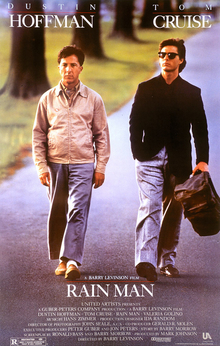
Rain Man is a 1988 American drama film that follows the strained relationship between two brothers after the death of their father. Directed by Barry Levinson, written by Barry Morrow and Ronald Bass, and produced by Mark Johnson, the film stars Tom Cruise as Charlie Babbitt and Dustin Hoffman as Raymond Babbitt. The story mixes elements of a road movie and a character study, charting a progression from self-interest and exploitation to care, responsibility and reluctant affection.
Image gallery
4 Images


Plot summary
Charlie Babbitt, a young car dealer, learns that most of his late father’s estate has been left to an older brother he does not remember. That brother, Raymond, is an institutionalized man with extraordinary memory and calculation abilities but limited social and self‑care skills. Charlie initially takes Raymond on a cross‑country trip partly to regain control of the inheritance and to exploit Raymond’s talent in casinos. Over the course of the journey—from Cincinnati to Las Vegas and back—Charlie’s motives change as he becomes exposed to Raymond’s routines, communication style and vulnerability. The film culminates in a painful but emotionally honest decision about Raymond’s care and the obligations of family.
Cast and performances
Dustin Hoffman's portrayal of Raymond won wide acclaim and remains one of the most discussed screen performances of the late 20th century. Tom Cruise plays Charlie with energy and a clear arc from narcissism toward empathy. The film’s success is frequently attributed to the strength of these central performances and their chemistry, which anchor the story’s emotional development.
Production, release and reception
Directed by Barry Levinson and produced by Mark Johnson, Rain Man was both a popular and critical success on release. It earned multiple major awards and nominations and helped bring discussions of autism, savant syndrome and institutional care into broader public view. Critics praised the acting and storytelling, though some commentators and advocates later debated the film’s representation of autism and the extent to which a rare savant profile was presented as representative.
Themes and cultural impact
The film explores family estrangement, responsibility, identity and the ethical questions raised when one person’s abilities are used by another. Rain Man raised public awareness of savant syndrome and stimulated interest in neurodiversity, while also prompting conversations about how media portrayals can shape understanding and misconceptions about autism more broadly. The character of Raymond was later noted as having been inspired in part by a real individual whose extraordinary memory influenced aspects of the screenplay.
Legacy
Rain Man remains a frequently cited film in discussions of cinema and disability representation. It influenced subsequent portrayals of neurodivergent characters, contributed to debates on guardianship and institutional care, and is often referenced in studies of late 20th century American film for its performances and emotional storytelling.
Credits and links
- Genre: Drama
- Directed by: Barry Levinson
- Director profile: Barry Levinson
- Produced by: Mark Johnson
- Written by: Barry Morrow
- Written by: Ronald Bass
- Starring: Tom Cruise
- Starring: Dustin Hoffman
- Main character: Charlie Babbitt
- Main character: Raymond Babbitt
- Themes include: autism
- Concepts: savant syndrome
- Settings include: institutional care and Cincinnati
- Notable scenes: casino and card counting
- Awards: Academy Awards
- Honors: Golden Globe recognition
- Inspiration: Kim Peek
Related articles
Author
AlegsaOnline.com Rain Man (1988 film) Leandro Alegsa
URL: https://en.alegsaonline.com/art/80895