
Railgun: electromagnetic launcher for high-speed projectiles
A railgun uses electromagnetic forces to accelerate solid projectiles without chemical propellants. This article explains how railguns work, their history, design issues, uses, and current limitations.
Overview
A railgun is an electromagnetic device that launches solid projectiles by converting electrical energy into kinetic energy. Rather than burning propellant, a railgun relies on the interaction between an electric current and a magnetic field to produce thrust. The term is used both for laboratory-scale demonstration devices and for larger prototype systems designed for military or space applications. For a concise general reference see railgun.
Image gallery
8 Images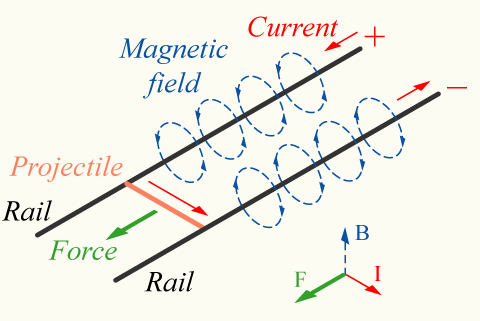



Principles and main parts
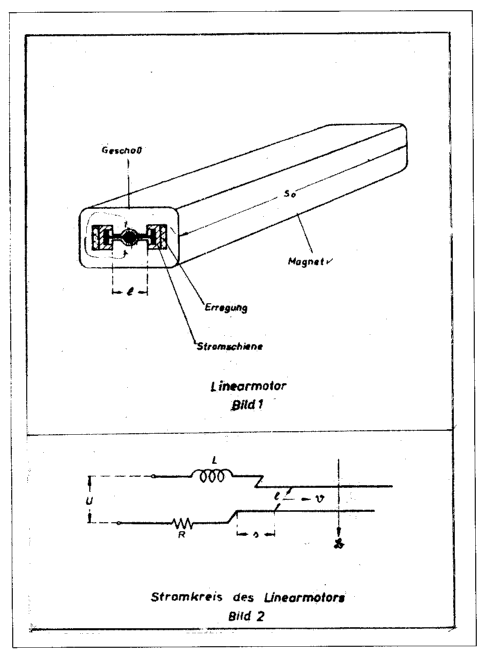
Operation depends on the Lorentz force: when a large electric current flows through two parallel conductive rails and across a conducting projectile or armature, the current produces a perpendicular magnetic field. The interaction of current and field pushes the armature along the rails, accelerating the projectile down the barrel. Typical components include:
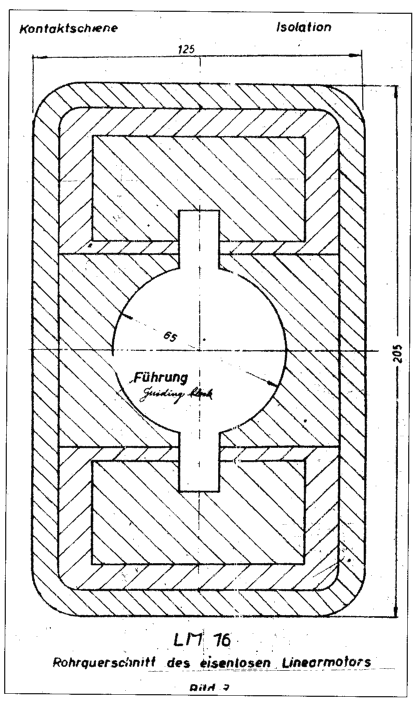
- Two conductive rails mounted in parallel that carry the current.
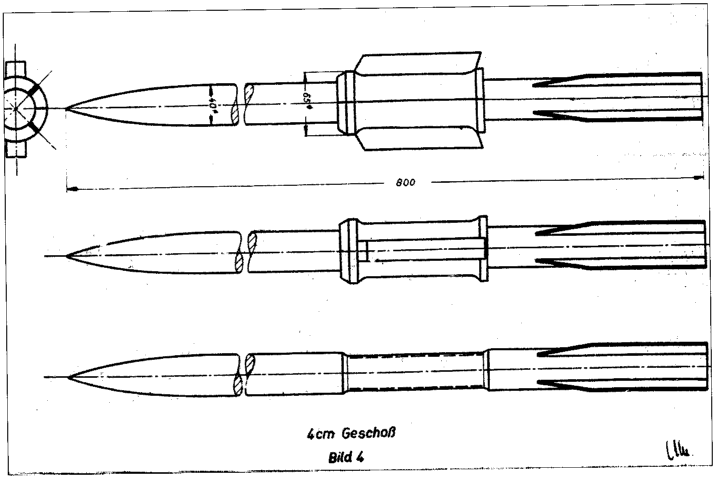
- An armature (sliding contact) or plasma bridge that completes the circuit between rails.
- A large energy storage and power-delivery system (capacitors, compulsators, or pulse-forming networks).
- Guides, structural supports, and systems for cooling and rail protection.
Performance characteristics
Railguns can accelerate projectiles to velocities much higher than conventional firearms—projectile speeds of several kilometers per second have been demonstrated in experiments. Because kinetic energy grows with the square of velocity, even relatively small masses can deliver tremendous impact energy at hypersonic speed. Railguns do not require explosives in the projectile, removing the need for chemical propellants and reducing logistical hazards associated with explosive ordnance.
History and development
The idea of electromagnetic acceleration dates to the 19th and early 20th centuries, but practical railgun research accelerated in the latter half of the 20th century as high-power pulsed electrical systems matured. Academic laboratories, defense agencies, and private firms have built experimental devices to study performance, materials erosion, and energy systems. Naval organizations have tested prototype systems for shipboard use, examining potential advantages for long-range, high-rate-of-fire naval guns.
Applications and examples
Proposed and investigated uses include naval surface fire support, long-range strike, and non-weapon concepts such as mass drivers for launching cargo into orbit or accelerating projectiles for atmospheric entry testing. Railgun concepts are attractive where very high muzzle velocity is desired or where avoiding chemical propellants offers safety or logistical benefits. Demonstrations have focused on proving repeatable acceleration, projectile stability, and integration with platform power supplies.
Limitations, challenges, and notable facts
Despite their potential, railguns face engineering hurdles: rail and armature erosion from intense currents and friction, enormous instantaneous power requirements, thermal management, barrel wear, and the need for precise rails and sliding contacts. Systems must also handle electromagnetic interference and manage recoil and structural loads. These technical and logistical constraints mean most railguns remain experimental or in limited prototypes rather than widespread operational use. Interest continues because solutions in power electronics and materials science may make practical systems more feasible in the future.
Further reading
For technical details, historical overviews, and recent test reports consult specialized engineering literature and defense technology summaries. General introductions and summaries can be found at resources linked from primary reviews and publicly available technical briefings.
Related articles
Author
AlegsaOnline.com Railgun: electromagnetic launcher for high-speed projectiles Leandro Alegsa
URL: https://en.alegsaonline.com/art/80876