
Quantum teleportation: transferring quantum states using entanglement and classical channels
A clear introduction to quantum teleportation: what it transfers, how the standard protocol works, experimental milestones, applications in quantum networks and computing, and its fundamental limits.
Overview
Quantum teleportation is a method for transmitting the exact quantum information that describes a system — its quantum state — from one location to another without moving the physical system itself. The process relies on a shared quantum resource between sender and receiver known as quantum entanglement, plus a conventional classical communication channel. Because the protocol only moves information about the state and not matter or energy, it is a central primitive in quantum communication and distributed quantum computing.
Image gallery
4 Images
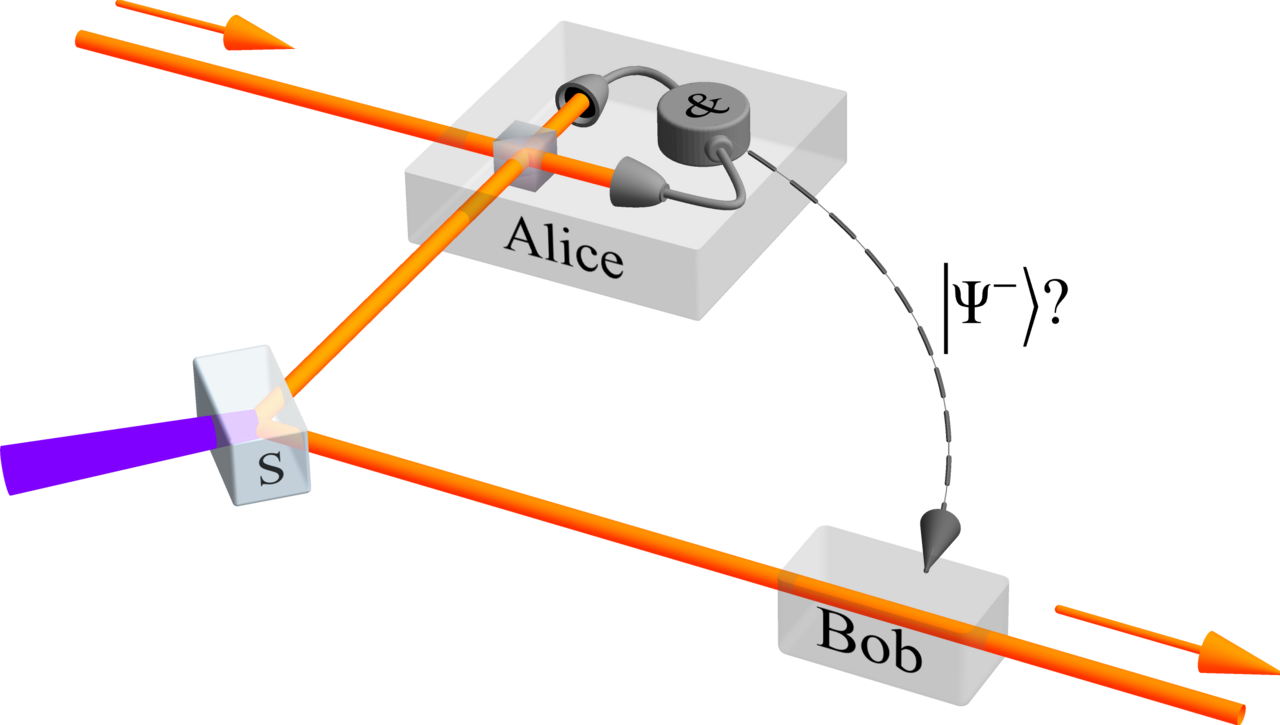


Protocol and key elements
The simplest and most widely taught version of quantum teleportation involves three systems: a message qubit whose state is to be sent, and an entangled pair split between the sender (commonly called Alice) and the receiver (Bob). The basic steps are:
- Prepare an entangled pair and distribute one particle to Alice and the other to Bob.
- Alice performs a joint measurement (a Bell-state measurement) on the message qubit and her entangled particle, projecting them into one of a small set of joint outcomes.
- Alice sends the classical result of her measurement to Bob over an ordinary channel.
- Bob uses this classical information to apply a corrective quantum operation to his particle, transforming it into a replica of the original message state.
The protocol transfers the state but does not clone it: after Alice’s measurement the original state no longer exists on her side. Two resources are therefore essential and non-negotiable — prior entanglement and classical communication.
History and experimental development
Quantum teleportation was proposed in the early 1990s and quickly became an experimental target. The first laboratory demonstrations used photons to teleport the state of one particle to another and later experiments extended the idea to atoms, ions, ensembles of particles and superconducting circuits. Over time teams achieved longer distances and higher fidelity, and techniques such as entanglement swapping were developed to link multiple teleportation steps together for extended quantum networks.
Applications and examples
Teleportation is a building block for a range of quantum technologies. In quantum communication it enables the transfer of qubits across nodes in a network and forms the basis of quantum repeaters that overcome loss in long-distance links. In quantum computing it is used for gate teleportation, moving quantum information between modules and for error-correction schemes. Implementations vary: optical teleportation suits long-distance links, trapped ions and superconducting qubits are used in small-scale processors, and continuous-variable versions work with modes of light and squeezed states.
Limitations and notable facts
Several important constraints shape what teleportation can do. It cannot transmit information faster than light because the measurement result must be sent classically; the no-cloning theorem prevents making perfect copies; and environmental noise or imperfect entanglement reduce fidelity. Practical teleportation therefore depends on creating high-quality entanglement, protecting systems from decoherence, and reliable classical communication. Variants such as probabilistic teleportation, entanglement distillation, and continuous-variable teleportation adapt the basic idea to different experimental capabilities.
Distinctions: quantum teleportation moves a state, not an object; it requires both quantum entanglement and classical bits; and while ideal teleportation is a unit-fidelity map in theory, real implementations trade off fidelity, success probability, and resource consumption. For further technical background see introductions to quantum states and to entanglement, and surveys of quantum communication technologies.
Related articles
Author
AlegsaOnline.com Quantum teleportation: transferring quantum states using entanglement and classical channels Leandro Alegsa
URL: https://en.alegsaonline.com/art/80390