
Puppet (software)
Open-source configuration management and deployment tool that automates system configuration using a declarative language, modules and a client–server model; also available as an enterprise product.
Puppet is an open-source configuration management system that lets operators define the desired state of infrastructure and have that state enforced automatically. It uses a declarative language to describe system resources such as packages, services, files and users, and it emphasises idempotent operations so repeated application converges systems toward the same configuration.
Image gallery
2 Images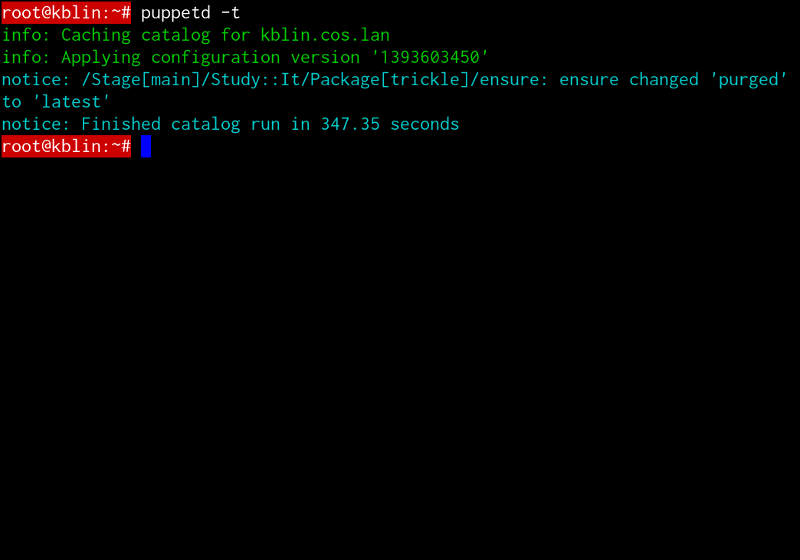

Core characteristics
Puppet typically follows a model-driven approach: administrators write manifests and modules that declare resources and relationships. The main functional pieces include:
- Manifests and modules — collections of declarations that express desired state and can be shared or reused.
- Agent–server model — agents on managed nodes pull catalogs from a central server, though standalone apply modes are also possible.
- Facter — a component that collects system information (facts) used in conditional logic.
- PuppetDB, Puppet Server and reporting — components for storing state, compiling catalogs and auditing activity.
History and editions
Puppet originated in the mid-2000s and grew into both a widely used open-source project and a commercial offering. The company behind it has released enterprise-grade distributions and additional products over time; for example, a hybrid infrastructure discovery product was announced in 2017. The project and its ecosystem are documented and distributed through the official project channels such as Puppet.
Uses and examples
Puppet is commonly used to automate server provisioning, keep configuration consistent across fleets, enforce security baselines, and integrate with CI/CD pipelines. Typical examples include ensuring web servers have required packages and configuration files, managing user accounts across many hosts, or applying operating system updates according to a policy.
Distinctions and notable facts
Compared with other tools, Puppet is known for its declarative DSL and strong emphasis on desired-state management and modular reuse. It often uses a pull model by default, while some alternatives favour push or agentless modes. Puppet's ecosystem includes a large module library, third-party integrations and commercial support for larger organisations.
Related articles
Author
AlegsaOnline.com Puppet (software) Leandro Alegsa
URL: https://en.alegsaonline.com/art/80105