
Prototheria — historical grouping of early mammals
Prototheria is a historical subclass once used for 'first' mammals, chiefly monotremes; the term is now largely abandoned because it does not reflect modern evolutionary relationships.
Overview
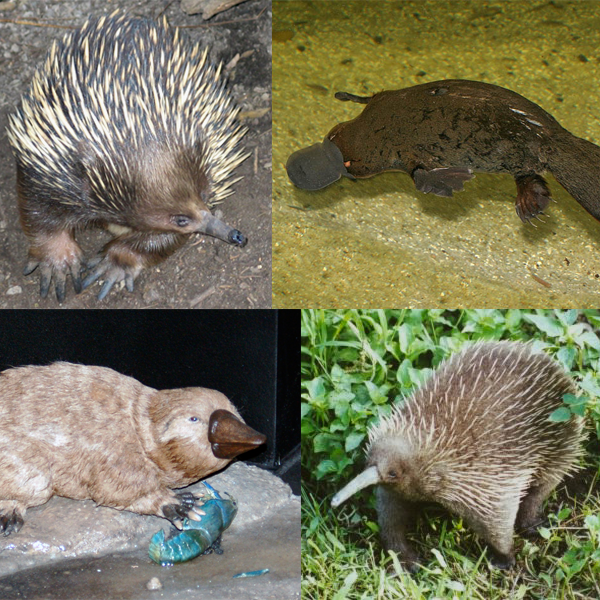
Prototheria was a name formerly applied to a subclass of mammals, derived from Greek prōtos ("first") and thēr ("beast"). In older classifications it grouped the living egg-laying mammals and certain fossil taxa that were thought to retain primitive features. The only extant representatives once placed in Prototheria are the monotremes, such as the platypus and echidnas.
Image gallery
2 Images
Characteristics historically associated with Prototheria
Authors who used the term emphasized a set of anatomical traits that appeared primitive compared with typical placental mammals. Commonly cited features included oviparity (egg-laying), a single posterior opening (a cloaca), some differences in skull and jaw bones, and distinctive patterns of teeth or tooth replacement. Many of these characters are best known from living monotremes, which also lack nipples and secrete milk onto patches of skin for their young.
Classification and why the term fell out of use
Advances in cladistics and molecular genetics showed that the historical grouping called Prototheria did not represent a single natural (monophyletic) branch of mammal evolution. Some fossil mammals once assigned to Prototheria are now seen as falling outside a single lineage that would include both monotremes and modern therian mammals. For that reason, most contemporary mammal systematists avoid the term and treat monotremes as an early-diverging mammalian clade distinct from the two living branches: Metatheria and Eutheria. Metatheria encompasses the marsupials, while Eutheria comprises placental mammals.
Fossil record and historical context
Fossils once grouped with Prototheria helped shape ideas about the earliest phases of mammal evolution by displaying combinations of reptile-like and mammal-like traits. As paleontological sampling and analytical methods improved, researchers emphasized evolutionary relationships inferred from shared derived characters and DNA, prompting reclassification of many fossil taxa and reducing reliance on the Prototheria label. Prominent modern textbooks and reviews of mammal evolution no longer list Prototheria as a valid subclass.
Importance and notable facts
- Prototheria is principally of historical and pedagogical interest: it appears in older literature but is deprecated in current taxonomy.
- Monotremes — the principal surviving remnant of the old Prototheria concept — are native to Australia and New Guinea and illustrate unique mammalian adaptations like egg-laying and electroreception.
- Understanding the decline of the Prototheria concept illustrates how taxonomy changes with new methods and data, favoring classifications that reflect evolutionary history.
For readers seeking more detail about living groups and modern classifications, consult works on mammalian systematics and evolutionary biology that treat monotremes as an independent early branch separate from therian mammals (Metatheria and Eutheria).
Related articles
Author
AlegsaOnline.com Prototheria — historical grouping of early mammals Leandro Alegsa
URL: https://en.alegsaonline.com/art/79550
Sources
- species.wikimedia.org : Prototheria