
Pseudoscorpion: small arachnids that prey on household pests
Pseudoscorpions are tiny arachnids (order Pseudoscorpiones) with pincers but no tail. Beneficial predators of mites and larvae, they occur worldwide, have a long fossil record, and practice phoresy and maternal care.
Overview
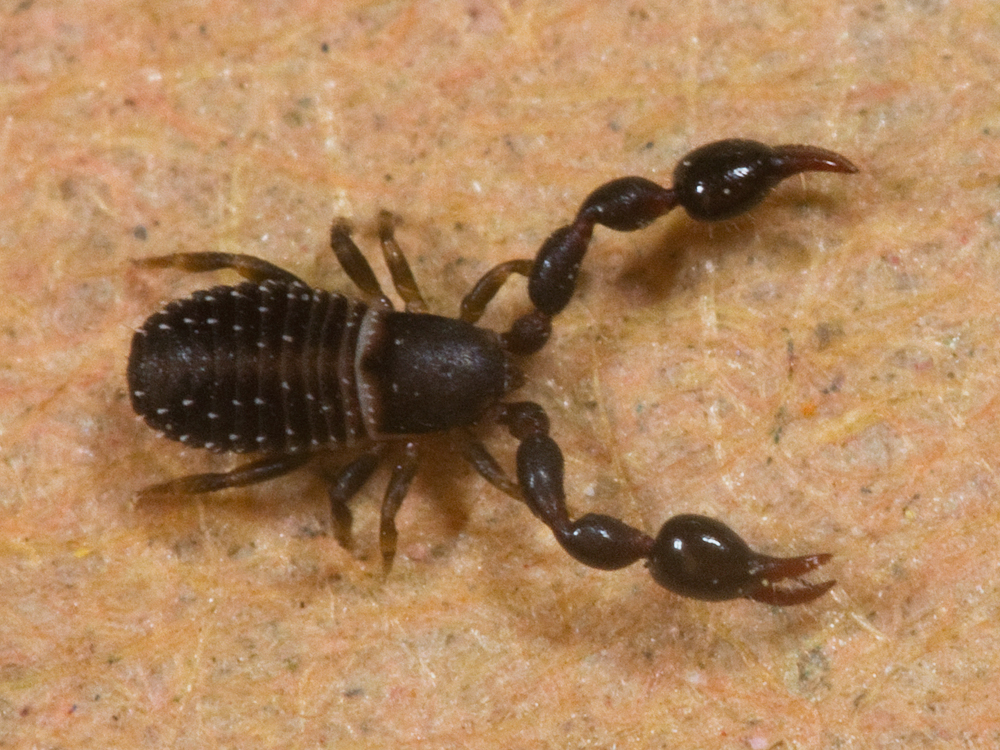
Pseudoscorpions, also called book scorpions, are minute arachnids belonging to the order Pseudoscorpiones. Most species measure only a few millimetres in length, commonly between 2 and 8 mm, though some island forms, such as Garypus titanius, reach about 12 mm. They resemble true scorpions because of their large pincer-like pedipalps, but they lack a segmented tail and sting. Worldwide more than 3,300 species have been described, occupying a wide range of habitats from leaf litter and soil to caves and the interiors of human dwellings.
Image gallery
8 Images


Physical characteristics
Pseudoscorpions are compact, flattened arthropods with two main body regions and four pairs of walking legs. Their most conspicuous feature is the pair of chelate pedipalps that end in pincers; these often contain small venom glands used to subdue prey. The chelicerae (mouthparts) are small but may produce silk used to construct protective brooding chambers. Colour and texture vary by species, and many are adapted for life under bark, stones, within books, or among leaf litter.
Behavior, diet and life cycle
These predators feed on tiny arthropods and other invertebrates such as mites, booklice, springtails, insect larvae (including clothes moth and carpet beetle larvae), ants, and small flies (examples) and (small flies). Hunting is usually conducted on foot; the pedipalps grasp prey while venom and digestive enzymes immobilize and begin external digestion. Reproduction typically involves transfer of a spermatophore; some species perform elaborate courtship displays often described as a "mating dance." Females lay eggs and commonly guard the brood; juveniles remain with the mother in a silk-lined sac until they undergo several moults.
Ecology, human importance and dispersal
Pseudoscorpions are generally harmless to people and can be beneficial by reducing populations of household pests, which is why they are tolerated in human environments. Some species live in close association with humans and historic books, earning the name "book scorpion." Many species disperse by phoresy — hitching rides attached to larger insects or other animals — enabling colonization of new habitats across considerable distances.
Fossil record and history
Fossils indicate that pseudoscorpions are an ancient group, with specimens known from the Devonian era approximately 380 million years ago (fossil evidence). This long history suggests a successful, stable body plan and life strategy that has persisted through major environmental changes since the Devonian period.
Notable facts and distinctions
- Pseudoscorpions lack the tail and stinger of true scorpions, distinguishing them easily from those arachnids.
- They possess venom glands in their pedipalps, but their small size makes them incapable of harming humans.
- Many species produce silk from the chelicerae for egg protection or moulting chambers.
Because of their secretive habits and tiny size, pseudoscorpions are often overlooked despite their ecological role as predators of small arthropods. For further reading, consult specialized taxonomic or natural history resources (order overview) and regional faunal accounts such as those that document island endemics like Garypus titanius.
Questions and answers
Q: What is a pseudoscorpion?
A: A pseudoscorpion is an arachnid that is 2 to 8 millimetres long.
Q: What is the largest known species of pseudoscorpion?
A: The largest known species of pseudoscorpion is Garypus titanius, which can be found on Ascension Island and is 12 millimetres long.
Q: What do pseudoscorpions eat?
A: Pseudoscorpions eat clothes moth larvae, carpet beetle larvae, booklice, ants, mites, and small flies.
Q: Are pseudoscorpions harmful to humans?
A: No, pseudoscorpions cannot harm humans because of their small size.
Q: Why are pseudoscorpions liked by humans?
A: Pseudoscorpions are liked by humans because they eat pests that can harm clothes and books.
Q: How do some species of pseudoscorpions attract mates?
A: Some species of pseudoscorpions do a "mating dance" to attract mates.
Q: How long do the eggs of pseudoscorpions stay with the mother?
A: The eggs of pseudoscorpions will stay with the mother until the pseudoscorpions are about a month old.
Related articles
Author
AlegsaOnline.com Pseudoscorpion: small arachnids that prey on household pests Leandro Alegsa
URL: https://en.alegsaonline.com/art/79823
Sources
- commons.wikimedia.org : Pseudoscorpionida
- species.wikimedia.org : Pseudoscorpiones
- museum.wa.gov.au : Pseudoscorpions of the World