
Pragmatics: Meaning and Use in Context
Pragmatics examines how people use and interpret language in real situations, focusing on intention, context, and the non-literal aspects of meaning.
Overview
Pragmatics is the branch of linguistics that investigates how meaning arises from the interaction between linguistic expressions and the contexts in which they are used. Where meaning studied by semantics is concerned with conventional or literal senses of words and sentences, pragmatics considers the extra contributions made by situation, speaker intentions, background assumptions and shared knowledge. It studies what speakers mean, how listeners infer intentions, and how context shapes interpretation in everyday communication. For broader discussions of language and use, pragmatics connects to many areas of language study.
Pragmatics treats context broadly: not only the physical setting and time, but also prior discourse, social roles, cultural norms, and beliefs. Context determines how a short utterance like "It's cold in here" can function as an observation, a complaint, or an indirect request to close a window. This interplay of words and circumstance is central to pragmatic analysis and links to research on context in communication.
Image gallery
1 Image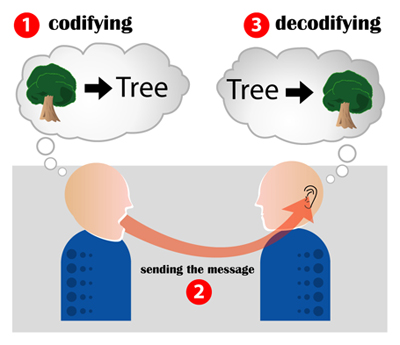
Core concepts
- Deixis — terms like "I", "here", and "now" whose reference depends on who speaks and when.
- Speech acts — actions performed by uttering words (asserting, questioning, commanding, promising).
- Implicature — meanings that are suggested or inferred rather than explicitly stated.
- Presupposition — background assumptions taken for granted by an utterance.
- Reference resolution — identifying what entities expressions refer to in a given context.
- Politeness and face — strategies speakers use to manage social relations and maintain respect.
Pragmatics also examines how listeners resolve ambiguity and derive intentions when literal meanings are insufficient or misleading. For instance, sarcasm and irony depend heavily on shared knowledge and tone; a sentence that is grammatically clear may nonetheless be interpreted in a contrary way when pragmatic cues point elsewhere. Studies of ambiguity and indirectness link to work on ambiguity and how it is resolved.
History and development
The modern study of pragmatics emerged in the 20th century from multiple traditions: philosophy of language, speech act theory, and empirical conversation analysis. Influential ideas include the notion that utterances perform actions, and that many aspects of meaning must be inferred rather than read off from sentence structure alone. Over time, theoretical advances have been complemented by experimental work in psycholinguistics and by computational approaches that model pragmatic inference.
Applications and importance
Pragmatic knowledge matters in many domains: language teaching and assessment, translation, human–computer interaction, legal and clinical settings, and intercultural communication. Examples include interpreting indirect requests in customer service, avoiding pragmatic failure when speaking a second language, designing virtual assistants that understand implied intentions, and analyzing courtroom testimony where implication and presupposition can be consequential.
Distinctions and notable facts
While semantics asks what expressions mean in principle, pragmatics asks how meanings are used and understood in practice. Pragmatic competence — the ability to use and interpret language appropriately in context — is a key component of communicative ability. Cross-cultural research shows that pragmatic norms vary: what is polite, indirect, or persuasive in one culture may not be so in another, making pragmatics essential for effective multilingual and multicultural interaction.
For introductory overviews or further reading, consult resources that link linguistic theory with examples and experiments. See also materials on meaning, language, and the role of context in interpretation for complementary perspectives.
Related articles
Author
AlegsaOnline.com Pragmatics: Meaning and Use in Context Leandro Alegsa
URL: https://en.alegsaonline.com/art/78594