
Port Royal: Jamaica’s 17th‑century port, its rise, ruin and legacy
Port Royal was a wealthy, notorious English port in 17th‑century Jamaica that largely sank in the 1692 earthquake; today it is an important archaeological and historical site.
Overview
Port Royal was the principal English port on the island of Jamaica during the late 17th century. It grew quickly as a commercial entrepôt and naval base, becoming known for the great wealth that flowed through its docks and for a lively, often unruly social life linked to seafaring, trade and entertainment.
Image gallery
10 Images





Origins and growth
After the English capture of Jamaica mid‑century, Port Royal expanded because of a sheltered harbour, proximity to Atlantic shipping lanes and colonial policies that encouraged private enterprise. Merchants, ship chandleries, sugar and provisioning businesses, and investors established an economy built on maritime services. The town attracted a diverse population of sailors, merchants, soldiers and artisans, making it unusually cosmopolitan for its size.
Society, commerce and piracy
Alongside legitimate trade, Port Royal developed a reputation for piracy and privateering. State‑sanctioned privateers operated from the port during times of war, and the line between licensed privateering and outlaw piracy was often thin. Taverns, gambling houses and other entertainments catered to crews and visitors, and observers of the time remarked on the city’s conspicuous consumption and moral licence.
Disaster: the 1692 event
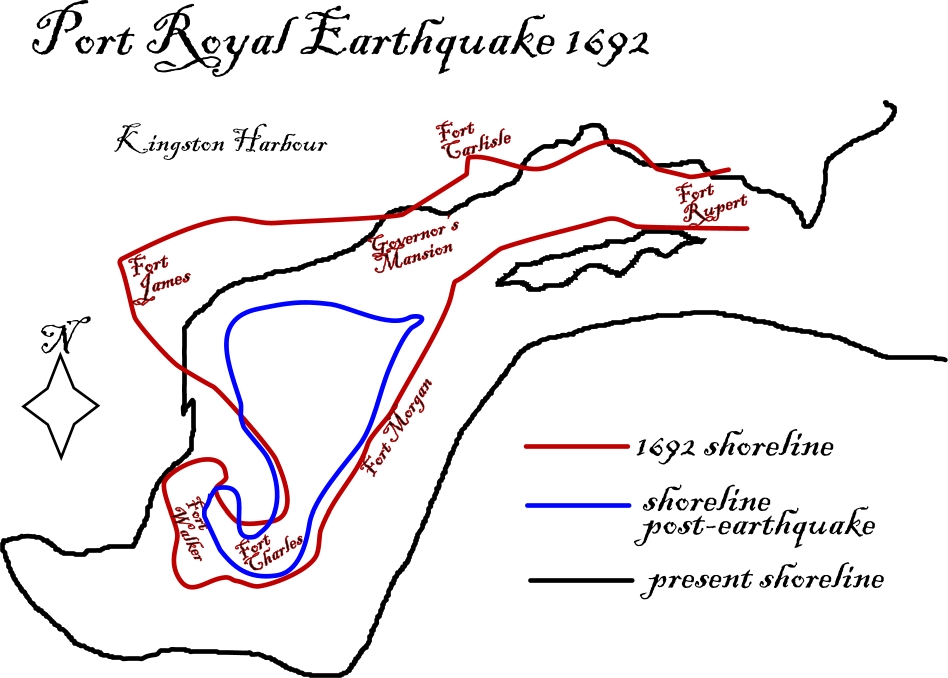
In June of 1692 a powerful seismic event and its aftershocks devastated Port Royal. Historical accounts and geological studies indicate that the earthquake triggered liquefaction of sandy soils; large sections of the town collapsed and slid into the Caribbean Sea. Contemporary witnesses and later investigators estimated that roughly two‑thirds of the settlement sank or became submerged, and many lives were lost. Parts of the original town today lie under several metres of water.
Archaeology and preservation
Because much of Port Royal is submerged and relatively quickly buried, archaeologists regard it as one of the region’s most important archaeological sites. Both underwater and land excavations have recovered household items, building remains, ship timbers and personal possessions that provide an unusually detailed window onto daily life, commerce and maritime culture in the early colonial Caribbean. Preservation in anaerobic wet contexts has helped retain organic materials not commonly found at terrestrial sites.
Aftermath, decline and legacy
Following the catastrophe the island’s commercial focus shifted to other centres, notably Spanish Town at first and later to ports such as Kingston, which grew to assume much of the maritime trade. Port Royal never regained its former pre‑eminence, but its story remains central to studies of Atlantic trade, colonial urban life, privateering and the social consequences of rapid maritime wealth. The site also serves as a case study in how natural hazards can abruptly transform an urban landscape.
Notable distinctions
- Port Royal combined official port functions with a flourishing privateering economy and attracted both licensed and outlaw seafarers.
- The 1692 disaster is a well‑documented example of earthquake effects on a coastal colonial town, illustrating liquefaction and subsidence.
- Modern research at Port Royal integrates underwater archaeology, archival records and geological analysis to reconstruct life before and after the disaster.
Related articles
Author
AlegsaOnline.com Port Royal: Jamaica’s 17th‑century port, its rise, ruin and legacy Leandro Alegsa
URL: https://en.alegsaonline.com/art/78224