
Poplar DLR station
Poplar DLR station is a major Docklands Light Railway interchange in Poplar, east London, providing connections across multiple branches within Travelcard Zone 2 and serving as a key operational junction.
Overview
Poplar DLR station serves the Poplar area of east London and forms a central interchange on the Docklands Light Railway. It lies within Travelcard Zone 2 and functions as a hub where several branch services meet, giving passengers frequent connections across the network. The station handles a very high number of scheduled movements, making it one of the busiest DLR stops in terms of train services.
Image gallery
5 Images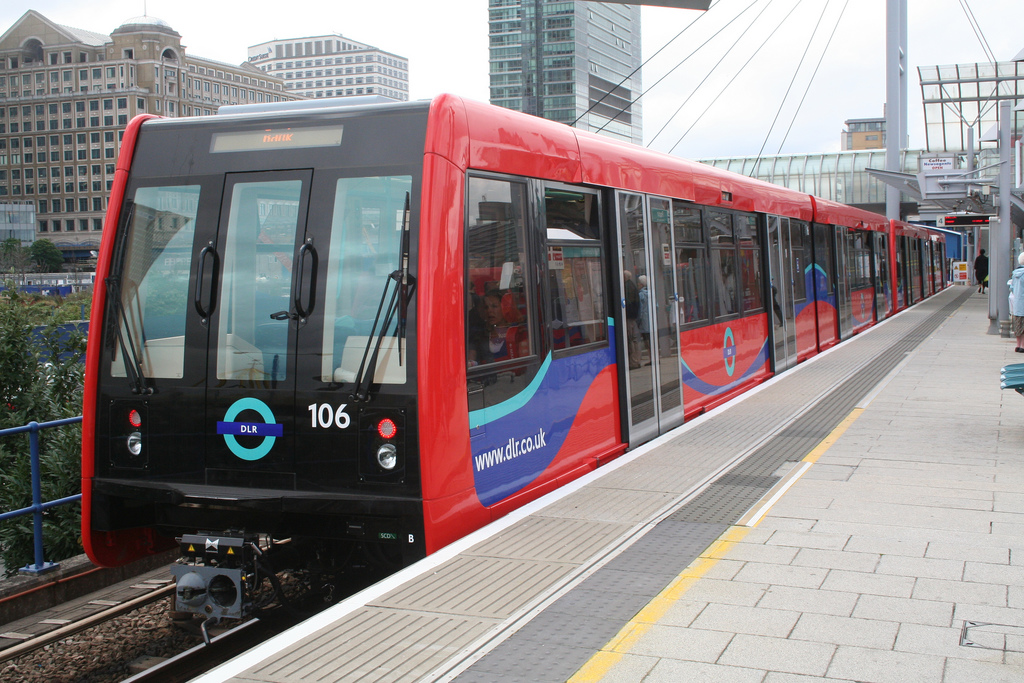


Design and layout
The station is arranged to accommodate trains arriving and departing on multiple routes. Platforms are laid out to allow easy cross-platform interchange between branches and to enable trains to reverse or change direction as operational needs require. Typical DLR features — such as raised platforms for level boarding, clear signage and sheltered waiting areas — are present to support passenger flow.
History and development
Poplar was established as part of the original Docklands Light Railway network during the redevelopment of London’s docklands in the late 20th century. Its role has grown alongside commercial and residential expansion in the area, linking local communities with employment centres on the Isle of Dogs and beyond.
Services and connections
The station is served by multiple DLR branches, making it possible to travel to many destinations across east and southeast London without changing to heavy rail. As an interchange it supports frequent turn-up-and-go services and is often used by passengers transferring between branch lines. For more details on the surrounding area see Poplar, London and for network information see Docklands Light Railway.
Accessibility and local links
Like most DLR stations, Poplar provides step-free access between street and platform levels, and is integrated with local bus routes and cycle facilities to aid onward travel. It is located within Travelcard Zone 2, which affects fares and ticketing options for commuters and visitors.
Notable facts
- Functions as a key operational junction on the DLR network, served by four of the system’s five main routes.
- Important for interchange rather than as a single-destination terminus; its value lies in connectivity and service frequency.
Related articles
Author
AlegsaOnline.com Poplar DLR station Leandro Alegsa
URL: https://en.alegsaonline.com/art/78107
Sources
- content.tfl.gov.uk : "Step free Tube Guide" · web.archive.org
- whatdotheyknow.com : "Freedom of Information DLR usage 1213"
- whatdotheyknow.com : "Up-to-date DLR entry/exit statistics for each station"
- whatdotheyknow.com : "Passenger Numbers - Docklands Light Railway Limited"