
Popigai crater — Siberian impact structure and diamond-bearing deposit
A large, well-preserved impact crater in northern Siberia formed about 35 million years ago; notable for shock-formed diamonds, distinctive geology and scientific importance.
Overview
The Popigai structure is a large meteorite impact feature in north-central Siberia, within the Russian Federation (Russia). Formed roughly 35 million years ago during the late Eocene, it is among the planet's better preserved large terrestrial impact craters. The feature covers an area on the order of tens of thousands of square kilometers and the visible rim diameter is approximately 100 kilometres, with a deeply disturbed central region produced by the collision.
Image gallery
5 Images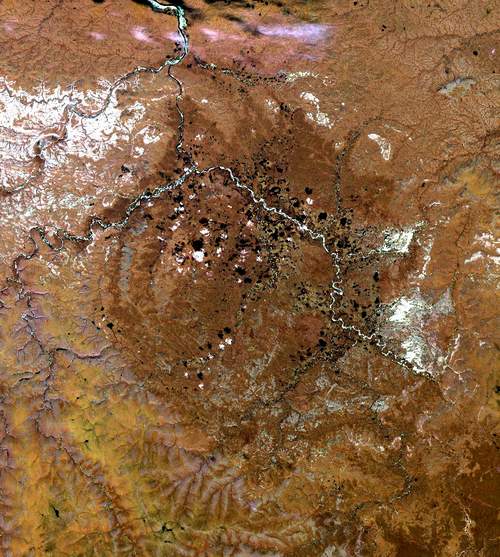


Geology and structure
The impact produced characteristic shock-metamorphosed rocks: breccias, melt sheets and a layer of fragmented ejecta. Minerals show diagnostic impact signatures such as shocked quartz and planar deformation features. The target sequence included graphite-bearing sediments and crystalline basement; high pressures and temperatures during the event created a melt-rich zone and complex deformation of strata around the rim.
Diamonds and shock metamorphism
One of the Popigai crater's most notable features is the widespread occurrence of impact-generated diamonds. During the collision the intense pressure converted native graphite and carbonaceous material into various carbon allotropes, including microscopic diamonds and hexagonal forms sometimes referred to in the literature as lonsdaleite. These grains are typically small and aggregated, making them useful for industrial applications rather than for gem-quality stones. The transformation process is a classic example of shock metamorphism: sudden compression and heating followed by rapid quenching.
Scientific importance and uses
Popigai is important for researchers who study planetary impacts, shock processes and crater evolution. It provides a natural laboratory for observing how target rocks respond to extreme pressures and for tracing the formation of high-pressure minerals. While the area contains extensive diamond-bearing rocks, practical extraction is limited: the deposit is remote and the diamonds are mainly of industrial quality, and laboratory-grown diamonds now compete strongly with natural industrial stones. For these reasons commercial mining has not developed at scale.
Distinctions and notable facts
- Popigai ranks among the largest known well-preserved impact structures on Earth and has been studied by both Russian and international teams.
- The diamonds are generated in situ from pre-existing carbon (graphite and organic matter); see discussions of graphite transformation and carbon allotropes.
- Interest in Popigai spans geology, materials science and economic geology; references often discuss meteoritic impactors, regional geology and the nature of diamonds found there.
Access and conservation
The crater lies in a largely Arctic, sparsely populated region with permafrost and seasonal constraints on travel. Its isolation has helped preserve geological exposures but also complicates any survey or extraction effort. Scientific fieldwork is typically seasonal and conducted from logistical bases far from major settlements. For up-to-date logistics and research reports consult institutional summaries or the regional geological survey (impact crater resources and databases).
Related articles
Author
AlegsaOnline.com Popigai crater — Siberian impact structure and diamond-bearing deposit Leandro Alegsa
URL: https://en.alegsaonline.com/art/78104