
Poor People's Campaign: The 1968 Movement for Economic Justice and Its Legacy
A multiracial 1968 movement initiated by Martin Luther King Jr. and the SCLC to demand economic reforms for the poor, culminating in Resurrection City and continuing to influence later campaigns for a moral and economic revival.
Overview
The Poor People's Campaign was a national effort in the late 1960s that sought to place economic justice for low‑income Americans at the center of public life. Begun within the civil rights movement as a program to address poverty across racial lines, it combined direct action, policy demands and long‑term organizing to press for jobs, an adequate income, housing and access to education and health care.
Image gallery
3 Images

Origins and goals
In November 1967, leaders of the civil rights movement, including Rev. Martin Luther King Jr., and staff of the Southern Christian Leadership Conference set out plans for a campaign focused on poverty. King envisioned bringing thousands to Washington to demand federal action on unemployment insurance, job creation, a living minimum wage and educational opportunities for poor children and adults. The initiative sought to broaden civil rights work by making economic rights a public priority.
The 1968 campaign and Resurrection City
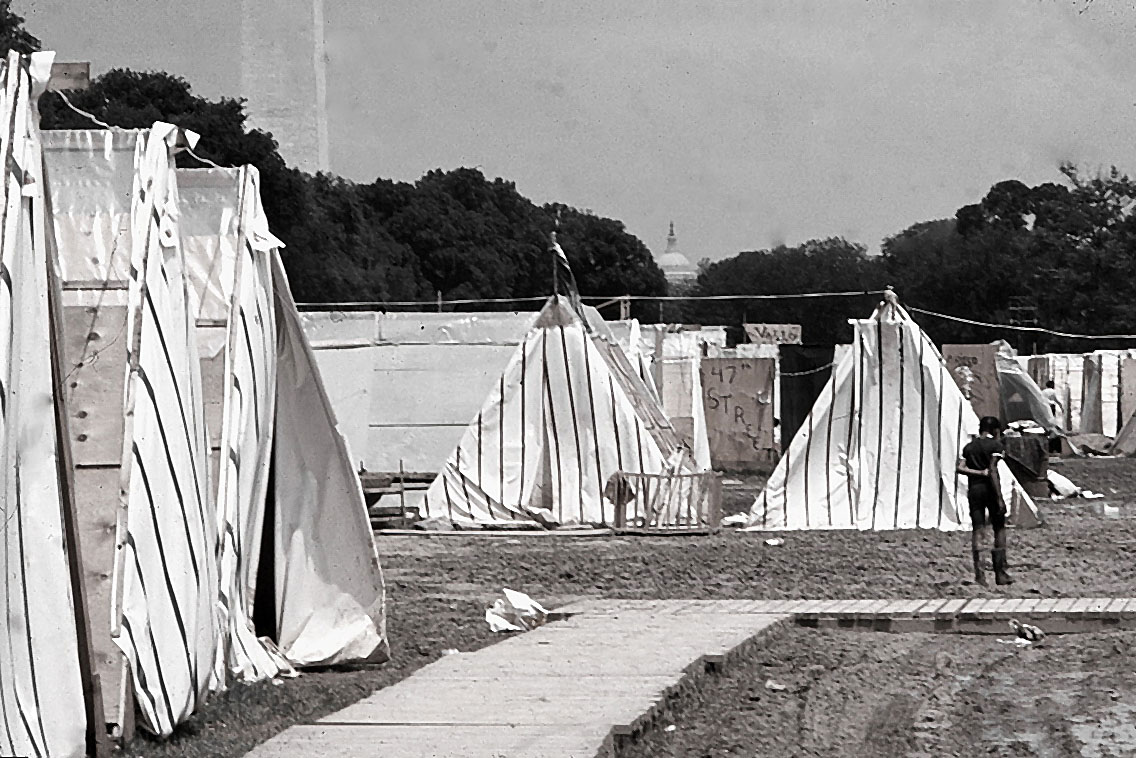
After King’s assassination in April 1968, organizers continued the plan under leaders such as Ralph Abernathy. In late May the campaign established an encampment on the National Mall—commonly called Resurrection City—where poor people and activists from across the United States staged demonstrations, hearings and acts of civil disobedience. The encampment remained for several weeks and became a visible symbol of the campaign’s demands.
Key demands and tactics
- Guaranteed jobs or income and expanded unemployment insurance
- A living or fair minimum wage and federal programs to reduce poverty
- Improved housing, education, health services and access to public benefits
- Nonviolent direct action, mass mobilization and moral persuasion
Impact and legacy
Though the campaign did not secure comprehensive federal legislation at the time, it pushed economic inequality onto the national agenda and demonstrated a multiracial coalition of poor people organizing for policy change. The encampment’s visibility, the critiques of federal policy it generated, and the political conversation it fostered became part of the broader history of American social movements.
Continuing relevance
Decades later, organizers invoked the Poor People’s Campaign name and principles in efforts to highlight persistent poverty and inequality. Contemporary revivals and moral‑economy initiatives trace their roots to the 1968 campaign’s combination of grassroots participation and policy advocacy, underscoring the campaign’s lasting influence on debates about poverty and economic justice in the United States.
Related articles
Author
AlegsaOnline.com Poor People's Campaign: The 1968 Movement for Economic Justice and Its Legacy Leandro Alegsa
URL: https://en.alegsaonline.com/art/78038
Sources
- kingencyclopedia.stanford.edu : kingencyclopedia.stanford.edu