
Potsdam Conference (July–August 1945)
Allied leaders met in Potsdam in July–August 1945 to decide Germany’s postwar administration, demand Japan’s surrender, and address reparations—an event that shaped the early Cold War order.
Overview
The Potsdam Conference was the last of the major wartime summits between the three principal Allied powers following the defeat of Nazi Germany. Held from July 17 to August 2, 1945, it brought together representatives of the Soviet Union, the United Kingdom and the United States at Potsdam, near Berlin in Potsdam, Germany. The meeting aimed to finalize arrangements for the occupation and reconstruction of Germany and to address outstanding political and territorial questions created by the war.
Image gallery
10 Images


Context and participants
The conference occurred against the backdrop of rapid political change. President Franklin D. Roosevelt had died earlier in 1945, and Harry S. Truman led the American delegation. The British leadership changed during the meeting when wartime Prime Minister Winston Churchill lost a national election and was succeeded by Clement Attlee. The Soviet delegation was headed by General Secretary Joseph Stalin. Earlier agreements reached at Yalta had left unresolved tensions over Eastern Europe, especially concerning Poland, and differences over how strictly to enforce decisions were evident. Disputes about acceptable political arrangements — including matters described as neutral governance — contributed to growing mistrust.
Main decisions and measures
- Germany: The Allies agreed on a program of demilitarization, denazification, decentralization and democratization, and on dividing Germany and Berlin into occupation zones administered by the victorious powers.
- Reparations and economy: The conference set principles for reparations and for limiting Germany’s industrial capacity to prevent future aggression, while also recognizing the need to restore basic economic stability.
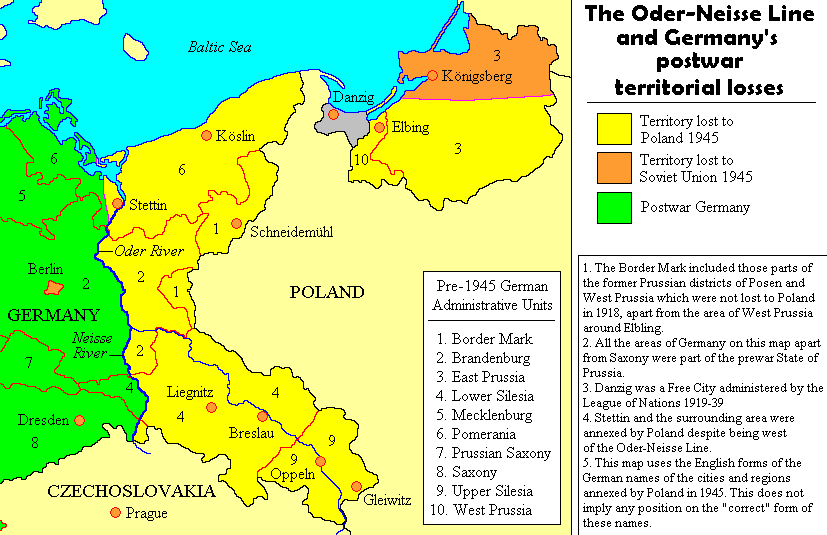
- Territorial adjustments and population transfers: Frontiers in Central and Eastern Europe were reassessed and the conference accepted large-scale transfers of German populations from some areas, a decision with far-reaching humanitarian effects.
- Japan: The leaders issued the Potsdam Declaration demanding unconditional surrender of Japan and outlining terms for occupation and reconstruction.
- War criminals and justice: The Allies reaffirmed plans to prosecute major war criminals, setting the stage for subsequent tribunals.
Tensions and legacy
Although the conference produced concrete administrative arrangements, differences in aims and mutual suspicion were apparent. The Western leaders and Stalin held divergent views on the political future of liberated countries, especially regarding the composition of governments in Eastern Europe. Disagreements at Potsdam foreshadowed the ideological and geopolitical rivalry that became the Cold War. At the same time, many practical measures agreed at the summit shaped postwar Europe’s map and governance and influenced rebuilding across the continent.
Notable facts and significance
- The meeting took place at the Cecilienhof palace in Potsdam and is remembered both for its policy outcomes and for the changing cast of leaders present.
- Decisions about occupation, reparations and political restructuring had immediate consequences for millions of civilians and for postwar diplomacy.
- Potsdam is often studied as the moment when wartime alliance cooperation began to give way to rivalry and competing visions for Europe’s future.
For further reading about the conference’s background, participants and long-term impact, see materials on the Yalta Conference, the wartime policies of Franklin Roosevelt, and the political careers of the principal figures such as Clement Attlee, Harry S. Truman and Joseph Stalin. Contemporary histories also explore how questions over Poland and notions of neutral governance shaped negotiations and postwar settlements. Additional resources are available through archival collections and specialized studies of the conference location and documents (Soviet records, British papers, American archives).
Questions and answers
Q: What was the goal of the Potsdam Conference?
A: The goal of the Potsdam Conference was to discuss what should happen to Germany now that the Second World War was over.
Q: Who attended the Potsdam Conference?
A: The Prime Minister of the United Kingdom (Clement Attlee), the President of the United States (Harry S. Truman) and the dictator of the Soviet Union (Joseph Stalin) attended the Potsdam Conference.
Q: What was the Yalta Conference?
A: The Yalta Conference was a meeting of the Soviet Union, the United Kingdom and the United States in Yalta, Crimea in February 1945 to discuss what would happen after the Second World War.
Q: Why was the United States tougher on communism during the Potsdam Conference?
A: The United States was tougher on communism during the Potsdam Conference because they had a new president, Truman, who was much tougher on communism than the previous president, Franklin Roosevelt, had been.
Q: Who replaced Winston Churchill as the leader of the United Kingdom?
A: Clement Attlee replaced Winston Churchill as the leader of the United Kingdom.
Q: What did the Allies agree on at the Yalta Conference?
A: The Allies agreed at the Yalta Conference that Poland should have a neutral government.
Q: Why did Stalin cause trouble at the Potsdam Conference?
A: Stalin caused trouble at the Potsdam Conference because he saw himself as far more experienced than the new leaders and also caused trouble as the allies agreed on Poland having a neutral government, but Stalin had killed the neutral government leaders and replaced them with others who did what he wanted. This caused many problems at Potsdam, and other countries no longer trusted the Soviets.
Related articles
Author
AlegsaOnline.com Potsdam Conference (July–August 1945) Leandro Alegsa
URL: https://en.alegsaonline.com/art/78450