
Digon (two-sided polygon)
A digon is a polygon with two edges and two vertices. Degenerate in the Euclidean plane, it is realized on curved surfaces and in abstract polytope theory and appears in graph and tiling contexts.
Overview
A digon is a polygon that has exactly two sides (edges) and two vertices. The term derives from Greek roots meaning "two" and "angle," and it occupies the simplest nontrivial position in the hierarchy of polygons. Although the idea of a two-sided polygon is easy to state, its geometric realization depends on the ambient space: in standard flat (Euclidean) geometry a digon is considered degenerate, while on curved surfaces or in combinatorial settings it becomes a meaningful object. For background on the broader subject, see geometry and the general notion of a polygon.
Image gallery
5 Images



Construction and characteristics
Formally, a digon has two vertices joined by two edges. In the Euclidean plane the two straight edges would coincide as the unique straight segment connecting the vertices, so either the edges coincide (degenerate case) or one or both edges must be curved to keep them distinct. To avoid degeneration one can use curved segments or embed the figure on a curved surface, where distinct geodesic arcs can join the same pair of points.
Non-Euclidean realizations
On the surface of a sphere a common realization of a digon is a lune: two great-circle arcs that connect a pair of antipodal points and bound a lens-shaped region. Such spherical digons can have nonzero area and nondegenerate interior angles. More generally, on any curved surface two distinct geodesic arcs between the same points can form a digon. These realizations illustrate why the digon is useful in spherical and other non-Euclidean geometries; see also discussions of the sphere in geometric contexts at sphere.
Abstract polytopes and operations
In the language of abstract polytopes, the digon is the simplest rank-2 polytope and is denoted by the Schläfli symbol {2} when it is regular (equal edges and equal angles). Certain polytope operations applied to {2} produce familiar shapes: truncating the digon, written t{2}, yields the square {4}, while alternation (removing alternating vertices) of {2}, written h{2}, produces the monogon {1}. These relationships show how the digon fits into the combinatorial theory of polytopes even if its Euclidean embedding is degenerate.
Occurrences, applications, and examples
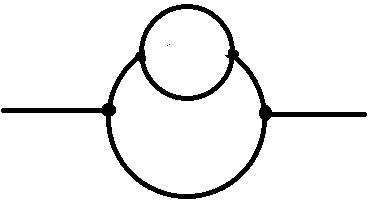
Digons appear in several mathematical and applied settings. In planar graph theory a pair of parallel edges between the same two vertices creates a 2-cycle often called a digon; such features matter when analyzing embeddings, electrical networks, and network simplification. In tiling and map theory on closed surfaces, digonal faces arise naturally and are treated explicitly in classification results. Lens-shaped regions bounded by two arcs (digons) are also used as examples or counterexamples in teaching curvature, geodesics, and spherical trigonometry.
Notable facts and distinctions
- Regular digon: denoted {2}; it has two equal sides and two equal angles in the abstract sense.
- Euclidean degeneracy: in the plane a digon cannot be formed from two distinct straight edges between distinct vertices without overlap.
- Topological perspective: on a sphere and other surfaces digons are legitimate 2-faced regions and are often called lunes.
- Related terms: the digon is adjacent to the monogon ({1}) and the square ({4}) through alternation and truncation operations; see an elementary example such as a square obtained from t{2}.
For concise illustrations and further reading, introductory texts on spherical geometry and combinatorial polytope theory provide accessible treatments of digons and their role in broader geometric frameworks. Additional reference material can be located through surveys of geometry and introductory polygon theory at standard sources.
Author
AlegsaOnline.com Digon (two-sided polygon) Leandro Alegsa
URL: https://en.alegsaonline.com/art/27406