
Plasma lamp (plasma globe)
A plasma lamp is a decorative gas-discharge device that creates glowing, interactive filaments of ionized gas. It demonstrates dielectric-barrier discharge and is used for education, display, and novelty lighting.
Overview
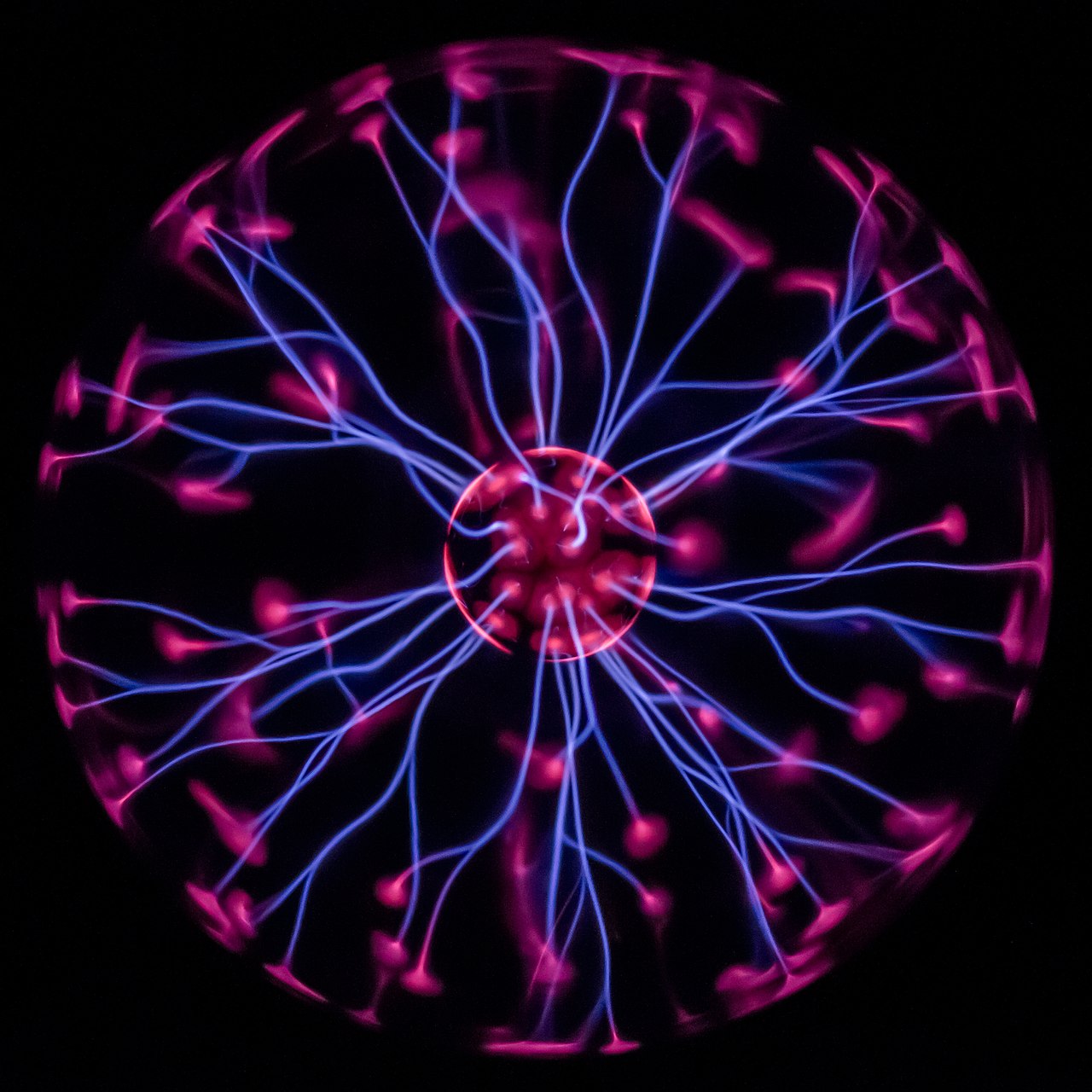
A plasma lamp, often called a plasma globe, is a sealed glass sphere containing low-pressure gases and a central electrode. When driven by a high-voltage, high-frequency power source the gases become ionized and form luminous tendrils that extend from the electrode to the inner glass surface. The device is primarily used as a visual demonstration of ionized gas (plasma) and as a novelty light.
Image gallery
10 Images




Design and operation
Typical components include a glass enclosure, a small high-voltage electrode at the center, and a dielectric barrier that prevents a sustained arc. The lamp operates by producing a dielectric-barrier discharge that creates many short-lived microdischarges across the gas. Common noble gases and mixtures are placed inside to influence color and behavior; touching the globe alters the electric field and causes filaments to concentrate toward the point of contact.
- Main parts: outer glass shell, central electrode, inert gas fill, power oscillator.
- Typical gases: neon, argon, xenon or mixtures—each gives different hues and intensities. See noble gases for properties.
- Related category: a form of gas-discharge lamp.
History and development
Early experiments with ionized gases and discharge tubes were carried out in the late 19th century. Nikola Tesla developed and patented varieties of inert-gas discharge tubes while exploring high-frequency phenomena; his work is often cited in accounts of the device's origins. Commercial and decorative versions emerged in the 20th century and gained wider popularity as tabletop novelty items in the late 20th century.
Uses, demonstrations and safety
Plasma lamps are popular in science education and museum exhibits because they visibly demonstrate concepts such as ionization, electric fields and spectral colors. They also serve purely decorative or ambient-lighting roles. While the filaments look dramatic, most consumer lamps operate at low current and are not dangerous to brief touch. However, they can interfere with nearby sensitive electronics and should be kept away from medical implants; avoid prolonged skin contact or using damaged units. A few practical safety points are listed below.
- Do not place near credit cards, unshielded electronics, or strong magnetic devices.
- Avoid using with a pacemaker or other implanted medical device nearby.
- Replace units with cracked glass or faulty wiring; keep out of reach of small children.
Notable facts and distinctions
Plasma lamps are distinct from fluorescent or incandescent lamps in their reliance on plasma discharges rather than thermal radiation or continuous electron excitation in a phosphor. They are often used to illustrate plasma physics in an accessible way and sometimes feature in art and design. For more on the science behind the glowing gas, see resources about plasma and historical context such as writings on Nikola Tesla.
Questions and answers
Q: What is a plasma lamp?
A: A plasma lamp is a type of gas discharge lamp that is filled with different gases.
Q: How does a plasma lamp work?
A: A plasma lamp uses dielectric barrier discharge, which is also known as plasma discharge.
Q: Who invented the plasma lamp?
A: Nikola Tesla invented the plasma lamp in 1892 to study the properties of plasma.
Q: When did Nikola Tesla obtain a patent for the plasma lamp?
A: Nikola Tesla obtained a patent for the plasma lamp in 1894.
Q: What did Tesla originally call the plasma lamp?
A: Tesla originally called the plasma lamp Inert Gas Discharge Tube.
Q: When were plasma globe lamps popular?
A: Plasma globe lamps were popular in the 1980s.
Q: What was the purpose of creating the plasma lamp?
A: The purpose of creating the plasma lamp was to study the properties of plasma.
Related articles
Author
AlegsaOnline.com Plasma lamp (plasma globe) Leandro Alegsa
URL: https://en.alegsaonline.com/art/77306