
Plum pudding model (Thomson's early atomic model)
Overview of the plum pudding model: its origin, assumptions, experimental tests that refuted it, and its role in the development of atomic theory.
Overview
The plum pudding model was an early 20th-century proposal for atomic structure put forward by J. J. Thomson. It sought to account for the recent discovery of the electron while preserving the observed electrical neutrality of the atom. In Thomson's picture the atom consisted of a diffuse positively charged medium with negatively charged electrons embedded within it; the arrangement was popularly compared to a pudding with pieces of fruit, hence the informal name "plum pudding".
Image gallery
3 Images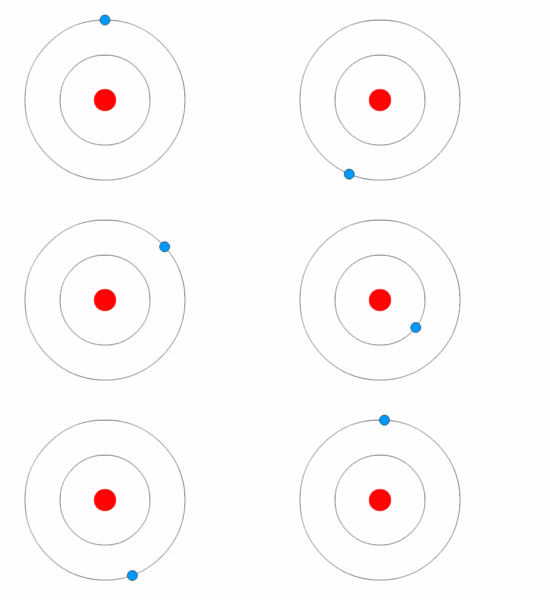


Origin and historical context
At the time the model was proposed (around 1904) experimental work had revealed charged subatomic particles but had not yet located a compact, concentrated positive center. Scientists knew that atoms were overall electrically neutral, so any satisfactory model had to balance negative and positive charge. Thomson's concept provided a simple mechanical image linking the new particle electron to a neutral atom by distributing positive charge throughout the atom's interior rather than confining it to a point.
Key assumptions and structure
The central assumptions of the plum pudding model were cautious and classical in spirit. The positive charge was treated as a continuous background or "soup" occupying the atomic volume, and the electrons were discrete, negatively charged constituents embedded in that background. Electrons could be stationary or oscillatory within the positive medium, and mechanical stability or restoring forces were invoked to explain spectral and electrical behavior in qualitative terms. The model did not include a small, dense atomic nucleus or quantized electron orbits; it was formulated using classical electrostatics and mechanical ideas familiar at the time.
Experimental tests and refutation
The plum pudding model made general predictions about how charged particles would scatter when passing close to atoms: because the positive charge was assumed diffuse, no very large-angle deflections were expected. When alpha-particle scattering experiments were performed, notably the gold foil experiments led by Ernest Rutherford and his collaborators, a small but significant fraction of alpha particles suffered large-angle deflections. Those results indicated the presence of a concentrated positive charge in a very small region compared with the atom's overall size. The experimental evidence was inconsistent with a diffuse positive medium, and the plum pudding picture was superseded by the nuclear model in which most positive charge and mass are concentrated in a central nucleus while electrons occupy the surrounding space.
Why the model mattered
Although the plum pudding model was ultimately incorrect, it played an important role in the transition from indivisible-atom ideas to modern atomic theory. It provided a testable hypothesis that guided experimental work and sharpened questions about how charges are distributed inside atoms. The model exemplifies how provisional theoretical pictures are useful: they organize existing knowledge, suggest new experiments, and are replaced or refined as better evidence accumulates.
Comparison with later models
Following the downfall of the plum pudding model, several successive frameworks improved the description of atomic structure. Rutherford's nuclear model introduced a compact positive nucleus; Niels Bohr added quantized electron energy levels to explain spectral lines; and later quantum mechanics replaced classical particle trajectories with probabilistic electron distributions and wavefunctions. In contrast to the plum pudding's continuous positive medium or space, modern models describe charge and mass distributions through discrete particles and quantum probability densities.
Common misconceptions and careful points
- The plum pudding model is sometimes caricatured as a literal pudding; historically it was a physicist's qualitative picture intended to reconcile known charges, not a detailed microscopic theory.
- Thomson proposed the model after the discovery of the electron but before experimental identification of the nucleus, so its assumptions were reasonable given the limited evidence available at that time.
- Statements that the model "predicted" particular numerical scattering rates should be treated cautiously: the model provided qualitative expectations rather than precise quantum predictions.
Legacy, sources and further reading
The plum pudding model remains an instructive episode in the history of science because it highlights how models evolve. Readers interested in broader background can consult summaries of early atomic models, biographical accounts of J. J. Thomson, introductions to the electron, experimental descriptions of the discovery of the atomic nucleus, and discussions of atomic neutrality and charge balance. Historical and pedagogical treatments also point to why careful experiments in defined geometric space were crucial in overturning the diffuse-charge picture and developing the nuclear and quantum theories that followed.
The plum pudding model therefore occupies an important place in textbooks and histories: it represents both a step toward understanding subatomic structure and a reminder that scientific knowledge advances by proposing, testing, and revising models in light of new evidence.
Questions and answers
Q: What is the plum pudding model?
A: The plum pudding model is a model of an atom proposed by J.J. Thomson in 1904.
Q: When was the plum pudding model proposed?
A: The plum pudding model was proposed in 1904 by J.J. Thomson.
Q: Was the plum pudding model proven to be correct?
A: No, the plum pudding model was later found to be wrong.
Q: Who proposed the plum pudding model?
A: The plum pudding model was proposed by J.J. Thomson.
Q: What did scientists know about the charge of an atom before the plum pudding model was proposed?
A: Scientists knew that there was a positive charge in the atom that balanced out the negative charges of the electrons, making the atom neutral, but they didn't know where the positive charge was coming from.
Q: Why was the plum pudding model called a "plum pudding" model?
A: The plum pudding model was called a "plum pudding" model because the positive medium was like a pudding, with electrons, or plums, inside.
Q: What did J.J. Thomson's plum pudding model show?
A: J.J. Thomson's plum pudding model showed an atom that had a positively charged medium, or space, with negatively charged electrons inside the medium.
Related articles
Author
AlegsaOnline.com Plum pudding model (Thomson's early atomic model) Leandro Alegsa
URL: https://en.alegsaonline.com/art/77499
Sources
- universetoday.com : "Plum Pudding Model - Universe Today"