
Pikaia gracilens — early Cambrian chordate from the Burgess Shale
Small, eel‑like Middle Cambrian animal from the Burgess Shale. Pikaia shows primitive chordate features and is important to studies of early chordate and vertebrate origins.
Overview
Pikaia gracilens is an extinct, small, laterally compressed animal known from the Middle Cambrian Burgess Shale deposits. Often cited as one of the earliest animals to exhibit features interpreted as chordate-like, Pikaia has been central to discussions about the origins of the vertebrate lineage. Fossils are preserved as flattened impressions in fine-grained shale and are comparatively rare, with roughly on the order of a few dozen to around sixty specimens reported from the site.
Image gallery
10 Images


Anatomy and inferred lifestyle
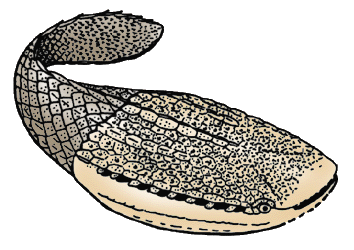
Specimens of Pikaia reach only a few centimetres (commonly reported around 40 mm) in length and show an elongated, ribbon-like body. Impressions reveal a series of V- or W-shaped muscle blocks (myomeres) along the sides, and a linear axial structure that many researchers interpret as a stiffening rod comparable to an early notochord or axial support. A dorsal fin-like membrane and paired lateral flaps have been described in some specimens. These features together suggest it was capable of swimming above the seafloor, likely a relatively slow swimmer that may have fed by picking particles from the water column or by simple scavenging.
Discovery and scientific history
Pikaia was first collected by Charles Walcott in 1911 from the Burgess Shale near Mount Pika in what is now British Columbia. Walcott originally classified the animal as a type of polychaete worm. Later re-examination of the Burgess Shale material in the latter half of the twentieth century led to new interpretations: comparative study of muscle blocks and the axial structure prompted several researchers to consider Pikaia a candidate for a stem-group chordate. Discussion of its affinities has continued in paleontological literature, illustrating how fossil interpretation changes with new techniques and comparative frameworks; for background see entries on Charles Walcott and the region of British Columbia.
Classification and debate
While many authors treat Pikaia as showing primitive chordate characters, its precise position in early deuterostome or chordate evolution remains debated. Some interpretations emphasize the similarity of the axial rod and myomeres to chordates, whereas others argue that these resemblances could represent convergent or plesiomorphic features not unique to the chordate lineage. As a result, Pikaia is commonly discussed as a possible stem-group chordate rather than an unambiguous direct ancestor of modern vertebrates. For context consult summaries of primitive chordates and the broader fauna of the Burgess Shale.
Paleoenvironment and preservation
The Burgess Shale represents a deep-water depositional setting from the Middle Cambrian, a period marked by rapid diversification of animal body plans. Fine-grained muds facilitated exceptional preservation of soft-bodied organisms such as Pikaia. The mode of preservation and the sedimentary context provide important constraints on how Pikaia lived and how commonly its soft tissues could be fossilized. See general treatments of the Middle Cambrian for environmental and evolutionary context.
Significance
Pikaia remains a touchstone fossil in studies of early animal evolution because it illustrates early occurrences of segmented musculature and an internal axial structure that may be related to later chordate features. Although simple compared with later vertebrates and possibly representing a side branch, its anatomy informs models of how complex vertebrate characters evolved from simpler Precambrian and Cambrian forms. Continued discoveries and reanalyses of Burgess Shale material help refine interpretations of Pikaia's biology and its place in the tree of life.
Further reading and resources
- Specimens and the Burgess Shale community: Burgess Shale.
- Geological and temporal context: Middle Cambrian.
- Issues in chordate origins: primitive chordates.
- Region of discovery: British Columbia.
- Historical collector and first descriptions: Charles Walcott.
Because interpretations continue to evolve with new methods and comparative data, descriptions above are deliberately cautious: Pikaia is widely regarded as important for understanding early chordate-like anatomy, but its exact evolutionary relationships remain an active subject of research.
Related articles
Author
AlegsaOnline.com Pikaia gracilens — early Cambrian chordate from the Burgess Shale Leandro Alegsa
URL: https://en.alegsaonline.com/art/76887